Bursitis of the elbow joint
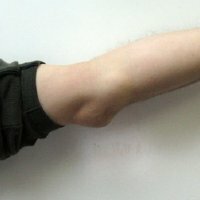
Inflammation that develops in the subcutaneous bag of the elbow on the surface( extensor) of the end of the elbow bone is bursitis. In the normal state, the bag is usually flat and smooth. It is necessary to facilitate the movement of the skin and muscles during flexion and extension of the elbow. Bursitis of the joint can take place in permanent and in newly formed bags, in those places where there is continuous pressure and rubbing of the skin, tendons, muscles about the bony projections.
What are the causes of bursitis of the elbow joint?
The cause of bursitis of the elbow joint is often a traumatic effect. In most cases, this disease affects athletes, it is for this reason bursitis joint is considered to some extent a professional disease. For example, for tennis players, the localization of the process( between the radius and the tendon of the biceps) is characteristic in the lightbulb bag.
As a rule, after injury, infection of the cavity with pathogenic bacteria occurs. Pathogenic agents can be staphylococcus or streptococcus - this is nonspecific bursitis or such pathogens as, syphilis, tuberculosis, gonococcus, burcella - this is a specific bursitis. Determine the type of bursitis of the elbow joint is very important, because this determines the choice of treatment of the disease.
The nature of the exudate, simpler than the fluid located in the cavity of the synovial bag, can also be different. Exudate can be serous( less complicated variant), hemorrhagic( presence of blood) and purulent. By the duration of the inflammatory process, bursitis can be divided into acute, recurrent, chronic.
In some cases, bursitis of the elbow joint is the result of arthritis, often rheumatoid, psoriatic or gout. Also, it often develops as a result of chronic microtrauma, from "rubbing" the elbow on the surface of the table, the floor, etc. This usually happens in those people whose work is associated with this action( draftsmen, engravers, etc.).The elbow bag is perhaps one of the favorite places for this disease. That is why bursitis in this joint is much more common than other forms of it.
The course and symptoms of elbow bursitis
In the area of the inflamed bag of the elbow joint, there is a condensation and an increase in the volume of tissues. Through the skin it is impossible to see that it was the synovial bag that underwent inflammation, but we can determine it by some characteristic signs of the disease.
The size of the swelling can reach up to 10 centimeters and the consistency of it is quite mild. With palpation, it is possible to determine the fluctuation in the affected area. A person has pain in the elbow joint. There are signs of general intoxication, fever and other ailments.
There is an important difference in this disease from arthritis of the elbow joint. With bursitis, the function is disrupted due to pain, but the volume of movements is not limited, as is the case with arthritis.
If the bursitis of the joint acquires a purulent character, neighboring tissues are also inflamed( this is a phlegmonous inflammation).The state of health of the person strongly worsens, the temperature raises even to 40 degrees. In such a case, hospitalization may be necessary.
How to treat this disease
Treatment of bursitis of the elbow joint is made from such a factor as infectious or not. When septic bursitis joint is prescribed therapy with antibiotics, often intravenously. Aspiration of fluid from the bursa is also required. At the same time, in the sterile conditions, the accumulated liquid is removed by means of a needle and a syringe. When treating this type of bursitis, repeated aspiration, drainage may be required, even in rare cases it may be necessary to remove the inflamed bursa.
In chronic bursitis calcium deposits are sometimes removed if they interfere with movement.
In non-infective bursitis injections of corticosteroids can be introduced into the bursa. But basically the patient is prescribed painkillers and anti-inflammatory drugs. Also, various ointments and gels are prescribed. With aseptic bursitis, cold compresses can be used. Physiotherapy is also prescribed for the treatment of this disease.
Joint bursitis is a disease that needs to be treated, so the sooner you seek help, the easier it will be to treat this disease, as there will be less inflammation in the joint.