Angelmann's Syndrome
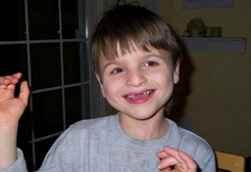 Angelmann syndrome is a disease that is attributed to a genetic abnormality characterized by a delay in mental development and accompanied by seizures, chaotic hand movements, frequent laughter and smiles. This disease is also called the syndrome of "parsley" or "laughing doll".
The scientific name of Angelman syndrome was in honor of the paediatrician from Britain, Harry Angelmann. This disease was first described in 1965.According to different data, the frequency of occurrence is one case per ten to twenty thousand newborns. However, there are data that these are underreported figures and such people are born more.
Angelman's Syndrome Causes
There are no separate genes for the 15th chromosome in this disease. Most cases are characterized by a partial deletion or a mutation of the 15th chromosome. Angellman syndrome suffers from a maternal chromosome, and in the case of changes in the paternal chromosome, Prader-Willi syndrome develops. Often, the syndrome is provoked by a spontaneous chromosomal defect, which is characterized by the absence of an adjacent region consisting of four million base pairs of DNA in the places q11-q13 of the 15th chromosome.
Angelmann syndrome has a karyotype of 46 XX or XY, 15p. Independent studies to the causes of the Angelman syndrome include mutations in the gene UBE3A.The enzyme component of a complex protein degradation system is considered the product of this gene.
Angelman syndrome symptoms
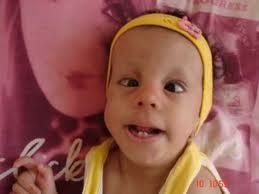
The disease is recognizable by the following symptoms: less than average head size, rarely located teeth, flattening of the occiput, wide mouth, tongue out, tongue protruding outward, prominent chin forward. Patients suffer from sleep disorders, strabismus, curvature of the spine, sensitive to high temperature. Those suffering from Angelmann's syndrome feel excellently in the water.
Angelmann syndrome and its symptoms: problems with breastfeeding, low weight of the baby, delay in the development of general motor skills( difficulty with walking, sitting);Undeveloped speech, delayed speech development. For children, there is a good understanding of speech, but there are difficulties with the reproduction of their thoughts. Toddlers are difficult to concentrate, attract to attention due to hyperactivity.
Students experience learning difficulties. In 80% of cases, patients have epileptic seizures, as well as changes and disorders in electroencephalography. For all patients, unusual movements are typical, such as small tremor and chaotic limb movements. A distinctive feature of patients with Angelman syndrome is a frequent without cause for laughter, as well as walking on stiff legs. Children with this disease are compared to puppets.
For all patients, symptoms such as a happy state, mild irritability, a desire to clap, and low concentration of attention are inherent. Often, the diseased are subjected to hypopigmentation, salivation, intensified chewing movements, hyperactive tendon reflexes and a constant desire to drink. It is noteworthy that seizures do not cover all patients, but only 80% of patients, starting from the age of three.
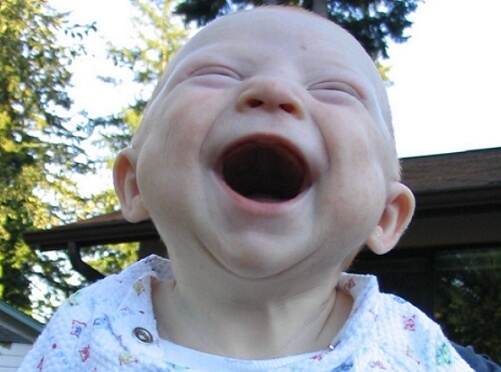
photo of a child with Angelmann syndrome
Angelmann syndrome diagnosis
This disease is diagnosed after genetic analysis of the fifteenth chromosome. Diagnosis is prescribed to newborns with a hypotonic( low muscle tone), with a lag in the development of speech, as well as general motor skills. Parents should pay attention to a specific facial expression, small tremor, chaotic, as well as gustatory movements of the limbs, stiff legs during gait and very frequent laughter.
Methods of analysis include fluorescence in situ hybridization, DNA methylation of the 15q11-q13 region, as well as direct mutation analysis in the UBE3A gene and mutation analysis of the imprinting center.
There is a separate group of people who have all the symptoms of Angelmann's syndrome, but the results of all the analyzes described above remain normal.
Angelman Syndrome Treatment of
There are currently no ways to treat the disease, but there are separate treatment measures aimed at improving the quality of life of patients.
Babies with a hypotonic massage are prescribed, as well as other types of physiotherapy( special therapy).Special methods for the development of the child, as well as classes with a defectologist and speech therapist, are shown. When sleep disturbs, light sleeping pills are prescribed. American doctors to improve the quality of night sleep prescribe to their patients half an hour before bedtime 0.3 mg melatonin.
Stool disorders in patients are resolved by the appointment of mild laxatives. With frequent seizures, an electroencephalography is shown, and epilepsy in patients is controlled by anticonvulsant drugs.
American doctors have noticed a lot similar to children suffering from autism and began to treat children according to the scheme of treatment of autism. Children with these diseases combine impulsivity, autostimulation, repetitive, obsessive movements, difficulty in communication, interest in things that are not appropriate for their age. A good result was obtained by American doctors in the treatment with intravenous injections with the hormone Secretin, which reduce the signs of undesirable behavior, and also provide a good level of communicative skills and sociability. Perhaps, in time, the world medicine will also be used in the treatment of Secretin.
Angelmann syndrome forecast
High probability of birth of the same parents of the second child with this disease. In order to reduce the risk of such a baby, it is necessary to get advice from geneticists. Physicians believe that the usual deletion occurs spontaneously and the risk of repetition is less than 1%.At molecular microdeletion in the mother in the area of 15q11-q13, the risk is up to 50%.If the mutations within the UBE3A gene become random or not inherited, then the risk of a repeat is less than 1%.However, you should know that these mutations can be inherited from a normal mother, and this risk is 50%.But the parthenogenetic dysomy of the 15th pair acts as a random situation and the risk of repeat is less than 1%.In general, the risk of repetition in parents to give birth to a child with Angelmann's syndrome depends on chromosomal abnormalities.
Angelmann syndrome and prospects for further development are favorable. Sick children are able to understand all the information and speech addressed to them, but it is difficult for them to express their thoughts in words. Despite this, patients with Angelmann's syndrome are very sociable, nice and friendly. In some cases, speech in children is generally absent or vocabulary is up to 5-10 words. In such cases, children are taught the language of gestures. Lessons with kids from a very early age are conducted under special programs that improve the development of motor skills and often give good results.
Therefore, the development prospects with Angelmann's syndrome directly depend only on the degree of chromosome damage. Often, people with angelman syndrome can learn skills of self-service, and also communicate at a primitive level. And some people will not be able to talk, walk. This is due to the deletion of part of the chromosome.
Over time, symptoms of hyperactivity, as well as sleep disturbances, soften slightly. For girls, Angelmann's syndrome in the puberty period is dangerous by frequent seizures. Most patients with angelman syndrome control excretory functions, including urination, as well as defecation, both during the day and at night.
People with angelman syndrome can learn etiquette, and eat with a knife, as well as forks, are able to serve themselves( dress, undress).However, the adult age is complicated by scoliosis, obesity. Sexual maturation of girls and boys occurs at regular intervals. There are cases of birth in a mother suffering from Angelman's syndrome of a child with the same diagnosis.