Sinus bradycardia
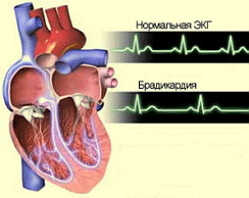 Sinus bradycardia is a pathology that is associated with the slowing of the formation of an impulse by the main driver of rhythm - the sinoauric formation. The remaining pacemakers have a lower frequency of spontaneous excitation, so their impulses are extinguished by the pulses of the sinus node. A normal rhythm is a cardiac contraction that is a multiple of 60-100 strokes. Values that will be less than those described above are attributed to bradycardia.
Pathological sinus bradycardia is a rhythm of less than 60 beats. In minutes, which does not increase by physical activity. Sinus node is an education that consists of specialized cells that have a unique property - automatism. Very often, such a pathology as a sinus bradycardia is unnoticed because of its asymptomatic course. A sinus bradycardia is most often detected in preventive examinations. A person with this condition feels good when performing daily simple actions, but it is worth to increase the physical load, as sinus bradycardia makes itself felt.
Severe sinus bradycardia is a palpitation of less than 49 beats per minute. At the same time, not every decrease in heart rate( heart rate) less than 60 per min is considered a sinus bradycardia. Athletes have an increased tone of the vagus nerve, which refers to the parasympathetic nervous system. His influence slows down the frequency of heart attacks, while not causing harm to health.
Sinus bradycardia causes
The sinus node is located at the site of insertion into the right atrium of the superior vena cava. The sinus node is a small formation, 1.5-2 cm in size. It is supplied from the coronary arteries. All pulses formed at a given node are directed to the underlying segments of the conductive heart fibers, which assume the function of producing pulses in the event of a sinus node being turned off. The cells that make up the sinus node are negatively charged, and the surrounding myocardium is positively charged. Under the influence of the action potential, a pulse occurs. The main role in the process of excitation is played by potassium ions, which is the main ion of the intracellular fluid.
Under normal conditions, the slowing of the sinus rhythm occurs with an increase in the influence of the autonomic nervous system, during sleep.
Rarely sinus bradycardia develops as an isolated disease. In this case, sinus bradycardia affects the elderly. The cause of isolated senile sinus bradycardia is amyloidosis and other similar conditions that alter the tissue of the myocardium.
Violation of the supply of the sinus node as a result of obstruction of the coronary arteries very rarely leads to a sinus bradycardia.
Symptomatic sinus bradycardia accompanies hypothyroidism, and in later stages of liver damage, hypothermia, typhoid and brucellosis. Increased pathological tone of the vagus nerve also causes a sinus bradycardia. Hypoxia, hypercapnia, acidemia, acute hypertension lead to sinus bradycardia. But at the same time, in many cases of this condition remains unknown etiology.
Sinus bradycardia occurs in response to impaired excitation in the sinoauric formation, as well as impaired conduction in the heart muscle. In the first case, a sinus node failure occurs, and in the second case, a blockade occurs.
Sometimes patients seek help after using some medications that reduce the rate of pulse advance on the myocardium, thereby aggravating sinus bradycardia. Drugs that slow the progress of the pulse include the following medications: cardiac glycosides, beta-blockers, quinidine drugs and other antiarrhythmic drugs, as well as verapamil and diazepam.
Another frequent pathological process, which is associated with the appearance of sinus bradycardia, is a sinus node weakness syndrome. The reason for this pathology is an isolated decrease in the functional capacity of the sinus node, or the so-called Leningra's disease, which occurs in the elderly.
Another very common cause of damage to the sinus node with the onset of sinus bradycardia is ischemic heart disease. In this case, sinus bradycardia accompanies 25-30% of myocardial infarction. The reason for the weakness of the sinus node is most likely cardiomyopathy, arterial hypertension, infiltrative diseases( amyloidosis, hemochromatosis, tumors), collagen diseases, myocarditis, congenital changes in the heart and neuro-muscular disorders.
Septic conditions, heavy metal poisoning, increased intracranial pressure also cause a sinus bradycardia.
Sinus bradycardia symptoms
The appearance of a sinus bradycardia leads to a decrease in the release of blood to feed the organs and tissues of the body. This leads to inadequacy and inefficiency of blood circulation. If the body does not receive oxygen and nutrients, the body tries to compensate for this process and reduce energy costs. As a result, there are manifestations of fatigue and general weakness, dizziness in a patient with sinus bradycardia. Reducing the flow of oxygen to the brain provokes fainting. During this period, the ECG reveals long pauses, or asystole. Severe sinus bradycardia leads to congestive circulatory failure.
Syndrome of weakness of the sinus node is composed of several symptoms: pathological sinus bradycardia, sinoatrial block, stopping the sinus node and bradycardia-tachycardia syndrome.
Sinus bradycardia with syndrome of sinus node weakness manifests itself in the form of all of the above symptoms. Syncope is most clearly manifested in the syndrome of weakness of the sinus node. Dyspnea, angina may also occur. Syndrome sinus bradycardia-tachycardia worries patients with a palpitation, but the registration of this phenomenon on the ECG is problematic, since such attacks occur suddenly and also stop suddenly.
The appearance of heart failure is indicated by edema on the legs, which gradually rise until the development of total edema of subcutaneous fat;An increase in the liver;Decreases resistance to physical work. Depending on the patient's ability to perform physical work, several functional classes are distinguished. The first functional class includes patients without manifestations of heart failure during exercise. The second functional class includes patients with dyspnea with low intensity physical activity. The third functional class consists of people who experience symptoms of heart failure with minimal physical exertion. The fourth functional class includes patients who even in peace suffer from symptoms of circulatory failure.
An easy sinus bradycardia does not appear clinically. The incidence of myocardial contractions with this form is approximately 60-50 beats per minute.
Sinus bradycardia accompanying sinoatial blockade of the first degree is not detected even on the ECG, it can be detected only by intracardiac examination. The complete blockade of the sinus node is characterized by the dissociation of contractions of different parts of the heart. Since pronounced sinus bradycardia manifests with paroxysmal faints, diagnostics are best performed with Holter monitoring. At the same time, monitoring should be daily, since a single ECG removal will not yield any results. Therefore, in some cases, you should resort to a sample with a compression of the carotid sinus or to a test with drug cutoff of the innervation of the heart. In healthy people, after the compression of the carotid sinus, a sinus pause occurs about 3 seconds. In patients with sinus bradycardia, the pause may exceed 5 seconds. With the introduction of Atropine, the cause of sinus bradycardia can be differentiated. If Atropine ceased sinus bradycardia after compression of the carotid sinus, then the cause is vegetative frustration.
The next informative test that determines the cause of sinus bradycardia is a pharmacological test. It consists in the introduction of Atropine and Propranolol, while the rhythm of the sinus node itself, which lacks innervation, arises. When the frequency is less than the normative frequency, a conclusion is made about the weakness syndrome of the sinus node.
Sinus bradycardia in children
The newborn heart rate is significantly higher than in adults. The more mature the baby becomes, the more the value of the heart rate approaches the value of adults. In newborns, the heart muscle contracts at a frequency of more than 140 beats. In minutes. If a one-year-old child has a heart rate of less than 100 per minute, then a sinus bradycardia is diagnosed. In older children, bradycardia can be said with the number of myocardial contractions per minute multiples of 80-60.
The cause of sinus bradycardia in children can be a family inclination. In this variant, such a diagnosis should be peculiar to some members of the same family.
A bradycardia in a baby can occur with fetal death in fetal blood. When there is a so-called nuclear jaundice, a bradycardia can also occur. Nuclear jaundice is a condition of newborns when the amount of bilirubin in the blood in children is much higher than normal, as a result of which it penetrates to the brain and permeates the structures of the brain. Congenital defects in the development of the conduction system of the heart lead to the development of sinus bradycardia.
In children older than one year, the causes of sinus bradycardia are identical to those of adults. The tone of the vagus nerve can also lead to peptic ulcer of the stomach and duodenum. Therefore, in children, who combine the signs of bradycardia and peptic ulcer, there is an increased effect of the parasympathetic nervous system. Treatment for this pathology will be appropriate.
Moderate sinus bradycardia
Moderate sinus bradycardia has a heart rate of 59-49 strokes. Most often this type of disorder occurs without any symptoms. This variant of sinus bradycardia occurs in autonomic disorders and increased tone of the vagus nerve. This nerve is an integral part of the parasympathetic nervous system. This nerve is responsible for the function of heart contractility. It determines the strength and number of heart beats per minute. When consuming drugs that reduce the predominance of the parasympathetic nervous system, the activity of the vagus nerve with respect to the heart is minimized. To reduce the influence of the vagus nerve on the pacemaker can be with the help of Atropine. Clinical manifestations can not be manefested, but with increased physical exertion, the condition worsens. Syncope attacks generally do not occur, but shortness of breath and fatigue are present.
If symptoms do not occur with moderate sinus bradycardia, then it does not serve as an indication for the use of medication. Detection and diagnosis is performed according to the results of ECG analysis. In this Holter monitoring can be carried out to clarify the diagnosis. With severe symptoms, this disease requires the installation of a permanent pacemaker, but this must be used in extreme cases.
Sinus bradycardia treatment
Emergency therapy for sinus bradycardia of any etiology is aimed at increasing the heart rate and eliminating the consequences of circulatory failure. It is necessary to give the patient a lying position with his legs raised. Introduce Atropine 1% solution with a dose of 1 ml, a factor of 3-5 times. At the same time, an air mixture with a high oxygen content is fed. If possible, perform a temporary pacemaker. If these methods are ineffective, Orciprenaline is used at a rate of 10-30 mg per min.
Treatment of sinus bradycardia as a syndrome of weakness of the sinus node is very effective when installing a permanent pacemaker.
Treatment of conduction disorders is reduced to the appointment of Atropine. Unique drug Antidigoxin, which is used in overdoses of digitalis preparations. It binds to digoxin with special sections of molecules and turns it into an inactive substance. Thus, the effect of cardiac glycosides on the body ceases. Blockades also require the setting of a pacemaker.
Treatment of sinus bradycardia, which arose after surgery, is reduced to setting the pacemaker 7 days after the intervention.
Treatment of the main pathology is of extreme importance, as with reducing the pathological effect on the sinus node, the frequency of cardiac contractions is normalized.