How is bladder cystoscopy performed in men?
Cystoscopy is a visual examination of the walls and cavity of the bladder using endoscopic instruments. Modern cystoscopes are rigid and flexible. The choice depends on the research tasks.
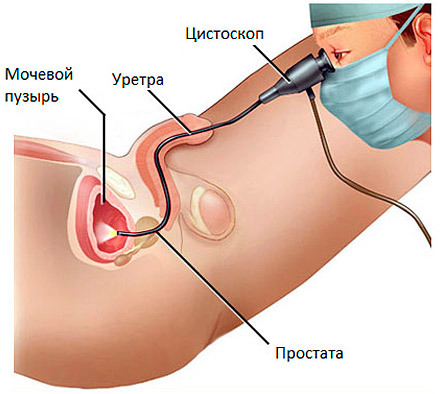
The procedure of cystoscopy of the urinary bladder in a man.
Cystoscopes have special optical devices and allow:
- to inspect the internal surface of the bladder mucosa and ureteral anus;
- to conduct ureteral catheterization;
- perform surgical interventions.
In clinical practice, not only the examination of the bladder is used, but also combines it with the study of the urethra. In this case, urethrocystoscopes are used, and the study is called urethrocystoscopy .If a colorant is injected parenterally before the procedure, the functional condition of both kidneys is determined and ureteral patency disorders are detected, such a study is called chromocystoscopy .
Contents
- 1 Indications for procedure
- 1 Indications for procedure
- 2 Contraindications to procedure
- 3 Technique for conducting
- 4 Features of conduction and evaluation of chromosystoscopy
- 5 Patient tolerability
- 6 Reviews of cystoscopy
Indications for procedure

Persistent urination disorders are indications for cystoscopy.
Cystoscopy can be both diagnostic and therapeutic manipulation.
Main indications:
- blood in urine;
- persistent urination disorders( difficulty, frequent urge, small portions);
- detection in several urine analyzes conducted at intervals( 1-2 weeks) of elevated white blood cell count;
- suspected neoplasm, developmental abnormalities and foreign bodies of the bladder.
Chromocystoscopy is used to determine the cause of acute pain in the abdomen, allowing the differentiation of renal colic and diseases of the abdominal cavity, reveals the overlap of the lumen( obstruction) of the ureters.
Therapeutic cystoscopy is performed with the catheterization and stent placement( flexible tube for restoring the patency) in the ureter.
Contraindications to procedure
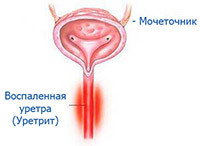
Acute inflammatory diseases are contraindication to cystoscopy
Contraindications:
- acute inflammatory changes of the bladder, urethra;
- prostatitis, orchitis, orchiepididymitis;
- violation of urethral patency;
- trauma to the urethra;
- reflux of the contents of the bladder into the ureter.
Chromocystoscopy is contraindicated in severe functional disorders of the kidneys and liver, a sharp decrease in blood pressure and an allergic reaction to the coloring substance indigocarmine.
Macrogematuria( discharge of blood in urine in quantities that color it) and pyuria( a significant amount of pus in urine) violate the transparency of urine and make it difficult to obtain images on optical instruments and computers. This requires mandatory washing of the bladder before inspection. Also, the small capacity of the bladder does not allow to see all the changes, which reduces the informative nature of the study.
Technique for carrying out
The procedure is carried out after the application of pain medication, or the patient is admitted to general anesthesia. Before starting the manipulation, the bladder must be emptied.
Procedure:
-

The procedure is carried out after anesthesia or after the introduction of the patient under general anesthesia.
Lie down on a urological chair, on your back, raise and bend your legs.
- Lubricated with sterile glycerin( to facilitate passage through the urinary tract), the cystoscope is injected into the bladder.
- Release urine remaining in the bladder.
- Wash the bladder with a warmed up to 36.6 ° C solution of furacilin( in a dilution of 1: 5000).
- Determine the volume of the cavity of the bladder, filling it with furatsilinom before the urge to urinate.
- Inspect all walls, bladder cavity and ureteral anus.
In the formation of the conclusion, localization, quantity, as well as the shape of the ureteral lobes, the color of the mucous membrane, the presence of ulcers, neoplasms, concrements and foreign bodies are determined. Normally, the mucosa is smooth, with a capillary vascular network. The absence of a pale pink color, the excretion of pus or blood from the mouth allows us to reveal the nature and localization of pathology.
For the catheterization of the ureter and the renal pelvis, cystoscopes with passages for the catheter and its lift are used. They allow you to correct the direction when you enter the mouth and at a certain height into the lumen of the ureter under visual control of the doctor. Disorders of urinary excretion due to stagnation are characterized by a change in intermittent( normal) discharge into a permanent and a jet.
Features of conduction and evaluation of chromoscystoscopy
Prior to the onset of cystoscopy, 2-3 ml of 0.4% indigo carmine solution is administered intravenously or intramuscularly, the beginning and severity of the dye secretion in the urinary bladder with urine from the ureters is observed and fixed. With intravenous administration, the expected time of appearance of contrast in the bladder is 3-5 minutes, with intramuscular - 15-20.Delay indicates a violation of the kidneys or obstructions in the ureters.
The absence of contrast in the bladder after 12-15 minutes after insertion into the vein indicates a blockage of the ureter lumen:
- with a stone;
- with the development of stricture( adhesion of the walls due to inflammation);
- tumor.
The reason for slowing the release of colorant in the bladder, except for ureteral lesions, is a sharp violation of the excretory function of the kidney.
Patient tolerability
Possible adverse effects:
-
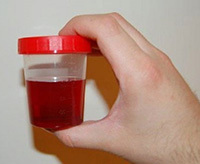
After the procedure, blood in the urine can be observed.
presence of traces of blood in the urine( especially after taking a biopsy);
- spread of infection through the urinary tract;
- temporary erectile dysfunction;
- decreased libido( sexual desire);
- erosion of the urethral mucosa and bladder;
- ruptured urethral wall;
- perforation( puncture) of the mucosa of the bladder;
- urinary retention when the lumen of the urethra is blocked by blood clots;
- allergic reaction to contrast( with chromoscystoscopy) or to painkillers.
Symptoms requiring urgent medical examination:
- severe pain;
- presence of blood clots and signs of continued bleeding;
- urinary retention;
- a sharp decrease in the amount of urine released;
- elevated body temperature;
- violations of sexual function and attraction.
Methods of correction of these disorders can be medicated and in the form of surgical intervention.
Reviews for cystoscopy
Review 1. Did cystoscopy. The procedure is unpleasant, but tolerable. There was anesthesia. I felt uncomfortable when the doctor injected the cystoscope, as if passing some small obstacles, and then very much wanted to go to the toilet when the liquid was injected. The doctor said that it is so necessary to see how much urine the urea contains. After the procedure, they said to observe whether there is blood in the urine, drink anesthetic and rest. A day later fully recovered. I am glad that I agreed to the procedure, now I know for sure that there is nothing terrible there.
Review 2. Cystoscopy was done and the polyp was removed immediately. They injected painkillers. It was not painful, but unpleasant, especially when a catheter was inserted and the polyp was removed. After I saw the blood in my urine a couple of days. They said hot showers do not take and drugs to drink( antibiotics, against pain and inflammation).In a week, everything passed.
See also: Cystitis in men - symptoms and treatment
Recommended viewing: