In detail about operation on varikotsele - kinds, their advantages and disadvantages
Varicocele - varicose veins of the testicle of the testicle, which affects male subjects regardless of age. Most varicocele appears on the left;The widening of the veins of the spermatic cord of the right testicle is a weighty occasion to undergo ultrasound of the kidneys to exclude tumor pathology. The varicocele of the left testicle is not a life threatening condition, but it can affect a man's ability to fertilize and lead to testicular atrophy.
The degrees of disease 4, they range from the severity of the pathological process. So, at 1 degree varicocele there are no external manifestations, changes in veins are fixed with ultrasound with doppler. At 4 degrees, the papillate plexus of the testicles is visible to the naked eye.
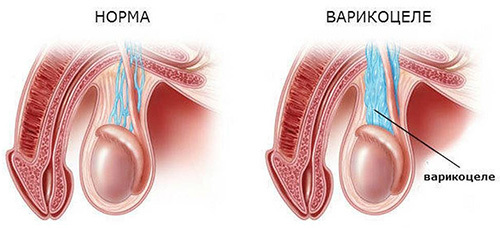
Normal condition and varicose veins( varicocele).
Contents
- 1 Types of surgical intervention for varicocele
- 2 Indications for surgical intervention
- 2.1 Do I have to agree to an operation?
- 2.2 Is it necessary to perform an operation for a teenager diagnosed with varicocele?
- 2.3 Which operation is best?
- 3 Classic open surgery
- 3.1 Operation Ivanisevicha
- 3.2 Operation Marmara
- 4 Laparoscopic surgery for varicocele
- 4.1 advantages of endoscopic technique in the treatment of varicocele
- 4.2 Disadvantages
- 4.3 Contraindications for laparoscopy in varicocele
- 5 Microsurgical interventions in varicocele
- 6 Contra operations inVarikotsele
- 7 Preparation for operation
- 8 What can be after the operation?
- 8.1 Early complications of
- 8.2 Late complications of
- 9 Reasons for recurrence of varicocele
- 10 Restoration after surgery for varicocele
- 11 What to look for?
Types of surgical intervention for varicocele
Operative treatment of varicocele is the only effective way to combat this pathology. The essence of ongoing surgical interventions is reduced to switching out of the general circulation of varicose dilated vessels of the lobate plexus.
In urology, a number of operations are carried out concerning varicocele:
- classical open( operation Ivanisevicha, Marmara);
- endoscopic;
- intravascular;
- microsurgical.
But open surgery for varicose veins of the spermatic cord in modern urology is less common.
Indications for surgical intervention
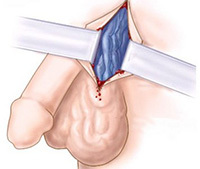
Varicocele is the only adequate treatment for pathology.
Indications for surgical intervention with varicocele are:
- spermatogenesis disorder with confirmed varicose veins of the spermatic cord;
- severe pain syndrome;
- relapse varicocele;
- expressed degree of veins, confirmed by ultrasound examination with Doppler.
Operative treatment is performed in a hospital based on a surgery or urology clinic. Depending on the planned operation, an anesthetic method is chosen: anesthesia can be local or general.
Do I have to agree to an operation?
If a man of childbearing age wants to become a father in the future, the operation will be mandatory.
Identified varicocele on the left side of an elderly man does not require immediate surgical intervention if there are no clinical manifestations. If the patient is concerned about prolonged aching pain in the testicle, it is better to agree to surgery.
With the onset of irreversible testicular atrophy on the background of varicose veins of the plexus plexus, surgical treatment is not shown, since it has lost its relevance.
Is it necessary to perform an operation for a teenager with a diagnosis of varicocele?
In the initial stages of varicocele has no effect on spermatogenesis, so up to 18 years of age with surgical intervention with varicocele on the left can be delayed. During this period, complex therapy is prescribed for the treatment of varicose veins, because the varicocele on the left is a complication of varicose veins.
The postponement of the operation is explained by the fact that even with the removal of the enlarged site of the vein, the likelihood of recurrence of varicose disease and the development of a second varicocele remains. In addition, there is a possibility of surgical complications, which will lead to an irreversible loss of the functional ability of the male sex gland.
Which operation is best?
Before choosing the tactics of surgical treatment, the cause of varicocele should be diagnosed and its primary character proven.
The scope and technical side of the surgical procedure is determined by the operating physician, taking into account the general condition of the patient, the severity of the vascular changes, and the possibilities of the surgical department.
Classical open operations
Operation of Ivanisevich
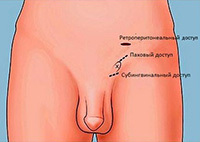
Location of the cut in the open operation.
Operation is possible under local anesthesia.
At the level of the upper iliac on the left, a horizontal incision of 4 cm is performed, the aponeurosis and muscles are dissected lengthwise, they are bred to the sides. The ovarian vein is excreted, it is separated. Between the clamps, the venous vessel intersects with the proximal end bandage. Remove excess blood from the plexus plexus. Stitch and bandage the stump.
There is a risk of damage to the femoral artery due to the anatomical proximity of the neuromuscular bundle to the inguinal canal.
Operation Marmara
It is considered more gentle, since the cut is only 2 cm and the technique does not require opening the abdominal tissues. The operation is performed with the use of special eye lenses by the surgeon, which improves visualization.
An incision is made along the outer edge of the inguinal canal, in the inguinal region, the inguinal vein is isolated and bandaged. Conduct a survey with Doppler, in order not to accidentally bandage the arteries. Lymphatic vessels are not involved in the operation.
Laparoscopic surgery for varicocele
Surgery is performed through a small incision in the abdominal cavity, a flexible tube with optics and 3 laparoscopic ports are inserted into different areas of the abdomen. Endoscopic optics can greatly increase the desired picture and display it on the monitor. Due to the fact that in this case the visualization of small vessels is much better than with the operations of Ivanisevich and Marmara, it is easier to implement the necessary intervention.
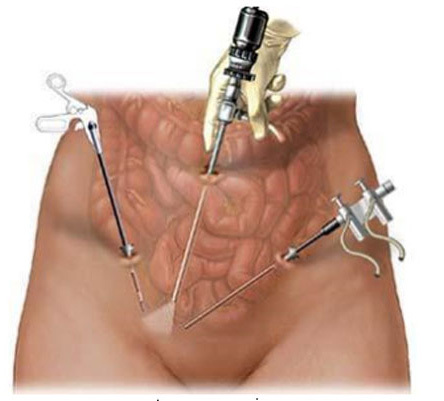
Laparoscopic intervention.
Advantages of the endoscopic method in the treatment of varicocele
- Minimal trauma.
- Ability to perform intervention on both sides with a 2-sided varicocele.
- Minor pain syndrome.
- No postoperative scar.
Disadvantages of
The peculiarities of the operation include the high cost of laparoscopic equipment, the availability of highly qualified specialists, who usually work in large cities.
The need for general anesthesia is a contraindication for patients with cardiovascular pathology.
Contraindications to laparoscopy for varicocele
- Tumor diseases;
- Acute inflammatory process in the abdominal cavity( acute cholecystitis, pancreatitis, appendicitis, etc.);
- adhesive disease( many previous laparoscopic operations).
Microsurgical interventions for varicocele
Microsurgical operations with varicocele are an effective way to solve the problem of varicose veins of the spermatic cord. The essence of surgical intervention is the replacement of the affected vein with a healthy one.
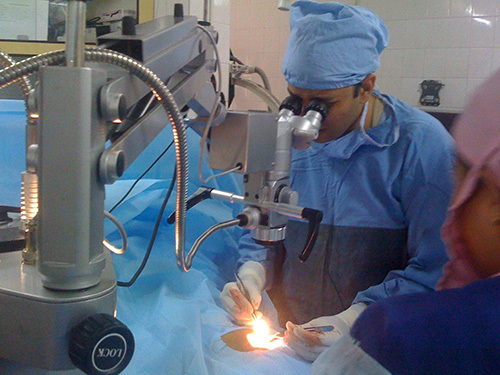
Carrying out a microscopic operation.
To carry out the plastic use an epigastric vessel, which is replaced by a pathologically altered varicose vein. The purpose of the operation is the creation of an anastomosis between healthy vessels and the disabling of the pathological site. Advantages of the microsurgical technique:
- rare relapses;
- short rehabilitation period;
- short hospitalization;
- physiological;
- restoration of blood flow immediately after surgery, in contrast to other operational techniques.
Contraindications to surgery for varicocele
For a number of diseases, surgical intervention is undesirable and even dangerous.
These include:
- diabetes mellitus at the stage of decompensation;
- coagulopathy of different genesis( bleeding disorder of blood);
- heart attacks, strokes in an acute period, transient cerebral circulatory disorders;
- inflammatory diseases of the male sexual sphere;
- marked extragenital pathology.
Preparation for operation
Before carrying out the operation, it is necessary to conduct the following investigations:
- ultrasound of the scrotum organs with doppler;
- angiography;
- a clinical blood test, urine, blood sugar;
- blood for hepatitis B and C, HIV infection, syphilis.
What can be after the operation?
After the operative treatment for varicocele complications of early and late postoperative periods may develop.
Early complications of
- bleeding;
- joining bacterial infection;
- traumatization of the spermatic cord: due to the anatomical proximity of the blood vessels and the spermatic cord, damage to the latter can occur;
- damage to the testicular artery.
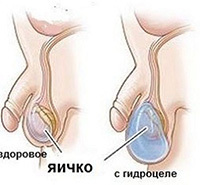
One of the possible late complications is hydrocele( hydrocele).
Late complications of
- Recurrence of varicocele.90% dependent on errors during surgical treatment;
- Dropsy( hydrocele) of the testicle. It is associated with damage to the lymphatic system, it is expressed in the accumulation of fluid in the testicles on the side of the lesion;
- Testicular atrophy. Because of erroneous damage to the testicular artery, trophic and blood supply to the testicle is disrupted, which gradually leads to its atrophy.
Reasons for recurrence varicocele
The most common reasons for reappearance of varicocele include:
- Diagnostic error. Removed not all the vessels, in the future they cause a repeated varicocele.
- The age for the operation is incorrect. Operative intervention performed against the background of the growth of the sexual glands during puberty( growing up) is often complicated by the repeated development of varicocele. For the doctor, an important task is to determine the "golden" time for the operation, too early - it's bad, but even in varicocele of the 3rd degree, surgical intervention is considered somewhat belated.
- Technical error of the surgeon during the operation.
- Insolvency of consumables.
Recovery after surgery for varicocele
More common are found after open abdominal operations.
After the operation of Ivanisevich, the postoperative scar heals 10-12 days. In the early days, you can take analgesics.6 months you can not go in for sports and categorically you can not lift weights. It is necessary to wear tight meltings that will help keep the scrotum in a raised position, which will prevent the development of dropsy.
With microsurgical interventions and endoscopic operations, the rehabilitation period is shorter, the pain syndrome in the early postoperative period is not significant, the man returns much earlier to the usual life.
Regular walking allows normal circulation.
The intake of vitamins with microelements will raise the general strength of the body( see Vitamins for immunity for men).
It is desirable to adhere to proper nutrition, to fight with constipation, which lead to stagnation of blood in the veins of the small pelvis.
What should I look for?
You should see a doctor urgently if you have:
- high temperature( above 38 ° C);
- of a large size of the hematoma( the scrotum is enlarged, painful, bluish);
- isolation from a postoperative scar of a purulent discharge with an unpleasant odor;
- significant discrepancy of the edges of the rumen;
- with laparoscopic interventions - the allocation of blood in large quantities from the puncture sites;
- loss of sensitivity of the skin of the femoral surface( suspected nerve trauma).
After the surgical intervention for varicose veins of the spermatic cord, the spermogram normalizes within 6 months, sometimes a year.
Sex( masturbation) after surgery for varicocele can be done 10-12 days after minimally invasive operations;During the operation of Ivanisevich or Marmara - after 3-4 weeks.
Urological doctor Mishina V. V.
Recommended screen viewing: