Stones in the prostate: when they arise and how to get rid of the problem?
The formation of stones in the prostate is a late complication of prostatitis. According to statistics, it develops in 80% of men after 5-10 years from the onset of the pathological process. The essence of the disease is the development of concrements in the tubules of the glandular organ. As a result, the normal outflow of the prostate secret is disrupted. The symptoms of the underlying disease are further exacerbated.

Stones in the prostate gland are one of the most common complications of chronic prostatitis
Contents
- 1 Developmental factors
- 1.1 Main causes
- 1.2 Indirect factors
- 2 Clinical picture
- 2.1 Specific symptoms
- 2.2 Nonspecific symptoms
- 3 Classification of concretions
- 3.1 By origin
- 3.2 By mineral composition
- 4 Diagnostic measures
- 5 Therapy
- 5.1 Medication treatment
- 5.2 Surgical treatment: types and indications
Developmental factors( pathogenesis)
Calculous prostatitis ( another name for stone formation in the prostate gland) is a multifactorial disease.
The main causes of
The following causes the pathogenesis of :
- Chronic prostate diseases with prolonged course. First and foremost, it is an inflammatory prostatitis, benign hyperplasia( adenoma).These pathological processes lead to stasis of the secretion of the organ. In addition, constant inflammation leads to the deposition of calcium salts on the walls of the ducts of the prostate( calcification).
- Cancer of the glandular organ.
- Incorrect power. Errors in the diet can change the composition of the juice of the prostate gland. Surpluses of salts eventually form concrements.
- Traumatic injury of the pelvic organs.
- Long-term use of antibacterial drugs-sulfonamides. These pharmaceutical agents crystallize to form stones.
- Circulatory disturbance in the pelvic area due to hypodynamia.
- Irregular sex life.
Indirect factors
Also there are factors of that affect the prostate indirectly, increasing the risk of developing the disease:
- smoking;
- alcohol abuse;
- lack of motor activity;
- frequent urinary tract infections;
- physical inactivity;
- subcooling.
Clinical picture of
All manifestations of the disease can be divided into specific and nonspecific .
Specific symptoms of
Specific pathognomonic only for this disease and allow to determine the diagnosis:

Frequent urination accompanied by pains - a specific syndrome of calculous prostatitis
- Pain syndrome. The leading symptom that accompanies the patient most of the time. Pain intense, stitching, aching. Localize in the groin area, give into the penis, testicles, anal opening, legs, lower back. Increase when you change the position of the body, erection, ejaculation. Physical activity, as well as straining in the process of defecation lead to an intensification of pain.
- Violations of urination. Calculous prostatitis is a neglected stage of the disease. It is characterized by significant violations of the process of emptying the bladder. A man is constantly drawn to visit the toilet. Desires imperative. However, when it comes to urinating, urine either does not go out at all, or comes out drop by drop. It is a question of pollakiuria. Perhaps a sharp interruption of the process of urination: the jet becomes lethargic or completely disappears.
- Impotence. It is caused by disturbances in testosterone production by the testicles, as well as changes in the contractility of the prostate. The erection becomes weak, the penis is not strong enough to make a penetrating sexual contact. Impotence can manifest itself in a paradoxical way. Erectile function is preserved to the fullest, but even before the intimate process begins, ejaculation occurs.
- Hematuria. The appearance of blood in the urine. It is caused by the destruction of capillaries under the mechanical action of concrements.
- Pain syndrome in the lumbar region.
- Decreased libido. Sexual desire is significantly reduced.
- Admixture of blood in the semen.
Nonspecific Symptoms of
Non-specific manifestations characterize various pelvic diseases.
Among them:
- general weakness;
- feeling of indisposition;
- decreased appetite;
- hyperthermia at the level of low-grade markers( 37.2-37.5 degrees).
As we speak about the advanced stage of the disease, the clinical picture includes all the above manifestations in the complex. The intensity of the signs is high and significantly reduces the quality of life of the representative of the stronger sex.
Classification of stones
You can subdivide stones on several grounds.
By origin
The criterion of classification can be taken to be the origin of the stone.
In this case, the following are distinguished:
- The stones are true. Develop in the tubules of the prostate gland.
- Stones are false. Occur in the kidneys, bladder. With the current, urines penetrate the prostate gland and clog the ducts of the organ.
For the mineral composition
Another basis is for the mineral composition of the stones.
Accordingly, the following are distinguished:
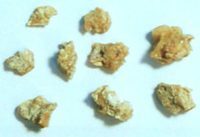
The type of stones determines the tactics of further treatment.
- Urinal concrements.
- Oxalate stones.
- Phosphate stones. Calcium calculus( considered the most dangerous).
Based on the mechanism of development of the process, the following are distinguished:
- Stones of internal origin. Endogenous calculi are formed as a result of prostate secretion stagnation. Long stagnation leads to thickening and folding of the juice. As a result, special protein structures are formed on which organic and inorganic salts settle. Such formations differ in their considerable size: about 2 mm or more.
- Stones of external( exogenous) nature. Developed as a result of casting urine into the ducts of the prostate.
Diagnostic measures
Diagnosis and treatment of urinary tract pathologies is the prerogative of the urologist. Since this is a complex problem that concerns the male sexual sphere, the best option is to visit the urologist andrologist. At the initial consultation, the doctor interviews the patient, finds out complaints, collects an anamnesis of life. Of great importance is the presence of chronic prostatitis. To establish and verify a diagnosis, a number of studies are required.
Among them:
- General analysis of urine. The most informative study. It makes it possible to identify salts in urine, as well as their concentration.
- Analysis of capillary blood. Gives a picture of classical inflammation with leukocytosis, high rate of erythrocyte sedimentation.
-
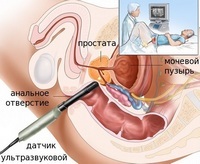
Prostate ultrasound is one of the most informative studies of
Sperm analysis( spermogram).Older prostatitis carries a huge danger for sexual health. The number of healthy and mobile cells decreases, oligospermia occurs. In the seminal fluid is determined by the blood.
- Research of prostate juice. Demonstrates a picture of prostatitis with a decrease in the volume of secretion, etc.
- Ultrasound examination of the prostate and pelvic organs. The most informative study, which will provide an opportunity to identify concrements, determine their size and, possibly, nature.
- Tomography.
- Urography.
In the complex, these studies make it possible to diagnose with great accuracy.
Therapy
Medication treatment
It is practiced, mainly, drug treatment. The basis of therapy is the intake of the following preparations :
- Anti-inflammatory non-steroidal origin. They are used to relieve chronic inflammation in the prostate.
- Spasmolytics. Help to relieve pain.
- Alpha-blockers. They help to relax the smooth muscles of the prostate and bladder, normalizing the evacuation of urine and secretion of the prostate gland.
- Antibacterial agents. Are necessary in case of an infectious origin of calculous prostatitis.
Surgical treatment: types and indications
But it is not always possible to cope with the problem with medicines alone. There is a clear list of indications for surgical treatment:
- formation of acute renal failure;
- intensive pain syndrome, which is not stopped by drugs;
- no urination;
- acute urinary retention.
Therapy option is only two:
- Complete removal of the prostate( see Prostatectomy).
- Partial excision of the organ with removal of the lobes of the gland, where the stones are located.
Be that as it may, the operation is an extreme measure.
On the Internet, widespread so-called. Folk recipes for treating stones in the prostate. As practice shows, effective recipes simply do not exist. By resorting to such dubious methods of therapy, the patient only spends valuable time. If there is a desire to normalize sexual health and restore fertility - the only possible way lies through the traditional treatment of a specialized specialist. Treatment with folk remedies is ineffective.
Recommended for viewing: