Conduction of catheterization of the urinary bladder in men
Catheterization of the bladder is the installation of a special medical device that provides urine outflow directly into the cavity of the said organ. The measure is used in cases when the option of independent urination of a person is excluded - is impossible due to various factors or is inadmissible according to the algorithm of specific manipulations. If the procedure can be performed by both a nurse and a doctor, then only a specialist with a higher education can use a catheter( especially a metal one, and not a flexible one) and who has perfect practice in this area.
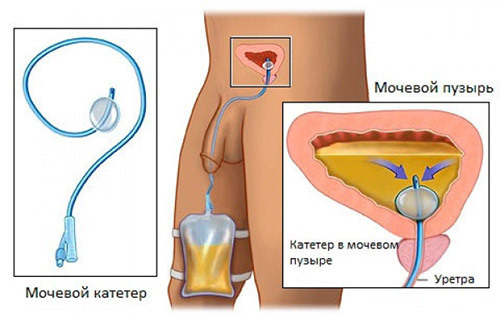
Catheterization of the urinary bladder in men to remove urine.
Contents
- 1 Indications
- 2 Algorithm for conducting catheterization
- 3 Possible complications
- 4 Contraindications
Indications
Catheter used in urological practice is flexible( rubber, silicone) and metal. A silicone product is placed in the organ of urination when it is necessary to ensure a prolonged outflow of urine( during and after the operation, when a man is deprived of the opportunity to get out of bed to urinate on his own).The metal device is used only for one-stage manipulation - it is not installed for a long time.

The main indication for catheterization is acute urinary retention.
In each case, the catheter is used when the patient:
- has an acute urinary retention( more often with prostate adenoma);
- there is a need to pass urine for a subsequent bacteriological or other study;
- complications due to the existing infectious process.
Inflammation of urine outflow, which is fraught with the development of edema of the kidney, occurs as a result of such reasons:
- arisen adenoma of the prostate;
- stenosis of the urethra( a pathological condition in which the urethral lumen narrows);
- presence of a stone-like deposit inside the urethra( a rare case);
- glomerulonephritis( an inflammatory process that encompasses the glomerular system of the kidneys);
- blockage of the urethra due to the tumor process;
- tuberculosis of the renal tissue and organs of the urinary system.
Also, the use of a catheter is necessary for the introduction of drugs directly into the bladder cavity: by catheter, overcoming the urethra, reach the bladder cavity. In the flexible tube, previously attached to the catheter, a drug is administered( more often - an antibiotic or disinfectant solution) to rinse the body, gradually eliminating the inflammation of its tissue.
A long-term catheter( silicone) is installed for a period not exceeding 5 days. If the patient's condition still does not allow him to urinate on his own, the catheter is replaced( to avoid the development of an inflammatory process).
Algorithm for conducting the catheterization of
During the procedure, it is important to observe the sterility regime in the office. Therefore, the staff works in masks and disposable gloves. There is a certain algorithm for bladder catheterization .Perform all the actions needed only after the psychological preparation of the patient, explaining the features and order of the stages, as well as the sensations that he will celebrate throughout the procedure.
- The patient is invited to the dressing room, where he is placed on the table located here with a pre-laid diaper and oilcloth.
- After removing underwear and remaining only in a special operating shirt( or disposable), the man is placed on his back, with his legs bent and divorced. By this time, the nurse is already preparing all the necessary tools and supplies.
- Before the introduction of the catheter, the doctor carefully processes the patient's genitals with an antiseptic solution, using napkins and tweezers for this. This stage is necessary to remove pathogens from the surface of the mucous membrane of the genital organ so that they do not move with the catheter into the bladder, causing inflammation.
- The doctor then lubricates the surface of the instrument with glycerin( to ensure slip) and carefully inserts the catheter to avoid damaging the internal structures. The urinary canal of men has a special structure, and the doctor, using the instrument, has to overcome two physiological curves. If you apply force at this stage, injuries can not be avoided. Therefore, the doctor performs the procedure very carefully. The success of the intervention is determined by the appearance of urine in the catheter.
- If the main goal - to release urine, substitute pre-prepared tray and fill it until the full emptying of the bladder. To ensure that the body is completely emptied, the doctor presses on the suprapubic area.
- If the purpose of the procedure is to introduce a drug, the staff uses a syringe and a rubber catheter. On the tube inject the drug into the bladder, then close the lumen of the adapter with the clamp so that the injected medicine does not pour back.
Possible complications of
Potential complications that can occur with catheterization of the bladder in men are associated with non-compliance with aseptic and antiseptic rules, as well as inept handling of the catheter.
- Cystitis, pyelonephritis, urethritis - the inflammatory process may be preceded by insufficient hygiene of the genitals before the moment of insertion of the catheter.
- Damage to internal structures of the penis, urethra, bladder.
Complications also occur when a preliminary diagnosis was incorrect or a hard catheter was inserted incorrectly.
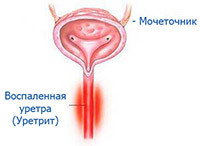
Inflammation of the urinary canal( urethra) is a contraindication to catheterization of the bladder.
Contraindications
Do not perform catheterization of the bladder if the patient:
- acute urethritis( including gonorrheal type);
- damage to the structure of the urethra or suspected of such;
- if the sphincter is reduced( physiological valve).
At the end of the procedure, the patient is moved to the ward, and a sample of the taken urine is sent to the laboratory.
See also: Buzhirovanie urethra in men - indications, procedure
Recommended for viewing: