Cystitis in men - symptoms and treatment
Cystitis is an inflammatory process of the mucous membrane of the bladder, leading to its functional disorder. In men, cystitis is very rare - 7-10 people per 1000. This is due to the anatomical features of the urethra( longer and narrower than the female urethra) and its distance from the anal area, which reduces its infection.
Contents
- 1 Cystitis classification
- 2 Symptoms
- 3 Reasons
- 4 Diagnosis
- 5 Cystitis treatment in men
- 6 Complications
Classification of cystitis
Allocate primary and secondary cystitis.
Primary cystitis refers to cases where the inflammatory process occurs directly in the bladder and can be caused by various factors:
- infectious( specific and non-specific pathogens);
- thermal( supercooling);
- chemical;
- medicinal;
- toxic;
- is alimentary( edible);
- is post traumatic.
In secondary cystitis, the inflammatory process spreads to the bladder from other organs of the genitourinary system( prostate, urethra, seminal vesicles) and from organs not related to the genitourinary system( respiratory system organs, ENT organs) in which there are chronic inflammatoryProcesses that spread by hematogenous( by blood) pathway.
According to the degree of flow, acute and chronic cystitis are isolated.
On the spread of the inflammatory process, and bladder involvement, cystitis is divided into cervical , focal and diffuse .
By the nature of the morphological changes that occur as a result of inflammation of the bladder, you can divide the cystitis into the following forms, presented in Table 1.
Table 1 - Forms of cystitis by the nature of morphological changes.
| CASTIST FORM | DESCRIPTION |
|---|---|
| Catarrhal | Bladder lesions spread within the mucous membrane. Depending on the degree of damage accompanied by secretions of clear, mucous and purulent exudate. |
| Granulation( polypoid, granulomatous) | Characterized by the development of granulation( connective) tissue with the formation of polypoid, granular and wart growths. |
| Hemorrhagic | Areas of hemorrhage with desquamation( exfoliation) of the mucosa, which leads to the discharge of blood in the urine. It can be a consequence of prostatitis in men. |
| Fibrinous | The deposition of fibrin on the mucosa of the bladder is characterized. |
| Ulcerous( necrotic) | Characterized by the appearance of defects in the wall of the bladder. |
| Phlegmonous | One of the forms of purulent inflammation, in which there is a continuous diffuse purulent impregnation of the submucosal layer of the bladder with a huge number of leukocytes. |
| Gangrenous | Characterized by the involvement of the entire wall of the bladder. There is a partial or complete death of the cells of the mucous membrane. |
| Cystic | Characterized by the formation of cysts on the mucous membrane of the bladder, located separately or in groups. |
| Inlaying | Characterized by the deposition of calcium phosphate on the mucosa of the bladder. |
| Interstitial | It is observed most often in women. |
Symptoms of
Among the symptoms of cystitis can be identified:
- urination disorders( dysuria), in the form of frequent calls, difficulties at the beginning and end of the act of urination, leakage of urine after the act of urination, reducing the portion of excreted urine;
- pain when urinating, having a different nature( from moderate burning, to severe rez), pain in the suprapubic, inguinal region, penis;
- change in the appearance of urine - turbidity, discoloration, the appearance of mucus, pus and leukocytes( pyuria), blood( hematuria) in the urine, putrefactive odor;
- symptoms of intoxication( fever, general malaise, weakness, chills) may indicate involvement in the inflammatory process of the kidneys and the development of acute pyelonephritis.
Among all the symptoms of cystitis, the main ones are:
- Dysuria;
- Leukocyturia - the detection of leukocytes in urine( an indispensable sign for cystitis);
- Hematuria( blood in the urine).
Acute cystitis is characterized by a rapid increase in the symptoms of urination disorders in the first few days, the earliest of which is frequent urination in men.
In chronic cystitis, the intensity of symptoms may be less pronounced.
Causes of
The causes of the inflammatory process of the bladder are a variety of factors that damage its mucosa and disrupt its function.
Among the infectious agents there can be both nonspecific flora( most often E. coli( 95% of cases of cystitis), staphylococcus, Klebsiella, Proteus, Candida) and specific pathogens - gonococci, chlamydia, trichomonas, mycoplasmas, viruses, tubercle bacillus.
If the latter are more likely to enter the bladder after sexual intercourse, the conditionally pathogenic flora can cause inflammation as a result of decreased immunity, hypothermia, stagnant processes in the genitourinary system, bladder damage in medical diagnostic procedures( cystoscopy, urethra buzhirovaniya, urinary catheterizationBubble).In addition, the infection can spread along the bloodstream from other organs( kidneys, prostate, tonsils, nasopharynx).Additional factors include the presence of stones in the bladder, traumatic spine injuries, and tumor processes.
Diagnostics
In the diagnosis of cystitis, laboratory methods of investigation are used( general urine analysis, urine bacteriological culture, general blood analysis, urinalysis according to Nechiporenko), pathological flora( general smear, PCR, secret of the prostate microscopy and sowing).
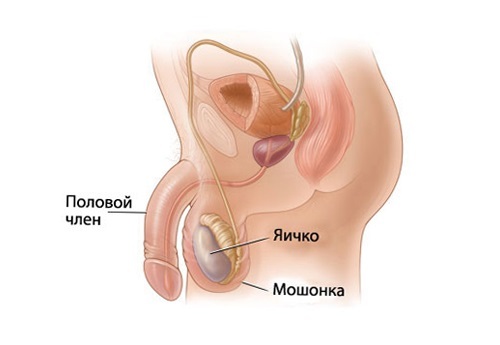
The examination pays attention to the study of the penis, testicles, appendages, prostate.
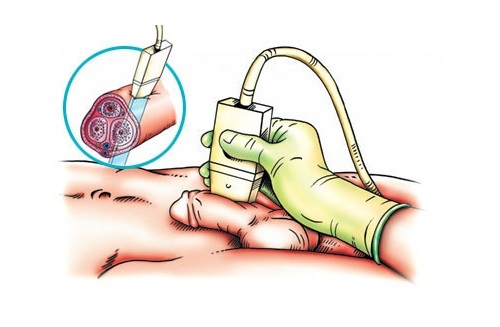
Additional methods of the study use ultrasound( kidney, bladder, prostate, scrotum organs), uroflowmetry, which allows to determine the nature of urination and its indices. In doubtful cases, cystoscopy with subsequent biopsy, multislice cystourethrography can be used.
Cystitis treatment for men
- General recommendations. In acute period of cystitis, it is necessary to observe bed rest, copious fluid intake( up to 2-2.5 liters of water per day), exclusion from the diet of acute, salty foods, some drinks( tea, coffee, carbonated drinks), alcohol, temporary exclusionSexual activity( 5-7 days).
- Antimicrobial therapy. Antibiotic therapy is the leading in the treatment of cystitis. Selection of drugs is carried out by a doctor on the basis of laboratory tests obtained, taking into account the sensitivity of infectious agents to antibiotics. More commonly used groups of fluoroquinolones, nitrofurans, cephalosporins. Therapy with drugs lasts, as a rule, 7 days.
- Taking painkillers and antispasmodics. To eliminate the pain syndrome, NSAIDs( ibuprofen, diclofenac), antispasmodics( nosh-pa, avisan, halidor, cystenal, baralgin) can be added to the treatment.
- Phytotherapy. In addition to treatment, phytotherapy( phytolysin, kanefron, lessons, uroflux, cystone) can be used. Many medicinal plants( bearberry, sporrush, field horsetail, etc.) have anti-inflammatory, antibacterial action. Cranberry and cowberry mors are also useful. There are reports that cranberries have an antiadhesive effect( prevents viruses and bacteria from "sticking" to the tissues, which contributes to their rapid removal from the body).In addition to cranberries, antiadhesive action has apples. Therefore, it is necessary to include them in the diet.
- Bladder flushing. Sometimes they resort to washing the bladder, novocain blockades.
- Physiotherapy. Physiotherapy is widely used to facilitate the penetration of drugs to the inflammatory focus, enhancing the anti-inflammatory and analgesic effects of basic therapy. To this end, endovezical phonophoresis, sinusoidal modulated currents( CMT), supertonal currents, ultrasound, laser therapy are used.
- Treatment of concomitant diseases. When diseases are detected in other organs( prostate, testicles, kidneys), treatment of the corresponding pathology is performed.
- Sanatorium treatment. In the period of remission, sanatorium treatment can be conducted, where, in addition to favorable climatic conditions, mud baths( mud therapy) and mineral water treatment( balneotherapy) are practiced.
Complications of
Complications of cystitis are most often associated with inadequately selected therapy or its inadequate prescription.
Most common among complications of cystitis are pyelonephritis, perforation( perforation) of the bladder wall, reflux of urine into the ureter and kidneys.
Recommended for viewing: