Delivery of tests for male infertility
The diagnosis of male infertility and elucidation of the causes of its development require a series of analyzes. To answer many questions concerning the reproductive system of men, the following studies will help:
- spermogram;
- tests for sexual infections;
- microscopic examination of the prostatic secretion;
- urine analysis;
- study of blood hormones.
content
- 1 Spermogram
- 2 Assays for genital infections
- 3 Microscopic examination of prostatic secretions
- 4 Urinalysis
- 5 Research hormones
Spermogram
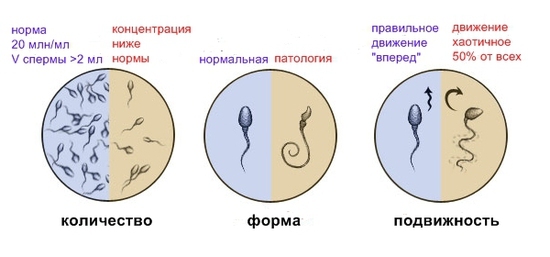
Semen is the most informative method for studying ejaculate, allowing high precision to estimate the reproductive potential of the patient. The obtained material is investigated by means of phase-contrast microscopy. This is a special staining technique, thanks to which it is possible to evaluate the morphological characteristics of spermatozoa. In normal healthy male sperm has a white-grayish color, specific smell, pH 7.2-8.0, a different turbidity and lack of mucus. Thus in 1 ml of an ejaculate it is found out from 20 up to 200 ml of spermatozoons. More than half of them should have the correct head structure and high mobility.
See "Spermogram preparation guidelines".
in favor of male infertility may indicate the following disorders:
- azoospermia - no sperm in the ejaculate;
- oligospermia - decrease in the number of spermatozoa;
- asthenospermia( astenozoospermia) - decreased motility of spermatozoa.
Analgesia for sexual infections
When diagnosing male infertility, it is important to identify sexually transmitted infections. The most common pathogens of such diseases are chlamydia, mycoplasma, ureaplasma, candida, herpes simplex viruses, cytomegalovirus, papillomavirus. The presence of these infectious agents can be determined using the following studies:
- polymerase chain reaction( PCR);
- enzyme immunoassay( ELISA);
- microbiological examination.
Microscopic examination of the prostatic secretion
A study of the secretion of the prostate gland allows one to evaluate its functional activity and determine the signs of inflammation. Fence secretion is carried out after a massage of the prostate gland. When studying the received material, special attention is paid to the number of leukocytes, the increase in the number of which may indicate the presence of inflammation. In addition, an unfavorable feature is the detection of bacteria and lecithin grains. In some cases, it is possible to cultivate a viral pathogen isolated from the prostatic secretion.
urine analysis results of urine analysis can reveal changes in the body, showing not only the fault in the reproductive system, but also the metabolic disease. So in men suffering from a violation of reproductive function, it is possible to diagnose symptoms of urinary infections, diabetes, hormonal disorders.
Research hormones
Complex examination of patients with suspected male infertility, is impossible without a blood test to determine the hormonal status of the organism. Special attention is paid to changes in the levels of such hormones as prolactin, testosterone, estradiol, LH and FSH( for more details, see here).Violation of the production of these substances can have a serious impact on the quality of sperm and the state of the reproductive system as a whole.
Qualitative examination is the first step towards the elimination of male infertility.
Recommended for viewing: