In detail about cryptorchidism: causes, types of pathology, treatment and prognosis
Cryptorchidism is a congenital pathology, as a result of which the boys do not have an egg or testicles( in the scrotum).The reason for this is the non-admission of the testicles from the retroperitoneal space. Contrary to the possible presentation, not only children suffer from the disease. If it is not corrected in early years, cryptorchidism remains in adulthood.
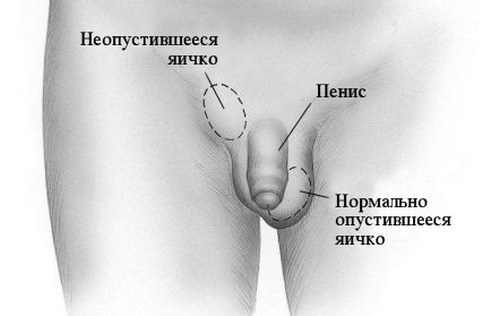
Cryptorchidism - testicular sciatica: testicles outside the scrotum, or incorrect lowering
Contents of
- 1 Some statistical data
- 2 Causes of the disease
- 3 Types of the disease
- 4 Clinical picture of the disease
- 5 Diagnostic measures
- 6 Treatment
- 7 Complications of cryptorchidism
- 8 Forecast of the disease
Some statistical data
According to the dataMedical statistics, cryptorchidism is perhaps the most common andrological congenital pathology. It accounts for about 4% of all visits to a doctor in children born in the prescribed period, and about 20-25% in preterm infants. In many cases( about ¾), we have to talk about physiological cryptorchidism, when the testicles descend into the scrotum independently, without outside help. This is due to the active development of testosterone. By the end of 12 months of life, only 0.5-1% of boys have the disease. In this case, no surgical treatment can not be dispensed with, and, the earlier it is carried out, the lower the risk of complications.
Causes of the disease
The exact causes of non-admission of the testicle are unknown. It is assumed that the following factors underlie the pathological mechanism:
- Genetic predisposition. If a father or other older relative on the ascending line has a lack of testosterone or cryptorchidism, the child remains predisposed to this disease. On average, we have to say about the probability of 35-50%.
- Mechanical factors. First of all, the narrowness of the inguinal canal, disturbances in the development of testicular ligaments, etc. Endocrine disorders in the mother. Fetal bearing requires great effort on the part of the mother's body. Any violation of the hormonal background significantly affect the health of the child. It is a question of insufficiency of the pituitary gland, adrenals, thyroid, pancreas. Endocrine disorders of the fetus. First and foremost, a local testosterone deficiency.
- Genetic mutations. In some cases, cryptorchidism can be associated with gene mutations.
- A huge role in the normal formation of testicles is played by the time at which the child is born. As already noted, almost 25-30% of preterms are diagnosed with cryptorchidism.
Cryptorchidism is a multifactorial disease caused by several reasons. Identify the initial factor can only be the results of objective research.
Types of the disease
The classification is based on the nature of the pathological process. Based on this basis, cryptorchidism can be divided into three types:
- Cryptorchidism is true. This type of disease is said if it is impossible to extract the testicle to the scrotum by mechanical action. Can be one-sided and two-sided. In the second case, the disease is often combined with disruption of the hypothalamus, pituitary, hypogonadism( lack of sex hormones).The true form of the disease occurs in about 30% of cases.
- False cryptorchidism. It occurs much more often in boys( about 50% of all clinical cases) and almost always in men( in 95% of cases).It is considered a variant of the physiological norm. This condition is also called testicular migration. With a migrating testicle, the testicle retracts into the abdominal cavity and leaves back into the scrotum without outside help. The main cause of the condition is the small diameter of the testicle with a large diameter of the inguinal ring. Life-threatening and reproductive health does not represent a migrating testicle. Ectopia of the testis. Even more rare condition. It should distinguish between true and false cryptorchidism. For ectopy is characteristic of the exit of the testicle not in the scrotum, but in the perineum( usually).This is a serious disease that requires urgent correction. Most patients with ectopia of the testicle remain infertile even after surgical treatment. The localization of the testicle in this case can be different: inguinal, perineal, femoral, penis, and so on. The main cause of development is a mechanical obstruction to the testicles.

The position of the testicles with cryptorchidism and ectopia of the testicle
Clinical picture of the disease
The clinical picture includes a number of symptoms:
- The absence of one or both testicles. Determined by physical examination. This symptom, as they say, is obvious. The scrotum thus appears asymmetric, flattened.
- Pain syndrome in the scrotal area. Pains drawing, aching, irradiate( give) to the groin, penis, lower abdomen. If the testicle is located in the abdominal cavity, the discomfort manifests later, during puberty and increases at the time of physical exertion, sexual arousal, etc.
- Infertility. It is a characteristic symptom and, at the same time, a complication of pathology. Characterized by a decrease in the fertilizing capacity and motility of spermatozoa.
- Discomfort sensations in the scrotum, including pressure, feeling of foreign object, etc.
Often cryptorchidism is asymptomatic, not including violations from the reproductive system and visual manifestations.
Diagnostic measures
Diagnosis is not difficult. The main thing that you need to do to the patient is to contact a urologist or urologist-andrologist. Diagnosis is based on a number of instrumental, laboratory studies, as well as functional tests.
Initial consultation begins with a patient's interview for complaints. Then palpation of the scrotum organs is performed. This is the most informative way to reveal pathological changes on the part of the testicles. If physical examination for some reason is impossible, resort to instrumental methods of examination:
-

ultrasound of the scrotum and ultrasound of the abdominal cavity in the diagnosis of cryptorhit
ultrasound of the scrotum. It is performed to determine the presence or absence of testicles in the scrotum.
- ultrasound of the abdominal cavity.
- Radiography of the abdominal cavity.
- Contrast MRI or CT scan. It is used to determine the degree and nature of the process. It is considered the most informative visual research.
If there is a suspicion of hermaphroditism, tests for testosterone concentration, genetic tests are additionally prescribed.
Treatment of
False cryptorchidism does not require correction.
With the true form of the disease, treatment is exceptionally prompt( with rare exceptions).Therapy is performed after the child reaches the age of nine months, expectant management allows the body to cope with the problem on its own. During this period, the introduction of hormonal drugs to accelerate the process. According to statistics, the effectiveness of such therapy is high( about 60% of clinical cases have been managed by conservative methods).However, hormones are not a panacea.
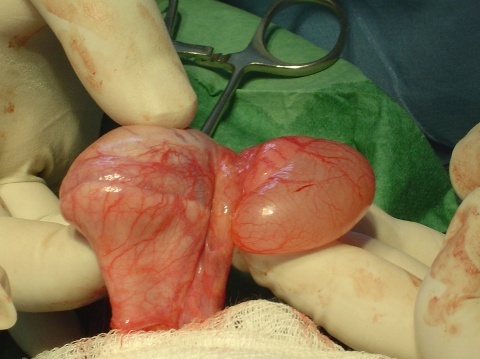
By two years, with unsuccessful conservative treatment, surgery has been shown. There are two types of surgery: open and laparoscopic. Laparoscopic intervention is performed by inserting instruments into the abdominal cavity through the navel. This is a minimally invasive method of treatment.
Read more: Surgery for the descent of the testicle
An open operation is required if the location of the testicle is already known. In this case, a small incision is made in the groin area( about 2 cm), through it a search for the testicle and its excretion into the scrotum is carried out. With atrophy of the testicle, an orchiectomy is performed( their removal).This operation does not represent particular complications. The whole procedure lasts about 30-90 minutes. At this time the patient is under general anesthesia and does not feel anything.
Postoperative period is standard, with wound treatment and subsequent removal of sutures.
Complications of cryptorchidism

Testicular cancer is one of the most frequent complications of cryptorchidism
. The described disease, if not treated in time, is fraught with the development of adverse effects. Among the most common complications:
- absolute infertility, caused by atrophy of testicles and violation of the hematotestick barrier;
- testicular cancer( seminoma);
- inflammatory diseases testicular;
- torsion of spermatic cord;
- necrosis of the affected egg.
The probability of developing complications increases exponentially if it is an adult patient with true cryptorchidism.
Forecast of the disease
With early treatment, it is most favorable. Thus, in the unilateral form of the disease, infertility occurs in a quarter of cases. If the cryptorchidism is bilateral, the prognosis is much worse. The number of infertiles is 70-80%.
Cryptorchidism is a complex disease, threatening its complications. If there is a desire to maintain reproductive health, it is necessary to begin treatment as early as possible. So the forecast is most favorable. The disease best suits therapy in childhood. So do not waste time.
Recommended for viewing: