How to measure intracranial pressure?
Contents:
- Reasons for changing intracranial pressure
- Measurement methods and preparations
- Procedure for measuring intracranial pressure
- Symptomatics and treatment
 In the modern world of electronics and technology, sometimes unresolved problems of human health arise. Headaches that occur for various reasons are symptomatic number one. One of the factors of manifestation of headaches, may be a change in intracranial pressure. If there is constant pressure in the head, it is recommended to consult a specialist, since intracranial pressure is measured only in a hospital.
Frequent recurrences of increased intracranial pressure( intracranial hypertension) that are allowed to run may lead to complicated pathologies of the brain and spinal cord. Decrease or increase in ICP in adults and children is characterized by certain symptoms, so the examination and treatment of babies is conducted only by a pediatrician.
Causes of change in intracranial pressure
An increase in the volume of cerebrospinal fluid( spinal fluid) or its decrease affects the state of the brain tissue, human health in general. The brain and spinal cord are washed with cerebrospinal fluid, which ensures the normal functioning of the nervous system and protects against minor injuries and infection. The full cycle of cerebrospinal fluid( CSF) renewal is a week.
How to check intracranial pressure, where this procedure is carried out and in what cases it is prescribed, informs the attending physician. The following factors can serve as the causes of pressure changes:
- the state of stress of the walls of the vessels of the brain;
- volume of circulating blood in the brain;
- dysfunction of the production of cerebrospinal fluid and its permeability to the bloodstream;
- viscosity( density) of the cerebrospinal fluid;
- work and condition of colloidal substances affecting the consistency of cerebrospinal fluid;
- trauma of the brain, spinal cord;
- a change in the volume of the cerebral ventricles in which the cerebrospinal fluid circulates;
- brain tumors;
- meningitis of different etiology;
- stroke;
- epilepsy.
Where to measure intracranial pressure - in a private medical center or in a public medical institution, the patient himself decides.
Measuring Methods and Preparatory Measures
Before you can measure intracranial pressure, you need to undergo certain examinations. These include:
- ultrasound examination, which shows the function and condition of the cerebral ventricles;
- magnetic resonance imaging for detecting hidden pathologies of the brain, determining the state of the circulatory mesh of the brain;
- echo encephalography;
- a control examination of the oculist, for the indirect diagnosis of an increase in ICP, in which vision is impaired due to changes in the fundus.
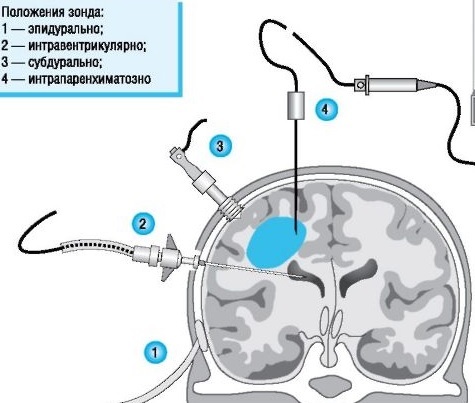 The often asked question of patients, how to learn intracranial pressure at home, has only a negative answer. This procedure should be performed by a doctor only in a hospital and with the availability of specialized equipment. Usually the procedure is performed in a specialized neuroreanimation department. There are following ways of measuring intracranial pressure:
- epidural;
- subdural;
- measurement using an intraventicular catheter;
- transcranial doppler.
Procedure for measuring intracranial pressure
How is intracranial pressure measured? The following manipulations are carried out:
- hygiene procedures;
- , depending on the method of measurement, shaving of hair;
- field treatment for puncture;
- introduction of a special catheter into the lateral ventricle of the brain;
- product of the measurement of ICP.
Depending on the severity of the patient's condition, a spinal puncture is prescribed in some cases before the measurement of CSF pressure.
Symptoms and Treatment of
Symptoms of changes in ICP with an increase and decrease are different. The increase in CSF pressure is characterized by severe headaches, noise in the ears, swelling of the face, weakness, pain in the neck, lack of normal sleep, meteorological dependence.
Reduced ICP is manifested by syncope and previous conditions, nausea, vomiting, pain in the heart area, increased pain in the head with vertical patient, restless sleep.
Important! The norm of intracranial pressure is 2-12 mm Hg. Art. In adults and 1-2 mm of Hg. Art. In children.
Before measuring intracranial pressure, the doctor conducts a survey, establishes the causes of the onset of symptoms. If you suspect a serious pathology that leads to a change in ICP, this procedure is assigned.
The main therapy is symptomatic, aimed at reducing the acute condition and normalizing the functions of the brain. In severe cases, surgical intervention is indicated, which is associated with certain risks.
In complex therapeutic therapy it is recommended to adhere to a special diet, to observe the regime of the day with uniform periods of exercise and rest. You should regularly consult a doctor and take medications that help normalize ICP.
write the question in the form below: