What are the functions of the testicles in men?
The exercise of the reproductive function is the main engine of life in any biological beings. A person has a sexual system for this function. In men, the glands are testes that perform two main functions:
- spermatogenesis - the formation of spermatozoa, ie, male sex cells;
- synthesis of steroid sex hormones( testosterone).
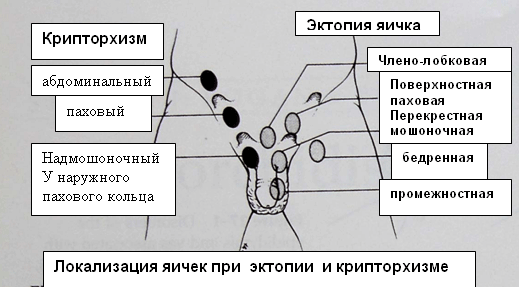
Development of testicles in the embryonic period
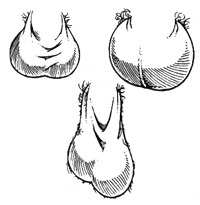
The left testicle may be located below the right - this is normal.
In the course of embryogenesis, the testicles are laid in the fifth week from the oblong genital elevation, in the region of the volphic body. In the middle of 3 months of embryonic development, connective tissue begins to grow in the testicles, which gives them a rounded shape and forms its mesentery. At the beginning of the 7th month, the testicles descend in the abdominal cavity into the area of the internal opening of the inguinal canal and on the 8th month they fall directly into the inguinal canal. By birth, the testicles descend through the inguinal canal and enter the cavity of the scrotum.
Structure of the testicles
Location. Both testicles are located in the cavity of the scrotum, and in most cases, the gland on the left side is located slightly lower than on the right. This is a physiological state and is associated with the peculiarities of the functioning of the venous system.
Size. Before the puberty period in boys, the testicles do not exceed 2.5x1.5 cm, and the weight is about 7-8 grams. When a boy reaches the age of 12-14 years, the testicles grow actively, and their size increases to 4.5x3.5 cm, weight is 25-30 g.
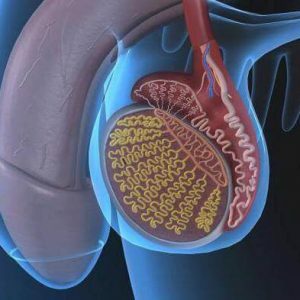
Structure. The testicles are covered with a dense white membrane, from which the connective tissue membranes or partitions leave. They divide the glandular tissue of the testicle into a lobate system. In each testicle it is possible to distinguish from 100 to 200 lobules formed by parenchymal and stromal tissues. In each lobule there are up to three seminiferous tubules, the length of each of which varies from 65 to 80 cm. The total length of all tubules can reach more than 500 meters.
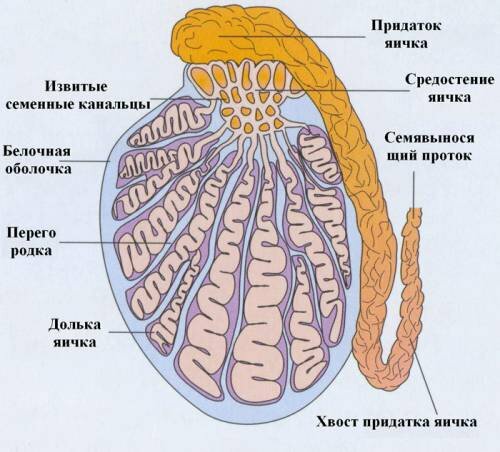
Fig.1 - Structure of the testis.
Immediately glandular testis tissue consists of Sertolly cells - glandular cells that participate in spermatogenesis and the formation of seminiferous tubules. Between the cells Sertolli there are additional cells - spermatogonia, which are the primary germ cells and are spermatozoa at different stages of histological maturation. Between the tubules, in which the ripening of spermatozoa occurs, interstitial cells of Leydig are located. These cells are involved in the production of a steroid sex hormone - testosterone.
Adherence of the testicle is anatomical formation, which is the initial part of the vas deferens. The appendages consist of a head, body, and tail, which adhere closely to the posterior lower edge of the testicle. The tail of the appendage smoothly passes into the spermatic cord. The vas deferens in its proximal part somewhat widens and passes into the ejaculatory part. The vas deferens from both testicles come together and represent 2 channels of a total length of 2 cm. The vesicle is passed through the prostatic tissue and ends with a narrow slit-like opening in the region of the tubercle of the prostatic part of the urethral canal.
The testicle and its appendage are covered with a special membrane called the vaginal sheath of the testicle and is formed by the parietal peritoneum. Male genitalia are located intraperitoneally - this means that they are covered with the peritoneum from all sides and the peritoneum forms a peculiar serous cavity around the testicle. In the testicle region, the peritoneum passes from the parietal to the visceral, which is densely attached to its walls.
Physiology and function of male testes
Physiology. Male testes reach their maturity by the age of 15-18, which largely depends on the hormonal background of the adolescent, as well as other factors such as:
- social and living conditions;
- power;
- presence of chronic diseases;
- heredity;
- and others.
For realization of high-grade spermatogenesis for male gonads, it is necessary to observe certain temperature conditions( see "What can lead to overheating of the testicles").Thus, the most active process of formation and maturation of spermatozoa occurs at a temperature of 32 ° C.; It is for this that male testicles are located outside the abdominal cavity, and the scrotum is a kind of thermoregulator. The function of thermoregulation is due to several mechanisms:
- Specific structure of the scrotum, which is a muscular-dermal sac. At low ambient temperatures, the scrotum is contracted and the temperature rises within it. Conversely, at a high ambient temperature, the muscular component of the scrotum relaxes, which allows it to lower the temperature inside its cavity.
- The peculiarity of the structure of the vascular network, with the venous plexus of the testicles literally entangling its tissues, which contributes to effective thermoregulation.
Functions. Male genital glands perform two main functions: external and internal secretion. Spermatogenesis and the formation of spermatozoa belong to the exocrine function, and the production of testosterone to the intrasecretory function. The intrasecretory function of the testes is controlled by the neurohumoral system in the pituitary gland. The most active influence on the synthesis of steroid hormones in the male sex glands is exerted by the gonadotropic hormone of the hypothalamic-pituitary system called luteinizing hormone( LH).It is formed and secreted in the anterior lobe of the pituitary gland.
Leydig cells produced several androgenic sex hormones, the main of which is the 17-ketosteroid. There are two fractions of this hormone: alpha and beta. The alpha fraction is produced in the testicles, and the beta fraction is produced by the adrenal cortex. Assuming that the hormonal balance is observed in the body, both fractions are produced in a ratio of 10: 1.An increase in the beta-fraction may indicate the presence of an oncological process in the adrenal glands.
Recommended for viewing: