Transurethral resection of prostate adenoma( TUR) - preparation for surgery, consequences
If you have been diagnosed with prostatic hyperplasia( Figure 1), and you are talking about the need for surgery, you should be aware that in medicine, for prostate disease therapy, there is transurethral resection of the prostate( TUR).
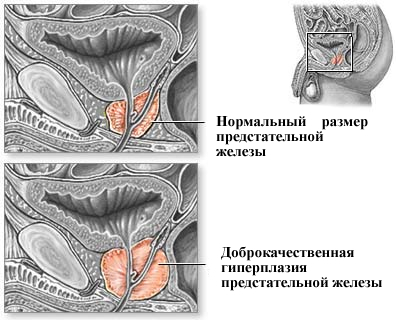
Fig.1 - Prostate adenoma as an indication for TUR.
This type of surgical treatment uses a laser beam to vaporize or remove the hypoplastic prostate tissue. The laser operation lasts, on average, about an hour. To access the prostate tissues, instead of cutting the abdominal wall, natural openings, in particular the urethra, are used.
TUR is an alternative to open interventions on the prostate gland.
Contents
- 1 Indications for
- TOURS 1.1 When will the operation help?
- 1.2 Who can be operated on?
- 2 Types prostate surgery
- 2.1 Public method
- 2.2 Laparoscopic surgery
- 2.3 Transurethral resection
- 3 Preparation for surgery
- 4 recovery period
- 5 Consequences operation
- 5.1 Early postoperative complications
- 5.2 late postoperative complications
Indications for TOUR
WhenWill the operation help?
Common indications for resection are:
- Impairment of the quality of life due to permanent dysuric disorders in the background of prostatic disease. Despite ongoing medical therapy, complaints remain about the weakening of the urine stream, the feeling of incomplete emptying of the bladder, the nighttime urination from 3 to 6 times a night, the urge to urinate a short time after urination.
- Chronic and acute urinary retention. If acute urinary retention inevitably leads to the provision of urgent medical care, then to determine the chronic retention of urine it is necessary to perform ultrasound, according to the results of which the volume of residual urine reaches up to 600-700 ml.
Who can be operated on?
Since this type of treatment for prostatic adenoma is considered to be a gentle method of intervention, the therapy method is suitable both for patients with large prostate volume without concomitant diseases, and for patients having:
- cardiovascular pathology;
- respiratory system diseases;
- endocrinological diseases;
- concomitant diseases of the genitourinary system;
- operative interventions on the urinary bladder, intestines, prostate gland in the anamnesis;
- desire to maintain erectile function;
- combination of prostatic hyperplasia with recurrent inflammation;
- suspicion of oncological pathology in the prostate.
Types of operations on the prostate
In urology, there are three types of surgery for the treatment of prostate diseases.
Open method
In this type of intervention, the incision is performed in the suprapubic region, and the hyperplastic prostate gland is transvezikalno, ie through the bladder.
Surgery is associated with a large number of complications, requires a long time and has a significant risk for the patient. With open surgery, blood loss is an impressive amount, which further promotes the development of anemia in the patient and leads to an extension of the rehabilitation period. Considering the considerable area of alteration( damage) of tissues and the risk of postoperative bleeding when the bladder wall is stretched due to urine filling, an irrigation system is used to wash out clots, which requires the installation of a urethral catheter and a functioning epicystostome.
Hospitalization takes about 4-5 weeks.
Long-term complications of the open prostatectomy method include:
- severe erectile dysfunction( potency violation);
- urinary incontinence due to damage to the sphincter of the bladder;
- no sperm in the ejaculate;
- stricture urethra( narrowing in the canal against the background of adhesive processes);
- inflammatory diseases of the male sexual sphere( orchitis, orchoepidymitis, epididymitis, cystitis);
- edema of the egg;
- hernia.
In the presence of severe extragenital diseases in the patient, this type of surgical manual is contraindicated, and epicystostomy is performed as a palliative method of urinary diversion in acute urination retention - removal of the elastic tube from the bladder through the surgical opening.
The advantages of the operation include:
- the ability to visualize regional lymph nodes and take material for histological examination, which is important for suspected prostate cancer to determine the stage of the process and further tactics of management.
- radical solution of the problem: with open prostatectomy, the recurrence of development in the future of hyperplasia( proliferation of gland tissues) was minimal.
Laparoscopic surgery
Laparoscopic surgery allows the removal of the hyperplastic prostate through small incisions under visual control.
With this operating aid, a biopsy from regional lymph nodes can be possible if there is a suspicion of a tumor process, but, as with open access prostatectomy, erectile dysfunction and throwing of semen into the bladder( retrograde ejaculation) is a complication of the operation. The percentage of other complications with laparoscopic interventions on the prostate gland is less.
Transurethral resection
To perform a resection( excision) in the bladder through the urethra, a special surgical instrument is applied-a resectoscope and using the loop, the areas of proliferation of the prostate tissue are excised using the destructive effect of the laser beam( see Figure 2).The operation is performed under spinal anesthesia, which is considered to be a sparing type of anesthesia for the patient.
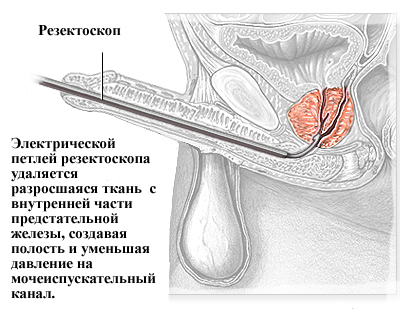
Fig.2 - Transurethral resection of the prostate.
Control over the occurring manipulations occurs with the help of high-precision optics. To provide visualization through the channels of a resectoscope, the flow and outflow of liquid is carried out, which significantly reduces the traumatization of tissues.
Surgical interventions on the prostate gland, depending on the laser used, are divided into:
- Laser ablation( vaporization), in which the laser burns( evaporates) enlarged prostate tissue;
- Laser enucleation, in which the laser beam replaces the surgeon's scalpel.
The result of the operation is the same: the removal of the tissues of the hypertrophied gland( see Figure 3), which allows to establish an act of urination.
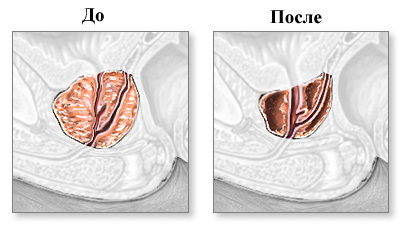
Fig.3 - Result of the operation.
Vaporization is suitable as an operational aid for a small volume of the prostate, and for a large volume it is preferable to perform enucleation.
After the operation is completed, the Foley catheter is placed in the bladder through the urethra to create conditions for adequate urine outflow. Unlike other methods of operation, the duration of the catheter in the bladder does not exceed 2-4 days.
The installation of the drainage pipe performs the following functions:
- irrigation( prevents the formation of blood clots and obstruction of the urethra);
- provides an "empty" bladder condition, which helps to prevent bleeding.
Preparation for surgery
necessary undergo clinical and urological examination for admission to the hospital:
- laboratory diagnostics( KLA, OAM, blood chemistry, blood for syphilis, viral hepatitis B and C, HIV infection, blood for prostate specific antigen( PSA), calOn n / r).
- instrumental diagnostics include ultrasound kidney, bladder, prostate, with control of residual urine, uroflowmetry( measurement of urinary flow rate), ECG, PL-graphy.
- consultation of the therapist and other specialists if there are concomitant diseases.
Sometimes, as additional methods of examination, administered survey and excretory urography to clarify the functional ability of the kidneys and diseases of the genitourinary system, and MRI of the pelvic organs.
Recovery period
The recovery period usually proceeds smoothly and without complications. Stay in the hospital takes 10-12 days.
Self-urination is restored on days 2-4 in almost 100% of cases after removal of the Foley catheter.
In the future, the patient goes under the supervision of an outpatient urologist and is on a home antibacterial anti-inflammatory therapy.
Consequences of operation
Undesirable consequences after TUR are quite rare. But considering that laser resection is an operative intervention, the following complications can occur.
Early postoperative complications
- Postoperative bleeding. Assign a blood-restoring means, if inefficiency is performed, endoscopic diathermocoagulation;
- Syndrome of water intoxication of the body. During operation, it is possible to get a lot of water into the bloodstream, it is extremely rare.
Late postoperative complications
- Sperm injection into the bladder;
- Urinary incontinence. A number of patients held in 2-3 months against a background of drug therapy( Vesicare, Vezomni, Urotol, Driptan, Spazmeks) and special exercises;
- Structures of the urethra. Complication occurs in one of 10 patients, the condition is corrected with the help of bougie, and in the absence of effect - the urethra plastic is performed;
- Chronic inflammatory diseases of the male sexual sphere. When adequate therapy with antibacterial drugs( Tavanic, Floracid, Suprax) is sufficiently well treatable.
Urological doctor Mishina V. V.
Recommended for viewing: