Symptoms and treatment of bladder cancer in men
Bladder cancer is a common neoplasm that has a malignant course. The tumor process proceeds swiftly, and in the absence of adequate treatment, a fatal outcome results. Only by interacting with a specialist, a man can count on competent treatment: attempts to normalize the state of health are fraught with tragic consequences.
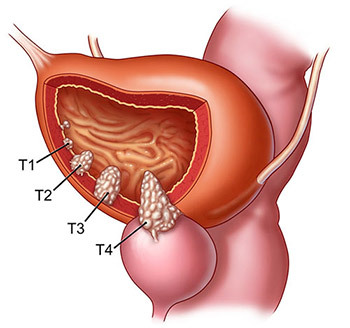
Stages of bladder cancer.
Contents
- 1 Causes of
- 2 Symptoms of
- 3 Diagnosis of
- 4 Treatment of
- 5 Prognosis for bladder cancer
Causes of
The causes of bladder cancer have not been fully established to date. However, oncologists identify a number of predisposing factors. Their effect increases the risk of tumor formation in the organ of the urinary system. The main factors are:
- Smoking.
- Chlorinated water consumption.
- Postponed remote radiation therapy for another disease.
- Abuse of fried meat;Products containing fats of animal origin.
- Inflammation of the bladder of the chronic course and the associated stagnation of urine( the latter may not be due to cystitis, but even as a separate phenomenon, it also acts as a predisposing factor).
- Hereditary predisposition to the development of a malignant tumor.
Symptoms of
As the pathology progresses, the patient will note problems from the urinary and digestive tract.
-

With cancer damage, blood appears in the urine and ejaculate.
An impurity of blood appears in the urine and semen( see hematuria): a sign indicates a violation of the integrity of the blood vessels lying in the tissue of the urinary tract organ and seminal vesicles. This sign attracts attention in the first place.
- Violation of urination. Increasing in size, the bladder is squeezed between the pubic bone and rectum, actually clamped between them, which provokes its irritation. There are strong, painful urges, mainly at night. The phenomenon is accompanied by a burning sensation inside the urethra( see Pain, burning sensation when urinating).The patient urinates up to three times a night, about 15 times in the afternoon. The jet is intermittent, at the end of the act of urination - it does not pour, but is interrupted: only drops fall out from the urethra. This is due to the incomplete blocking of the urethral canal by the tumor. There are also episodes of urinary incontinence.
- Pain. It is localized in the suprapubic region, groin, lumbosacral spine.
- Lower extremities, the base of the penis, the organ and the perineum are swelling - this is caused by the penetration of metastases into the inguinal lymph nodes.
- Difficulties with defecation indicate that the oncological process has swept the rectum. More often it leads to constipation.
- The bones of the spine and pelvis hurt, but an unpleasant sensation worries at later stages of tumor development, which indicates the localization of metastases in them.
- If the tumor, developing and progressing, damaged the fibers of the nerves lying near the genitals, the man suffers from problems with potency.
- When metastases affect the liver parenchyma, jaundice of the sclera and skin develops, if complications of the oncological process cover the lungs - respiratory failure, coughing, choking.
- Because of the constant bleeding of varying degrees of intensity( urine can be colored from a light pink to a rich red color), the patient develops anemia. Determine the lack of iron in the blood can be due to the pallor of the skin and mucous membranes, by lethargy, the presence of dizziness in the patient. This condition is confirmed in the laboratory way( the man hands blood from the finger).
Symptoms can build up gradually, for several years. A wide range of symptoms misleads the patient, motivating them to consult a therapist or pulmonologist.
Diagnostics of
The primary task of the doctor, who was contacted with complaints of bladder dysfunction( pain, urinary retention), is confirmation of the tumor process and the establishment of the stage of cancer. To do this, use informative diagnostic methods:
-

ultrasound of the bladder can detect the presence of a tumor.
ultrasound of the bladder. An easy way to detect an oncological tumor.
- Blood test for oncologic markers. The purpose of laboratory research is the detection of special antigens.
- Biopsy. For research, a small piece of bladder tissue is taken from the patient, sent to a laboratory for examination. Viewing and studying under a microscope will allow to define character of a tumor - malignant she or a good-quality.
- Cystoscopy. Instrumental type of research. The cavity of the bladder, the condition of the tissues of this organ, the specialist examines with the help of a special device - a cystoscope. In this way it is possible to establish exactly the fact of the presence of the tumor, its localization, size.
In case if a malignant tumor process is confirmed by a biopsy, is performed by the computed tomography to determine the size and location of the tumor, possible metastasis.
Treatment of
If a urologist becomes aware that a patient has a cancerous tumor, the specialist's goal is to determine the presence of metastases in neighboring organs. Also, diagnostic methods help plan a further therapeutic approach.
-

The optimal treatment for bladder cancer is surgery.
Surgical intervention. Optimal treatment is only surgical excision of cancer. The essence of the operation is the removal of the tumor and surrounding tissues, and in some cases - even lymph nodes. The surgeon performs all the actions through the incision made in the suprapubic region. The duration of surgery is more than 2 hours. After surgery, the patient is advised to undergo a course of immunotherapy or chemotherapy to reduce the likelihood of a tumor recurrence.
- Chemotherapy is a medicamental measure: a combination of chemicals with a directed toxic property is administered to a patient. Preparations destroy the shell and nuclei of cancer cells, thereby destroying the tumor. Such treatment lasts more than six months. To resort to it is actual and in the III and IV stages of the tumor process: in this case, the method of treatment is an alternative to surgical intervention. Side effects of chemotherapy - total alopecia, dyspeptic disorders, weakness.
- Specific treatment. Drugs that have an anticarcinogenic property are injected into the patient's bladder through the catheterization of this organ.
Prognosis for bladder cancer
The prognosis depends on the stage of the neoplasm at the time of its detection. If the patient has addressed at the initial stage of formation of the tumor process, the specialist will be able to offer several treatment options. Each of them will help to maintain masculinity, the functional capacity of the bladder and avoid multiple complications of the disease. If the bladder cancer is in the second and more stages of development, the range of possibilities for therapy is somewhat narrowed.
See also: The urologist-andrologist - what heals for men?
Recommended for viewing: