Plastic crowns on the front and chewing teeth: reviews and photos
Restoration of teeth is and will be a popular and necessary service for all segments of the population, regardless of affluence.Unfortunately, few allow themselves a durable ideal ceramic crown, but there is no desire to walk with a toothless smile either.Orthopedists took care of the wishes of the majority and created comfortable, aesthetic and affordable plastic crowns on the front and chewing teeth, the reviews about which are positive.We will consider their advantages and disadvantages, features of manufacturing and care.
The essence of plastic prosthesis
Plastic crowns were created one of the first and represented a temporary measure before permanent prosthetics with ceramics.That is, the question of which teeth is better to insert plastic or ceramic, you can give the only true answer - ceramics.

Temporary plastic crowns
When are these crowns used?First, they are placed on the supporting teeth immediately after their turning to prevent the destruction and damage of thinned enamel before the installation of permanent products.Secondly, immediately after installing the tripod, when implanted from the top, plastic models are first placed, while the selected design is made.All this allows the patient to enjoy a functional dental row and an aesthetic smile for the period of orthopedic treatment, which can take up to six months.
Why do temporary plastic models are installed:
- restores the function of important teeth( incisors, chewing molars, canines);
- returns the aesthetics of the oral cavity, which is especially important for working and secular people;
- protects prepared( turned) teeth before the installation of permanent structures from pathogenic microflora, injuries, chewing load, temperature fluctuations, etc.;
- is prevented from overgrowing the formed gingival hole under the implant;
- prevents changes in the position of supporting teeth in the cavity in the absence of elements between them;
- retains distinct language and familiar diction.
Types of plastic constructions
All products from this material differ by some features:
- manufacturing method( pressed, molded);
- type of attachment( removable, non-removable);
- period of use( temporary, permanent).

Complete removable acrylic denture
Molding models require a high-tech approach and fit the jaws extremely tightly and accurately.The technology completely reproduces the individual structure of the oral cavity, soft tissues and mucous, after which the prosthesis maximizes real teeth.
Pressed products are made faster and easier, but, accordingly, the quality suffers.This model should only be used for temporary recovery before installing permanent crowns.
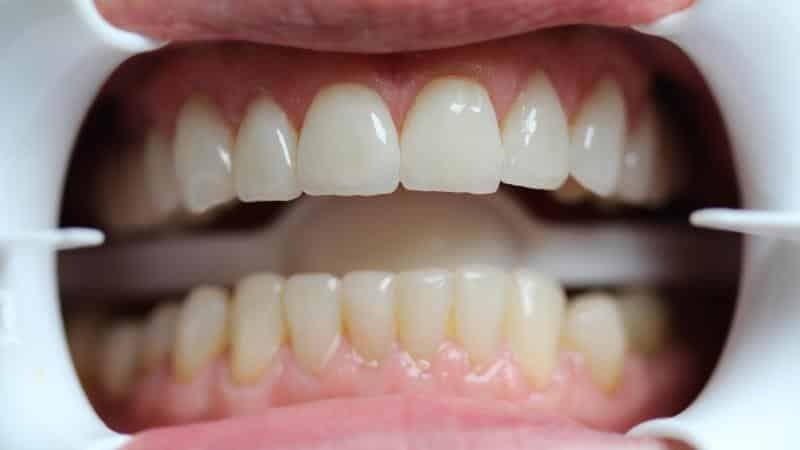
Consider plastic teeth on the teeth( photo above) depending on the type of fixation.
Removable products are manufactured much more often.In the absence of all the elements of the row, the gum supports the gum base, and the vacuum support acts as the fixing system.If there are supporting teeth on both sides, then the product is attached with hooks, locks or clasps made of metal, which are in the basis.They are fixed on the adjacent teeth and become almost invisible to the interlocutor.
Also such prostheses can be fixed with the help of invisible attachments.If there are no 1-2 teeth, the "butterfly2" prosthesis is often used.
Positive and negative properties of plastic
Plastic crowns on the front and other teeth( photo below) have a number of advantages, for which gained their popularity among the people.
- There are several simple techniques for making models, so you can quickly restore the aesthetics of the oral cavity.
- Pleasant price - the smallest in the market of prosthetics.

An important advantage of plastic is the pleasant price
- The temporary crown at a budget price allows the patient to get used to the design and the prosthesis itself, and in case of side effects or rejection of the product, replace it with implants with the least loss of funds and time.
- Plastic is a biological and ecological material, therefore it rarely causes rejection of the body and allergic reactions.
- Sufficient reliability, strength and functionality during the manufacturer's declared service life.
- Performs aesthetic wishes - the prosthesis is almost invisible to the interlocutor, since the artificial enamel completely imitates the natural.
- The load during biting and chewing is evenly distributed.
- Care for the prosthesis is not burdensome either in time or in finance.
- Crowns protect the sharpened supporting teeth before permanent prosthetics.
If you understand what kind of crowns are better from ceramics or plastic, then the first unequivocally win. And all this because they lack the drawbacks of plastic, which are many.
- Limited service life.Manufacturers promise reliable and faithful service of the product for up to 1 year, but, as a rule, they are installed for a shorter period.Up to 5 years, plastic crowns manage to carry units.
- During this period, the plastic quickly breaks down, splits and wears off.Also, it will not withstand serious loads, injuries, damage and shock, as well as increased chewing load( cracking solid objects, etc.).
- Plastic models are not suitable for prosthetics in professional athletes and people with extreme working conditions.
- Plastics are much more toxic and allergenic than ceramics.

Plastic is much more toxic and allergen
- Unfortunately, the porous plastic surface tends to absorb food pigments and dyes.Over time, the white enamel on the crowns dims and turns yellow, becomes stained, bacterial and a dark stone.You can clean the model only in a dental clinic with special equipment and tools, which is quite troublesome and expensive.
- Also, the rough surface well retains food residues and aromas, which creates a favorable atmosphere for the development of pathogenic microflora.As a result, inflammation foci, diseases, caries, dark plaque and bad breath appear.
- Dental crowns made of plastic( reviewed below) can not be considered flexible and elastic, so the design can rub and even injure the delicate oral mucosa.This reduces the comfort of wearing dentures.
Indications and contraindications
As a rule, plastic crowns are used for temporary prosthetics in the following cases:
- for the treatment of periodontitis and periodontitis;
- abnormal dimensions, shape, texture and shade of natural teeth;
- defects and pathologies of anterior teeth;
- for the protection of prepared supporting teeth before permanent prosthesis or implantation;
- installation of structures for socially unprotected layers of the population, middle class with limited financial resources;
- in case of injuries, damage and destruction of the tooth for prompt restoration of the functionality of the oral cavity;
- in the abnormal arrangement of the elements of the dentition;
- in the case of abutment of supporting teeth;
- for restoration of one, several or all teeth.

Plastic crowns are used to repair one, several or all of the teeth.
Despite the large number of indications to the procedure, there are also contraindications to the installation of plastic crowns for chewing and other teeth.
Do not use these products in the following cases:
- child's age;
- professional sports, extreme kinds of work;
- allergy to acrylic, plastic, plastic;
- presence of mental illnesses and pathologies;
- bite disorders;
- for non-observance of the rules of oral hygiene;
- inflammatory processes, fungus, virus, infection and other diseases of the mucosa and teeth;
- predisposition to bruxism.
Methods for manufacturing plastic crowns
Budget plastic products do not require special expenses for equipment, technology and materials.
Consider how a dentist makes a prosthesis.
- To begin with, the doctor pours out the mold of the tooth with a silicone composite.
- The tooth to be worn on the crown is pre-prepared( grinded and grinded until the required stump is obtained).
- The polymeric mass is then filled in the blind, after which it is placed on the supporting tooth.The mass should harden, after which the dentist can remove the impression.
- On the cult remains a plastic crown, which is long grinded, grinded and polished before the acquisition of a natural and patient-friendly form, texture.
- The prosthesis itself is fixed on the tooth with dental cement.
In the laboratory, the product produces a dental technician according to the following principle:
- removes the mold of the teeth;

Impression of the teeth
- produces gypsum dubbing of both jaws to maintain a normal bite and the most accurate fit;
- further the system is modeled with the help of wax, after which the technologist already uses a permanent option - plastic;
- after manufacture the prosthesis is polished and polished;
- when the model is ready, the dentist should try on the design of the patient and, if necessary, send it to the laboratory for revision, and then fix it with available fixing materials.
The service life of all plastic prostheses varies from 1 to 3 years, but only under the condition of regular and thorough care, compliance with prescriptions of the doctor and a planned visit to the dentistry at least once every six months.