Dental implants: complications and consequences
Modern technologies have moved far, and now everyone can count on the restoration of the dentition with the help of identical implant-real implants that serve for years without causing discomfort.Unfortunately, despite the sharpness of the technology and the comparative simplicity of the procedure, implants can, at least, not settle down, but as a maximum, cause serious consequences and complications for the body.In this article we will consider what complication after implantation of teeth on the lower and upper jaw can arise, why this occurs and how to prevent.
Why there are consequences after the procedure
Like many other dental manipulations, implantation is a mini-operation that is stressful for the body and can lead to a very different response.For example, in the presence of heart defects or hypertension, one can quite expect a small arrhythmia, pressure jumps, general depression of the condition.That is, in fact, any hidden ailment, pathology or chronic disease in the suppression of immunity can manifest with a new force - this should be prepared.
Also the cause of side effects can be a banal allergic reaction to drugs used during anesthesia and therapy, as well as components that are part of the implanted crowns( organic, metal, etc.).

Allergic reaction to drugs and to the composition of implanted crowns is one of the complications after tooth implantation
In some clinics, before the implantation of artificial teeth, X-ray examination and computed tomography are not performed.It does not make the dentist work or work quality worse.Simply during the surgical intervention, a nerve can be touched, and this becomes known only in the form of consequences.A person at the same time can feel sharp pains and spasms, complete loss of sensitivity of some soft tissues, easy swelling of the area, etc.
It also happens that the material is implanted in a bone with insufficient thickness, which leads to loosening of the implant, gaining some mobility.This result can also be obtained by mounting the material under the incorrectly chosen slope, which will cause undesirable compression in the bone.All this causes the patient strong discomfort and requires removal of the structure.
There have been cases when inexperienced or illiterate dentists installed implants in the upper jaw, without increasing the necessary volume of bone tissue.The consequence of such negligence could be the appearance of the rods of the structure in the maxillary sinus.At their ends in the end, there was an infection that causes sinusitis.
The installation of plate( basal) structures often causes complications in the jawbone, which requires a complete disassembly of the material.
Typical side effects after implantation
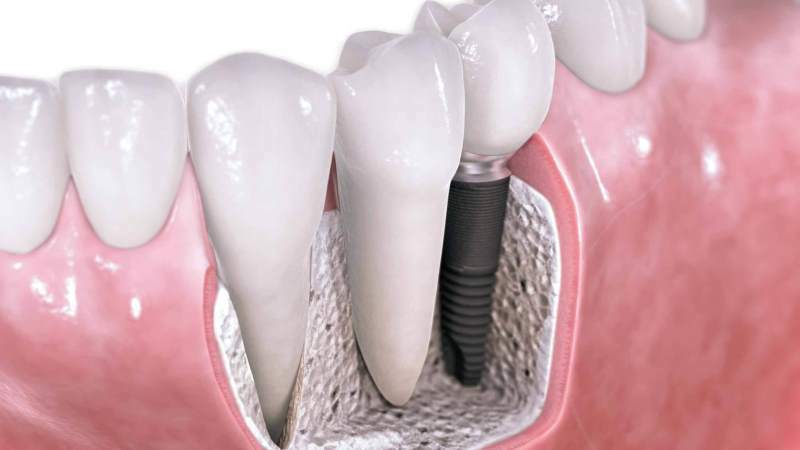
All complications after implantation of the teeth( pictured below) are accompanied by typical symptoms that we will consider :
If the pain is more than 3 days,Process in soft tissues
- Pain syndrome. Moderate soreness after the procedure is normal and manifests itself immediately after the departure of local or general anesthesia.The duration of unpleasant sensations should not exceed 3 days, during which the patient takes painkillers.Exceeding the period indicates that the inflammatory process in the soft tissues may have started, the allergy, or during the operation the nerve was touched.
- Puffiness .Swelling of the area is also considered a natural defensive reaction of the body to the introduction of a foreign object.Edema appears a couple of hours after the event and may last for a week, gradually decreasing.If you observe a strong swelling of the soft tissues for longer than the indicated period, as well as blue areas or bruises have been seen, which indicates inflammation.
- Bleeding .A small allocation of blood and syphilis within a couple of days from the operated zone is quite normal.If in addition to take aspirin and other drugs that affect coagulation, then the ailment can last up to 10 days.If the bleeding does not go away after this period, is intense, and also accompanied by hematomas, then we can safely talk about the damage to blood vessels and the need to immediately go to the clinic.
- Temperature increase. Normally the first 3-4 days after the procedure the body reacts to a foreign body with a low temperature - 37-37.5 ° С.If the temperature does not drop further, it rises above this level, and in the implantation area pus appears( redness, severe swelling, bruising, bleeding), then we can talk about inflammation.

Increased temperature after tooth implantation indicates the onset of the inflammatory process
- Loss of sensitivity. Easy numbness is permissible, as a consequence of the action of anesthesia, and should not exceed 5-6 hours.If the sensitivity to you has not returned( it concerns the lower jaw), then we can talk about damage in the process of the facial nerve.
- Divergence of seams. During the event, the dentist puts sutures from artificial threads that firmly hold the soft tissues.If, during a visual inspection of the house, you notice a break in the integrity of the threads or a discrepancy, they may have been damaged and require immediate supervision by a specialist.
Complications after implantation at different periods
First, let's look at the side effects that can occur during the engraftment process.
- Inflammation of a titanium "substitute" of the dental root, called "reimplant."
It occurs extremely rarely due to infection in soft tissue, which occurs in the case of:
- injury to the wall of the nasal sinus;
- violation of wound closure technology after implantation;
- presence of inflammatory processes located near the teeth;
- incorrectly selected crown;
- failure to maintain proper oral hygiene by the patient.
Symptoms of reimplantitis are as follows: bleeding of soft tissues, pain, swelling and redness of the area, numbness.
- Implant rejection. With an experienced doctor and a diligent patient, this pathology is extremely rare.Sometimes a titanium rod is rejected for the following reasons:
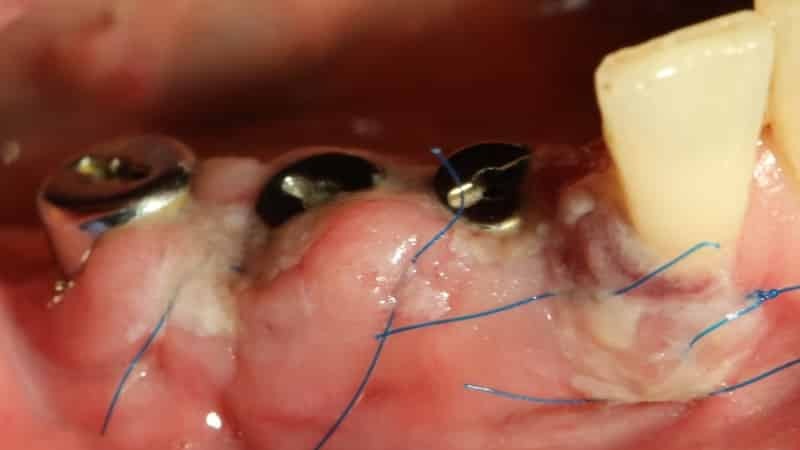
Exacerbation after prosthesis
- reimplant and other inflammatory processes;
- during the operation there was an error, the area was injured;
- deficiency of bone tissue;
- the patient smoked immediately after the procedure;
- systemic diseases have appeared, chronic ones have become aggravated;
- is an allergy to the material.
The rejection of the rod is manifested in the mobility of the structure, the discomfort and painful sensations in the area.
Now let's look at the complications caused by dental implants after the abutment is installed:
- The rod was unscrewed with a plug.It happens due to a violation of technology, side effects during the implantation period( rejection, reimplant).
- The design has passed in the axilla of the upper jaw.The reason is also a violation of technology, as well as problems with the restoration of tissue.
- Bone tissue appeared above the implant.
Rules for care of implants to avoid complications
Many consequences of implantation of teeth arise from the patient's fault( direct or indirect).
Therefore, you should familiarize yourself with the rules of competent care of the area:
- Cleaning with a toothbrush. Clean the protruding part of the structure, the lower part( the place of adherence to the gum), the interdental space, massage the gums - and all this at least 2 times a day.After sleep, cleaning is mandatory, as saliva production decreased overnight, and therefore, the antibacterial effect was not enough. The brush will fit any, but with a soft bristle( including electrical).Choose paste not abrasive and high-quality.The interdental space can be cleaned with interproximal and bundle brushes, dental floss.
- Use of rinsers and irrigators.

Use of rinsers helps remove bacterial coating from
implants. After eating and brushing your teeth, rinse your mouth with drug rinses to help remove bacterial coating from the implants.Irrigators with an impulse jet perfectly clean the interdental and other hard-to-reach areas, complementing the work of the toothbrush, improving the flow of blood to the gums.
Also periodically do a control occlusion and radiology examination, which should confirm the stability of the design.