First medical aid in case of frostbite and hypothermia
Frostbite.
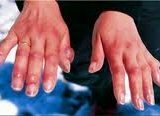
Damage to tissues that occurs as a result of exposure to the human body at low temperatures is frostbite. More often frostbite occurs in the winter with high humidity and low temperature. But even with minor frosts, you can get frostbite if there is high humidity in the street, accompanied by a strong wind. With a poor overall human condition. If your feet are wet and tight shoes. And also exhaustion, alcoholic intoxication, immobile state, blood loss increase the risk of frostbite. Such body parts as fingers and toes, nose, ears, cheeks - are most prone to frostbite.
What are the symptoms of frostbite? When frostbite, a strong feeling of cold first appears, then gradually the pain disappears, then numbness comes. Frozen areas simply lose all sensitivity. In case of severe frostbite and suspicion of hypothermia, an ambulance should be urgently called. And in one and in the other case, first aid in case of frostbite and hypothermia consists in gradual warming of the affected parts of the body.
There are four degrees of frostbite. Their degree depends on the severity and depth of the affected tissues. With frostbite of the 1st degree, the sensitivity of the affected areas is reduced or absent. The skin becomes pale and swollen. These frostbites occur with a short exposure to low temperature. When warming up there are dull pains and burning sensations, and the skin becomes crimson.
With a longer stay in the cold, a second degree frostbite occurs. At first, the blanching of the affected areas is observed, then the sensitivity disappears. With gradual warming, the skin becomes a blue-purplish shade. On the affected areas, swelling is formed, which spreads outside the frostbite zone. After the injury, bubbles are formed, which are filled with a clear liquid. There may be symptoms such as: poor appetite, chills, fever.
With frostbite of the 3rd degree, bubbles appear which are filled with a dark red liquid. There is necrosis of the skin. The wound itself does not hurt much or does not hurt at all. There is a rejection of tissues, then there is scarring. In the injured areas, scars form.
The heaviest frostbite is the 4th degree. With this frostbite, all tissues become dead to the bone. Traumatized area of blue color. After warming, a strong swelling is formed, which gradually increases. Frozen area of the body cold to the touch. Sensitivity is completely lost.
Subcooling.
The same factors as with frostbite, contribute to the overall supercooling of the body. There are three degrees of general hypothermia of the body - it is light, medium and heavy. With a mild degree of skin becomes pale, with a slightly bluish tint. Body temperature drops to 32-34 degrees. The pulse slows down, there is a chill and difficulty speaking. Can be observed with slight overcooling of frostbite of the 1st or 2nd degree.
At a general supercooling of an average degree the skin becomes pale, dark blue shade and to the touch cold. Body temperature drops to 29 - 32 degrees. The pulse slows down to 50 - 60 beats per minute. The blood pressure drops slightly, breathing becomes rare. At this degree, frostbite on the body of any degree is possible.
First aid for hypothermia is to call an ambulance. Do not allow the victim to sleep. After all, during sleep, the level of energy production decreases and can fall to a critical level - a person can die.
A characteristic sign of general hypothermia of severe degree is a decrease in body temperature below 31 degrees. There may be vomiting and convulsions. The victim is in most cases unconscious. Skin pale, blue and touch cold. Breathing becomes 3-4 in a minute, the pulse slows down considerably. Urgent need to call an ambulance. There are widespread and severe frostbite, even before glaciation.
Medical assistance for frostbite and hypothermia.
As soon as possible, in case of suspected frostbite and hypothermia, move the victim to a warm room. It is necessary to release him from soaked and cold clothes and shoes. It must be remembered that first aid in case of frostbite and hypothermia is the gradual warming up of affected areas of the body. With frostbite of limbs, rub them with a napkin soaked in alcohol, you can lower the frost-bitten areas into the water. Attention! The water should be slightly warm, gradually, within 30 minutes bring its temperature to 36 degrees. After this, you can continue to lightly grind the limbs, until the sensitivity appears. Then put a dry sterile bandage on the affected areas, give the patient a warm drink.
It is important to ensure the immobility of frost-bitten areas of the body - the blood vessels become brittle and can cause hemorrhages. To do this, a thick cardboard, bandaged up bandages. Remember that if frostbite is serious or there are suspicions of general hypothermia, urgently call an ambulance. When severe pain, give an anesthetic. Do not pierce the blisters if they have formed.
Do not grind the frozen areas of the body with snow. This can cause damage to the vessels, since they are very fragile. Raziranie snow only increases the cold and you can bring the infection through the emerging abrasions. Do not warm up the victim immediately( hot bath, warm water bottle, intense rubbing, etc.), as this will impede the restoration of blood flow and can lead to the necrosis of the skin in the affected areas. Do not lubricate sore spots with fat and ointments, as this will injure the skin and aggravate the cooling. Promotes the expansion of blood vessels drinking coffee and alcohol, which can lead to their rupture, and disruption of the cardiovascular system. Be careful when providing first aid in case of frostbite and hypothermia.