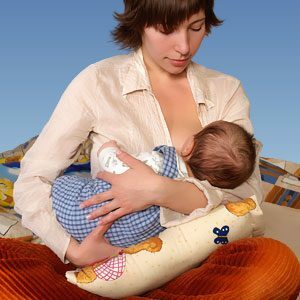
Rickets
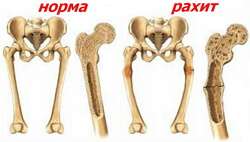 Rickets is a clinical syndrome based on the disturbance of the deposition of mineral substances in the bone matrix of the growing body. According to modern data, rickets unites a number of diseases that have similar anatomical and clinical changes. Changes occur in areas of growth of tubular bones. With the beginning of mass prophylaxis, the detailed clinical picture of rickets is rare, but the urgency of the problem is still not lost. Even mild forms of rickets are accompanied by hypoxia, a violation of immunity, a general reactivity of the organism and negatively affects physical development. Rickets is not life threatening disease. The danger can be represented by its outcomes, for example, the formation of a flat-pelvis pelvis in girls, which subsequently can complicate the course of labor and even make delivery impossible by natural means.
Causes of rickets
Children's rickets are a multifactorial disease. In its development, both internal and external causes matter. Its contribution is made both by the features of the course of pregnancy, and the way of life of the pregnant woman.
Human skin is capable of synthesizing vitamin D under the influence of sunlight. Therefore, an inadequate stay of a child in the sun, a climate unfavorable in terms of the number of sunny days, can easily provoke hypovitaminosis D. Close development of megacities, air pollution also contributes to the deficit of sun rays. Introduces its own corrections in the activity of the synthesis of skin color, the more tanned skin, the slower the synthesis of vitamin D.
The intake of vitamin D in the body occurs with food. On the level of content in food is not the most popular vitamin. Vitamin D derived from plant products( ergocalciferol) is recognized to be less active than vitamin D in products of animal origin( cholecalciferol).The greatest amount of cholecalciferol is found in codfish, milk, egg yolks, butter, liver of birds and fish. With food, calcium, phosphorus, necessary for the synthesis of bone tissue is also delivered. Therefore, nutritional deficiencies are another cause of child rickets.
Phytates, phenobarbital, glucocorticosteroids - all these groups of drugs blocking the receptors for vitamin D. Eating large amounts of grains increases the loss of vitamin D with feces, making it difficult to absorb it in the intestine because they contain phytate.
Malabsorption syndrome, which is manifested by absorption in the small intestine, can also cause rickets.
In the body cholecalciferol is absorbed in the small intestine, it is first transformed in the liver to 25-OH-D3, then in the kidneys to 1,25-( OH) 2-D3 and 24,25-D3.The second renal metabolite( 24,25-D3) is involved in the formation of bone collagen and activates the calcification of bones. All these processes occur under the action of enzymes. Any violation of enzyme activity or failure in the kidneys and liver can disrupt the chain of transformations. As a consequence - hypovitaminosis D. Diseases of the kidneys and liver - the next reason for the development of rickets.
The balance of calcium and phosphorus in the body is possible only with the normal operation of the C-cells of the thyroid gland and parathyroid glands. The thyroid hormone thyrocalcitonin inhibits the absorption of calcium in the intestine, accelerates its excretion in the urine, and inhibits the resorption of bones. The parathyroid hormone parathyroid hormone, has the opposite effect, enhances the excretion of phosphorus in the urine, deposits calcium in the bones with its excess in the blood. Violation of homeostasis in this system also leads to the development of rickets.
Create the soil for the development of rickets: pathological course of pregnancy, unbalanced feeding of the nursing mother, premature birth of the child, disease of the newborn. It is known that in the last months of pregnancy the body of an unborn baby begins to make a supply of phosphorus and calcium. That's why a pregnant woman is so important to eat right. This also explains why children born before the term simply did not have time to make a depot of these important trace elements.
Symptoms and signs of rickets
The concept of rickets is purely pediatric because rickets occur up to 3 years of age. Suffer the most intensively growing bones. Deficiency of vitamin D causes a number of changes in the work of the body. First of all, changes occur in the kidneys, the absorption of phosphorus in the tubules decreases, the excretion of phosphates in the urine increases, hypophosphatemia develops, the deposition of calcium compounds in the bone tissue is disrupted. In an effort to compensate for a lowered level of phosphorus, organic compounds of the nervous, muscle tissue begin to give off phosphorus atoms. As a result: demyelination of nerve trunks( predominance of excitation in the initial stages of rickets), a violation of energy metabolism in muscle tissue, a decrease in its tone.
The absorption of calcium from the intestine is reduced due to insufficient synthesis of the protein transporting calcium. Hence the increase in hypocalcaemia and compensatory resorption of bone tissue.
The reduced level of calcium in the blood activates the parathyroid glands, strengthening the development of parathyroid hormone, which tries to maintain the homeostasis of calcium in the body, displays calcium in the urine. As a result of all these changes, softening of the bones occurs, they become supple and incapable of holding the body weight in the correct position and resisting muscle traction, the skeleton warps.
First of all, rickets in children are manifested by behavioral changes, sleep is affected, children become restless. Hypocalcemia causes abnormalities in the musculoskeletal apparatus. Reduces the contractility of muscles, arises joint loosening, delay of static functions. External breath is broken, because intercostal muscles and diaphragm, responsible for breathing, suffer. There is shortness of breath, pulmonary ventilation, increases the likelihood of inflammatory changes, atelectasis. It is possible to expand the boundaries of the heart due to a decrease in the contractility of the myocardium. Hypotension of the intestine leads to constipation. The intensity of the processes of osteogenesis decreases, as a result of later teething.
The scales of the occipital bone, the seams, the chest, the pelvic bones are deformed, the spine and tubular bones warp, thickenings appear on the places of the transition of the cartilaginous tissue of the ribs to the bone, on the hands, so-called "bracelets", on the fingers - "strings of pearls"On the anterolateral surfaces of the thorax - "rosary"."Olympic forehead" - hyperplasia of parietal, frontal and occipital tubercles.
Rickets in babies are manifested primarily by symptoms from the nervous system: anxiety, sleep disturbances, sweating( the first sign of rickets), chin tremor during crying, the baby shivers during sleep. At the same time, the first sign of rickets is not pathognomonic for the diagnosis of rickets as a sign. Sweat irritates the skin, it begins to itch, which increases the anxiety of the baby. He restlessly rubs his head against the pillow, as a result, the hair on the back of his neck is wiped. The child is shy, constipations are observed. Red dermographism is noted. Signs of rickets in infants also include the late closure of the large fontanel, the delay in teething. Before the closure of the large fontanel, the initial rickets in infants can be suspected by softening its edges and bones along the seams.
There are several variants of rickets:
- Acute flow is observed in children who have not received preventive doses of vitamin D. The first signs of rickets are rapidly progressing. The clinical picture becomes bright, the processes of destruction of bone tissue prevail. Neurological and vegetative manifestations are well pronounced. Characteristic of this trend is for large children, who are predominantly carbohydrate-fed.
- Subacute variant of rickets current. The whole clinic is moderately pronounced. Changes in biochemical blood analysis are not sharp. Osteoid hyperplasia predominates. It occurs in children who were prevented with vitamin D and who were on natural feeding, or received milk mixtures with vitamin D.
- Recurrent flow is characterized by a change in periods of exacerbation and subsidence with preservation of residual phenomena. On radiographs with this course of rickets, several calcification bands are noted in the metaphyses of bones. Such a course of rickets is acquired under unfavorable conditions of a child's life, improper feeding and care, and non-compliance with preventive measures.
With severe bone deformities, it is possible that complications develop. The curvature of the chest can cause lung compression, which creates favorable conditions for the development of pneumonia, tuberculosis and other infectious diseases of the lungs. In addition, this is a pronounced curvature of posture. Deformation of the bones of the skull can cause mental retardation up to its severe degrees. Deformation of the pelvic bones is most significant for girls because it can provoke complicated childbirth. In children who have had rickets, fractures are more common than in other children, this is due to the altered structure of the bones. Curvature of limbs, muscle weakness slows the normal physical development of children.
Symptoms of rickets in children are often combined with increased susceptibility to viral and infectious diseases, since the functioning of the immune system is largely inhibited.
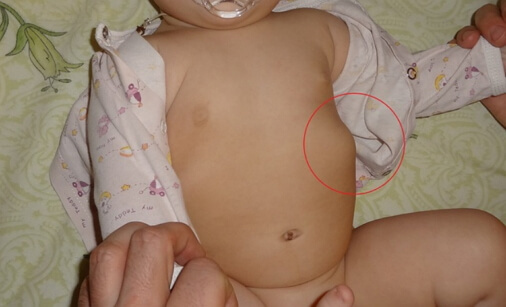
rickets: photos from infants
Degrees, stages and forms of rickets
Signs of rickets in children can be divided into several degrees of severity:
- Easy degree. The symptoms of rickets are poorly expressed and are observed mainly due to the nervous system both central and vegetative. Describe a slight degree of severity can only signs of rickets in infants. Infringements of internal organs are insignificant.
- Moderately severe rickets are already represented by bone deformities. Symptoms of mild degree become more pronounced. The thorax flattened on both sides, resulting in a keeled form of the chest. The people called "chicken breast."The lower border of the chest widens with the formation of the harrison sulcus. Begin to bend the lower extremities, deformities can be both varus and valgus character. The syndrome of osteoid hyperplasia is expressed, moderately hypertrophied parietal knolls of the skull. It is possible to detect the beginning formation of the "beads" on the fifth, sixth, seventh and eighth ribs in the places where they pass the cartilaginous part into the bone. There are small violations of the internal organs.
- Severe rickets are affected by pronounced muscular and bone changes. This is a "blooming" rickets, which is difficult not to notice. There appears a rickety hump because the static functions of the muscular apparatus are violated."Pearl strands", "rickets bracelets", craniotubes, all these changes are expressed in the brightest way. Physical development is delayed. Acidosis and related disorders of microcirculation cause a malfunction in the internal organs. Possible exophthalmos, hepato- and splenomegaly.
Rickets occur in several mutually changing stages( periods):
• Initial rickets. His manifestation falls on the fate of 2 and 3-month-old children. Preterm is the end of 1 month of life. This period lasts 4 to 6 weeks with acute course and can last up to 2 - 3 months with subacute flow. The behavior of the child changes, there are flinches with a flash of light, in a dream, with loud sounds. Plus, the child can find all the other signs of rickets in infants. Changes in biochemical blood analysis are insignificant, you can only detect a decrease in phosphorus, the level of calcium does not change.
• If the initial period has passed unnoticed for the pediatrician, the parents and the corresponding measures have not been taken, then the next period is coming - this is the peak period. This period justifies its name because all the symptoms are progressing. For an approximate determination of the age of manifestation of rickets, one can use knowledge about the periodicity of active growth of bones. The skull bones grow most intensively in the first months of the child's life. Then the bones of the chest are taken. It becomes "vulnerable" from the 6th month of life. In 10-18 months the tubular bones grow actively.
At the height of muscle hypotension becomes so pronounced that you can observe the symptom of a "folding knife", the child can be given any bizarre shape, the muscle tone will not prevent it. On the radiographic picture, osteoporosis is determined, the metaphyseal zone of the bones acquires a goblet shape, the zones of preliminary calcification are blurred. It should also be noted that clear signs of rickets on the x-ray can be determined in a child to 3 months of age.
Biochemistry of blood becomes more informative, hypophosphatemia increases, hypocalcemia manifests, alkaline phosphatase activity increases several times. The peak period can take place in two variants: in the form of a calcium penic or in the form of a phosphorpenic variant.
Phosphoropenic variant is manifested by the sluggish, apathetic behavior of sick children. The predominant symptoms are muscular hypotension, weakness of the ligamentous-articular apparatus, a divergence of the rectus anterior abdominal wall. On their background, signs of osteoid hyperplasia develop. If you perform a blood test to determine the level of parathyroid hormone and calcitonin, then an increased level of both the first and second is determined.
Calcium penic variant is often defined as spasmophilia. The most vivid manifestation of this condition is a high convulsive readiness. There is a tremor in the hands, chin during crying, regurgitation, violation of intestinal motility. Children, in contrast to the previous version of the current, restless, sweaty. White dermographism is noted. The blood has a high level of parathyroid hormone, but the level of calcitonin is lower.
• During the peak period follows the period of reparative processes. The state of children improves, vegetative and neurological disorders are eliminated. At the same time, muscle hypotension does not go away for a long time. Biochemical blood indicators gradually return to normal levels. The return of biochemical blood parameters to the norm indicates the onset of the last period, the residual phenomena. This period is characterized by the preservation of irreversible changes from the bony skeleton and the musculoskeletal system( joint loosening, hypotension).
There are a number of rachitis-like diseases from which it is necessary to differentiate exogenous classical rickets. The peculiarity of these diseases is that their manifestation occurs at an older age than with rickets and they are extremely resistant to treatment even with large doses of vitamin D:
- Phosphate-diabetes has an autosomal dominant type of inheritance, perhaps, a linkage to the X chromosome. Its development is associated with impaired absorption in the tubules of kidney phosphorus, which is excreted in the urine. Children with this disease have low growth, sturdy physique, rachitis-like bending of bones. In the blood, high alkaline phosphatase at a normal level of calcium.
- Pseudo-deficiency rickets. Inheritance by autosomal recessive type. The disease is associated with the disruption of the receptor apparatus of target cells, they become insensitive to metabolites of vitamin D. Another variant of this disease is associated with a defect of the hydroxylase of the kidneys. Clinically manifested "blooming rickets."
- Hypophosphatase. Rare disease. Characteristic of the complete or partial lack of activity of alkaline phosphatase in the tissues of the body. It is manifested by severe rickets.
- The disease of De Toni-Debreu-Fanconi. Severe tubulopathy is accompanied not only by a delay in physical development, but also by mental retardation, down to its severe degrees.
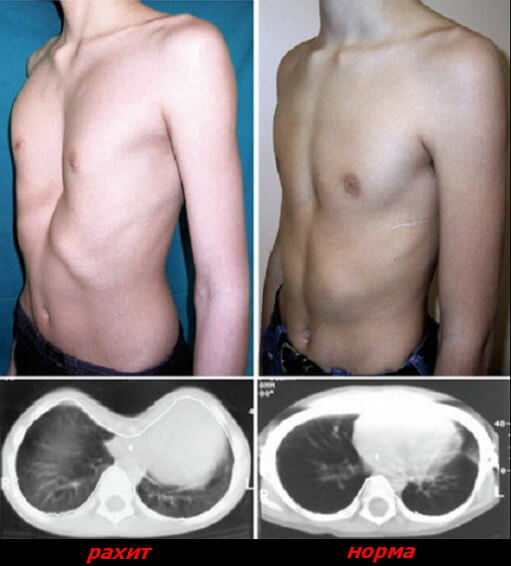
rickets: photos from children
Treatment of rickets
If a child is diagnosed with rickets, treatment is started immediately. Methods of treatment can be divided into specific and nonspecific. Specific - this treatment with the appointment adequate to the period and nature of the course of rickets dose of vitamin D, it is also possible to assign a general ultraviolet irradiation. Therapeutic doses of vitamin D are: for a mild degree - course 300000 - 400000, daily 4000 - 5000 IU;At the average - course 400000 - 500000, daily 5000 - 10000 ME;At heavy - course 600000 - 800000, daily 10000 - 15000 IU.
It is proved that water-soluble forms of vitamin D are most fully absorbed in the intestines and are better absorbed by the body than oil solutions, which were still widely used for the treatment of rickets.
The main drug for rickets is "Aquadetrim", in one drop of its solution contains 500 IU.Begin taking the drug with a dose of 2000 IU, if the first 3-5 days there are no side effects, then the dose should be increased to the required therapeutic. After 2-3 weeks, if the result is good, the total duration of treatment will be 30-45 days. As soon as this stage is finished, the use of a prophylactic dose of vitamin D. begins.
During the treatment, once every seven to ten days, a Sulkovich trial is performed to avoid an overdose of vitamin D.
Children with severe rickets after the end of the main course of treatment, after 3 months, carry out an anti-relapseTherapy, except for the summer months. After 2 weeks after the start of the drug therapy, LFK, massage is additionally prescribed. They stimulate metabolic processes in bone tissue and muscles, improve the mood and well-being of the child.
It is also recommended to arrange coniferous baths for restless children, salt baths, on the contrary, for sluggish children. Coniferous baths do this: 1 liter of water is put 1 teaspoon of pine extract. The water temperature should be 37 degrees. The first bath lasts 10 - 15 minutes, then the bath time can be increased. Salty baths are prepared in a similar way: for 10 liters of water, 2 tablespoons of salt, cooked or sea. After bathing the child is poured with clean water. Broths of herbs can also be added to the bath while bathing.
Ultraviolet irradiation. Begin the treatment with the definition of individual tolerance( biodozy) baby ultraviolet. The procedures are carried out every other day, increasing the irradiation time. The course of such therapy lasts from 15 to 25 days. At the height of the period, with the presence of signs of spasmophilia( rachitogenic tetany) and in acute course, ultraviolet therapy is contraindicated.
Because it is not always rickets that can be caused only by a lack of vitamin D, you should pay no less attention to the concomitant methods of treatment than the specific.
The citrate mixture is prescribed to enhance calcium absorption, improve ossification processes, reduce the effects of acidosis. The composition of the mixture includes citric acid 35 g, water 250 ml, lemon-acid sodium 25 g. The mixture is prepared in a pharmacy.
Assign also B vitamins, ascorbic acid to eliminate acidosis, 15% solution of dimephosphon, potassium orotate which promotes the synthesis of calcium-bound protein, the excretion of proteins.
If there is a decrease in calcium, the children are required to prescribe calcium preparations( calcium gluconate, calcium lactate, calcium glycerophosphate) at the age of dosage. The course of admission is 3 weeks. At home, as a source of calcium, you can treat the egg shell, cooked in a certain way. Take it should be 1 / 3- 1/4 teaspoon, along with lemon juice in dilution with water 1: 4 or a solution of citrate mixture, the course of taking 10-14 days.
Its correction of rickets also contributes to the nutrition of the child. Breastfeeds before the usual terms are introduced products containing vitamin D and calcium, i.e. egg yolk and cottage cheese. When artificial feeding is recommended to increase the amount of vegetable puree and reduce the consumption of porridge and yogurt, before the usual introduce complementary foods.
If the signs of rickets in children are pronounced, have a progressive course and poorly respond to the recommended treatment with vitamin D, you should think about other forms of rickets( rachitis-like diseases).
Prophylactic vaccinations are made according to the national vaccination schedule in one and a half months.
Prevention of rickets
The fetus has a huge need for calcium, which goes to build the skeleton. With the course of pregnancy, the need does not decrease at all, calcium storage starts at the end of pregnancy. Calcium transport occurs actively through the placenta from the mother to the fetus. How much calcium in the mother's blood, the same amount of calcium and in the fetal blood.
Antenatal prophylaxis of rickets is that a pregnant woman should first of all eat fully, lead an active lifestyle, walk more. It is undesirable to prescribe a pregnant vitamin D, because if it does not comply with the dosing, it has a teratogenic effect. Although pregnant women with extragenital pathology and recommend an additional intake of vitamin D from 28-32 weeks of gestation and a duration of 8 weeks. In recent months, the reception of Decamewith is shown.
After the birth of a child, it should be taken out as soon as possible to the street in the daytime. In summer, air baths are welcomed in the shade of trees. Preferably, natural feeding with the timely introduction of lures. It is believed that the child receiving mother's milk, many times less likely to develop rickets, especially if the mother takes vitamin complexes for breastfeeding women.
Specific prevention of rickets begins at the age of four to five weeks and consists of taking an aqueous solution of vitamin D. Earlier used in Soviet times, fish oil, has lost its relevance. The preventive dose of vitamin D solution is 500 IU per day. This dose completely covers the needs of the child and is recommended in all countries of the world. The drug should be taken in the morning.
If a newborn has a risk of premature closure of the fontanel, then the intake of vitamin D begins at 3 months of age, unless there are other recommendations of the child neurologist.
After a year, the preventive dose of vitamin D increases and is 1000 IU per day. Admission of the vitamin is carried out year-round, except for the summer months. Although in the adverse climatic zones in terms of the number of sunny days, the drug intake continues in the summer months. At 2 years, the drug usually ends.
For specific prevention of rickets with vitamin D, an oily solution( Ergocalciferol) can also be used. But it should be remembered that it is much worse absorbed by the body.
Contraindications for the intake of vitamin D are: intracranial birth injury, small size of a large fontanel, hypoxia. Admission of vitamin D is possible only after consultation of a child neurologist. Absolute contraindication to the intake of vitamin D preparations is its individual intolerance, hypophosphatase, idiopathic calciuria, organic damage to the nervous system, microcephaly. Prevention is also not carried out for children who are breastfed with adapted milk formulas, since vitamin D is already present in their composition in the required amount.
Preventing rickets in premature babies is carried out depending on the degree of prematurity. At 2-3 degrees the dose of vitamin D will be 1000 - 2000 IU for the entire first year of life and 500 IU for the entire second year of life. With 1 degree of prematurity, 400-500 IU starting from 10-14 days of the child's life during the first two years, except for the summer months.
Clinical examination is carried out after severe and moderate rickets. It lasts 3 years.