Signs and symptoms of liver disease: details
Traditionally, in the scientific literature, the liver is considered as an ordinary and rather multifunctional organ. Among about 500 of its functions, there is also the production of hormones that it secretes into the blood, which is the basis for classifying this organ as an endocrine gland. The variety of functions of any organ always presupposes a variety of types of violations of these functions. Therefore, there is a fairly significant list of pathologies for the liver.

Liver structure
Important! In men, with liver lesions, the development of the feminization process is possible, which may be accompanied by the development of mammary glands in the male half of humanity susceptible to the disease.
Content
- 1 Symptoms of liver pathologies
- 2 Painful symptoms of the liver
-
3 Characteristics of the skin in hepatic pathologies
- 3.1 Liver damage and skin rashes
- 3.2 Liver pathologies and itching of the skin
- 4 Video - Signs and symptoms of liver disease
Symptoms of liver pathologies
Among the symptoms that are most common in hepatic pathologies, the following can be listed:
- experiencing frequent nausea;
- heartburn is not uncommon;

Nausea and heartburn
- sweat discharge has a strong unpleasant odor;
- the color of the skin is yellowish;
- the color of urine is dark yellow;
- loose stools are observed;

Indigestion
- abnormal color of feces, up to green;
- acne in people who have already matured;

Acne and skin rashes
- high frequency of hunger or intense thirst that is often observed;
- a number of thin surfaces of skin areas may itch;
- vision may deteriorate;
- sleeplessness at night, accompanied by fever and increased heartbeat;

Insomnia and anxiety
- it happens that there is a loss of eyebrows and hair;
- the appearance of seizures;

Muscle cramps
- the formation of papillomas;
- atherosclerosis of the leg vessels can begin to develop, and it can also occur with the vessels of the brain, intestines and heart muscle.
Typical symptoms are usually characteristic of each specific hepatic pathology. But there are cases that are difficult to diagnose even by venerable hepatologists (doctors specializing in liver diseases). Diagnostic nuances are usually due to a specific type of lesion, the individual characteristics of each individual organism. Also in this case, an important factor is the presence or absence of associated diseases.
In the clinic, liver disease can manifest itself with the following symptoms:
- unpleasant sensations and pain symptoms in the liver area;
- an increase in the linear dimensions of the diseased organ;
- feeling tired, as well as general malaise;

Malaise, tiredness
- disorder of mental and mental functions;
- may have a headache;
- increased sweating and swelling;

Swelling in liver diseases
- rashes on the skin;
- yellowish color of the sclera, as well as the skin;

Pay attention to yellow eyes and skin
- intense itching of the skin;

Itchy skin
- an increase in the fragility of blood vessels, as well as the appearance of a tendency to bleeding;
- signs of a lack of vitamins for the body;
- periodic disturbance of the stool, the color and characteristics of feces may change;
- an increase in the waist in girth;

The waist increases in volume regardless of the diet
- more intense manifestation of veins on the skin of the abdomen;
- a decline in body weight for no obvious reason;

Weight loss in liver disease
- bitterness in the mouth;

Bitterness in the mouth
- the appearance of cracks on the lingual surface, as well as the manifestation of a white or brown plaque on this organ;
- increasing the temperature to varying degrees depending on the specific case.
Painful symptoms of the liver
Pain symptoms in conditions of hepatic pathology can be of a different nature. Here is a table that will give some idea of the interpretation of each of its types.
| The presence and nature of pain | Interpreting pain symptoms |
|---|---|
 Weak pains of a aching character on the right under the ribs, accompanied by a feeling of fullness, as well as heaviness. |
They appear when the process of hepatic pathology is sluggish, and it has a toxic cause. Also, inflammation or other factors can act as a cause. The alleged underlying reason for these pain symptoms is an enlargement of the organ, as well as the fact that the hepatic capsule is overstretched. The patient is unable to identify any one point that would be the source of pain. |
 Severe pain is felt under the ribs on the right. |
This symptomatology is rare and is observed with developed inflammatory processes. Also, these processes can be traumatic or purulent in nature. Another of the accompanying phenomena associated with this type of pain is the presence of stones in the bile ducts. |
 Intense local pinpoint pain in the liver area. |
The majority of cases are caused by damage to the gallbladder, as well as the bile ducts located outside the liver. |
 There is no painful symptomatology in the liver area. |
It can often be observed with liver lesions that are sluggish in nature. These pathologies are invisible for a long period of time and are detected when the process has reached the development of cirrhosis of the liver or its insufficient function. |
Characteristics of the skin in hepatic pathologies
Skin condition is a marker for the mass of different organs. The liver is not an exception here.
Hepatic pathologies can be accompanied by the following types of skin symptoms.
- The skin has a dark or pale appearance. There are also signs of sweating and swelling of the dermis (the so-called subcutaneous tissue). The latter is more typical for the skin of the limbs, as well as the face.

Swelling may occur on the face and limbs
- The skin can be dry and easily flaky and have a lot of scratching marks. Cracks can also be observed on the cover.

The skin is dry, flaky
- The skin is prone to allergies, psoriasis, atopic dermatitis, and eczema.

Psoriasis
- The skin may be jaundiced. This type of skin abnormality in different cases has different characteristics in accordance with its nature. Liver damage is usually associated with mild jaundice. The skin tone is orange. When jaundice is diagnosed differentially, this parameter is used to exclude other types of jaundice, such as mechanical and hemolytic. In the former, the skin color is brownish, and the latter are associated with the addition of lemon yellow to the shade.
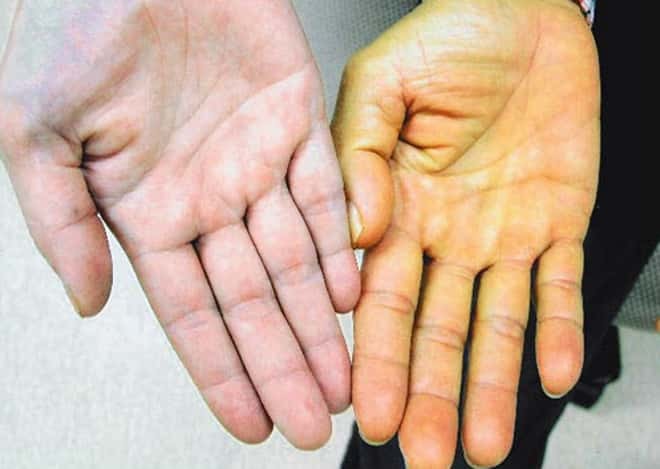
Yellowness of the skin
- Striae can be observed on the skin. These formations are stretch marks on the skin, mostly formed on the abdomen and are cyanotic streaks caused by thinning of the skin. The formation of striae is based on an overabundance of steroid hormones, both in women and men, when the liver can no longer cope with the excess of these hormones, not having time for all of them recycle.

Striae are strip-like scars, they can be of different lengths and widths.
On a note! One of the types of changes in skin color, in addition to yellowness in liver diseases, may be the appearance of its brownishness in the groin and / or armpits.
Liver damage and skin rashes
The bulk of liver diseases, in addition to the described changes in skin characteristics, are accompanied by the formation of various types of rashes. Different types of rashes have different mechanisms of their formation. Read more about them in the table.
| Type of rash associated with hepatic pathology | The mechanism of development of the disorder and its manifestation in patients |
|---|---|
 Pustular structures. There is a tendency to the formation of follicles and boils. |
The disorder is associated with insufficient immunity function, etiologically explained by the lack of hepatic immunoglobulin synthesizing function. |
 Allergic rash. They can be presented as papules or spots. |
Associated with a disorder of hepatic function, implying detoxification of metabolites. This state of affairs carries in itself the potential of the body to develop allergies even to ordinary environmental conditions. |
 Hemorrhagic rash. Represents a minor effusion of blood on all skin surfaces. These hemorrhages are called petechial rashes. |
It is explained by the lack of synthetic liver function and for the most part this is manifested in the underdevelopment of the components of the coagulation of such tissue as blood. There is a high tendency to hematoma formation from the smallest physical effects on the skin. |
Liver pathologies and itching of the skin
A skin rash observed in hepatic pathologies is always associated with itching, which has varying intensity depending on the nature of the skin changes.

The rash is usually itchy
So, its greatest degree is usually observed when the rash is associated with signs of jaundice. This situation is due to the following: bilirubin, which the liver could not process, begins to accumulate in the skin, and this leads to its irritation. Also, the microcirculatory network of the skin accumulates other metabolic products that have a toxic effect. Such a case also entails irritation of the skin and itching. Often in patients with liver lesions, manifested by skin ailments, doctors can observe traces formed as a result of scratching. This phenomenon of itching usually reaches the greatest severity on the surface of the abdomen from the sides, as well as on the forearms.