Genital herpes
 Genital herpes in developed countries is common. As the statistics showed, about 100 people per 100 thousand people are ill. The causative agent of the disease is the herpes simplex virus. It is transmitted during close contact with a sick person, that is, during intercourse, anal and oral sex. Genital herpes causes a simple virus of the second type. Mainly observed in people aged 20 to 30 years. Most often, genital herpes occurs in women. The likelihood of developing genital herpes increases significantly if a person has a large number of partners throughout life.
Causes of infection
 Infection with the herpes virus occurs:
- during sexual intercourse;
- with kisses;
- during childbirth( at the time of delivery, an infected mother gives her newborn baby a virus);
- Another variant of herpes infection occurs during direct contact through different subjects with discharge of the patient.
Infection with herpes can be in the presence of symptoms of the disease, and in their absence, because the herpes virus in half of sick people can be inactive for a lifetime. The aggravation occurs mainly on the background of other diseases, with overcooling, overfatigue, during heat and unfavorable factors in the environment.
Herpes simplex is a very common disease. Its causative agent is the herpes virus. During the course of the disease, the skin and mucous membranes of the genital organs are affected, both in men and in women. In its pure form, this disease does not belong to the venereal, although it is transmitted sexually.
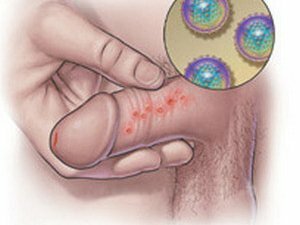
The main symptom of genital herpes genitalia in men are blistering painful rashes on the skin, as well as mucous membranes of the genital organs.
At first the disease affects the skin of the genital organs, then the virus moves through the nerve cells and is stored in a hidden form in the cells of the sacral nerve nodes. The virus is secreted on the surface of the skin, in saliva, in the secretions of the sweat glands and in the asymptomatic course of the disease.
Symptoms of the disease
After 3-7 days after contact with an infected person, symptoms of the disease may appear. There is inflammation of the skin and in the future are formed bubbles, which burst and formed sores. Within a few days the sore heals, and the formed crust disappears without leaving a scar. On the mucosa, the vesicles are not crusted, they are tightened with a grayish-yellow film. In men, signs of lesions appear on the penis and the inner surface of the prepuce. The rash is mainly localized on the head of the penis. Bubbles appear on the affected areas. The defeat of the skin is accompanied by soreness and itching. During the course of the disease in men, the rash can spread to neighboring organs: the urinary canal, the bladder, the testes and the prostate. As a result, prostatitis or urethritis may occur. The main symptoms of the spread of the disease are difficulty during urination.
Despite the fact that the diagnosis and treatment of herpes are very difficult, it is still possible to cure this ailment. Modern methods of treatment are aimed at blocking the recurrence of the disease. It is important to diagnose the disease on time. Today, there are several methods for diagnosing herpes: DNA diagnostics, that is, the virus itself( it can be isolated from foci of skin lesions, mucous membranes, in the urinary canal, in saliva, both during primary infection and during asymptomatic course), serological studies(In the serum, antibodies to the herpes virus are detected).Antibodies appear in the blood serum approximately 4-7 days after infection. During the detection of herpes, the increment of IgM antibodies is important. If antibodies are detected, this does not mean that the person is sick with genital herpes, because many already have antibodies in the blood. A higher increase in antibodies is observed not to genital herpes, but to normal, affecting the oral cavity.
Treatment of
disease For the treatment of genital herpes, antiviral drugs and immunity-stimulating agents are used.
Herpes of the urino-genital organs in men is treated with antiviral drugs. These include Acyclovir, Valaciclovir, Famciclovir and Foscarnet. Antiviral drugs are usually produced in various forms, that is, they can be tablets, creams, ointments, suspensions or solutions for intravenous administration. The effectiveness of treatment for herpes of genito urinary organs in men is about 70%.It all depends on what stage of the disease the patient has come to be treated. Naturally, in the initial stages, treatment helps to get rid of the virus to a greater extent.
The drug Acyclovir is most often used to treat genital herpes. It should be applied five times a day for 800 mg for 7-10 days.
Famvir or Famciclovir is also an excellent treatment for herpes. When using this drug, side effects occur less often: allergic reactions, headache, diarrhea. It is taken for 250 mg for 7 days. Famvir prevents the spread of the virus in genital herpes.
Excellent results showed drugs that are inducers of interferon. These drugs are Poludan, Flocazide, Amixin, Arbidol, etc.
Local treatment of affected areas of the skin is performed by Half-Blood. Before use, 200 μg of the drug should be dissolved in 5 ml of distilled water. The solution is administered subcutaneously. The duration of treatment with this drug for genital herpes should be at least 7-10 days.
Recently, other sexual infections have joined the infection of the genital herpes, for example, candidiasis, ureaplasmosis, mycoplasmosis and many others. In this case, treatment will be carried out in a complex manner.