Double vision (diplopia): causes and treatment, what to do at home
Many patients, coming to an ophthalmologist, indicate that when looking into the distance they see double in their eyes.
Often, the condition indicates a binocular vision disease and differs in that a person does not see the whole picture with two eyes at the same time.
One object appears in front of a person as two identical ones. The condition causes a lot of discomfort and indicates a disease of the organ of vision or nervous pathologies.
Patients suffering from double eyes find it difficult to navigate in the terrain, they often incorrectly determine the distance. With duality, dizziness, nausea, and eyes quickly get tired. Let's figure out why double vision, what it can be, its causes and treatment later in the article.
With good vision, everything that surrounds a person is projected onto the same areas of the retina of two eyes. In the brain, two objects are processed and combined into one, so a whole object appears before a person without distortion. If the image of objects falls on different areas of the inner shell of the eye, a person begins to bifurcate in the eyes when looking into the distance.
Light rays penetrate into different areas of the retina due to natural complications or disturbances in the innervation of the motor eye muscles. This provokes a change in the normal location of the eyeball and diplopia (double vision) occurs.
The resulting split is often provoked by incorrect refraction of the rays by the optical medium of the organ. This occurs with various problems and pathologies of the lens and cornea of the eye.
Content
- Diplopia (description of the disease)
- Causes of diplopia
- Types of diplopia
- Diplopia treatment
- Exercises for diplopia
- Folk remedies for the treatment of diplopia
- Drug treatment for diplopia
- What can you do if you see double to quickly pass
- What other diseases can you see double in your eyes?
- Conclusion
Diplopia (description of the disease)
Diplopia (double vision) - the disease is expressed in the duality of objects in front of the eyes. This happens due to the deviation of the visual axis of one organ. Problems arise due to the fact that the picture is projected instead of the main fovea onto another part of the retina.
Causes of diplopia
Diplopia (bifurcation of visible objects) has a wide range of ophthalmic, infectious, autoimmune, neurological and neoplastic causes.
- injury to the third, fourth, or sixth cranial nerves that control eye movement;
- malignant brain tumor;
- multiple sclerosis;
- in case of poisoning with botulinum toxin (botulism);
- Guillain-Barré syndrome;
- abscess;
- Graves' disease;
- heterophoria;
- orbital myositis;
- myasthenia gravis;
- anisometropia;
- strabismus;
- tick-borne borreliosis;
- keratoconus;
- salicylic acid poisoning;
- taking antibiotics of the fluoroquinolone group, neuroleptics, sedatives, streptomycin, glucocorticoids, salicylates, amphetamine, opiates;
- stroke in the brain stem.
Types of diplopia
Depending on the reasons, time of manifestation, development, there are some types of the disease.
The bifurcation is divided into binocular and monocular. The first type is characterized by a double picture when examining an object with two eyes and disappears when one of them is closed. With a monocular variety bifurcation is formed in one eye, and does not disappear when the second is closed.
Volitional diplopia is also considered. It is peculiar to her that a person calls her on his own. He can place an object in front of him and look into the distance, as if through it.
Read also:Myopia
Diplopia is divided into permanent and non-permanent. The latter type is formed due to injuries suffered, poisoning, intoxication, drinking excessive amounts of alcohol, taking a number of medications. Its main distinguishing feature from the permanent type is that the symptom gradually disappears.
Based on the underlying causes, binocular duality can be:
- strabogenic appears in people with different types of strabismus;
- neuroparalytic occurs due to damage to the nerve endings that innervate the motor muscles of the eyes;
- restrictive occurs due to eye damage, in which the apple is displaced or muscle entrapment;
- oculogenic formed as a result of surgical intervention in the treatment of retinal detachment, cataracts, strabismus.
Monocular disorder is less common. The bifurcation of the object occurs even when a person looks with one eye. Its essence boils down to the fact that the projection of objects falls immediately on 2 non-identical areas of the retina. The causes of monocular double vision are:
- subluxation cataract eyes;
- iridodialysis - separation of the iris from the ciliated body due to organ production;
- polycoria, which is a congenital disease characterized by the structure of the iris with several holes.
The main types of monocular vision disorder are:
- neurogenic;
- retinal;
- aberrational;
- papillary;
- refractive.
Diplopia treatment
Pathologies of a different nature involve the treatment of the primary ailment. Diplopia is dealt with by a neurosurgeon or neuropathologist. If it appears after an injury, you will need the help of an ophthalmologist.
The specialist will determine the feasibility of the operation.
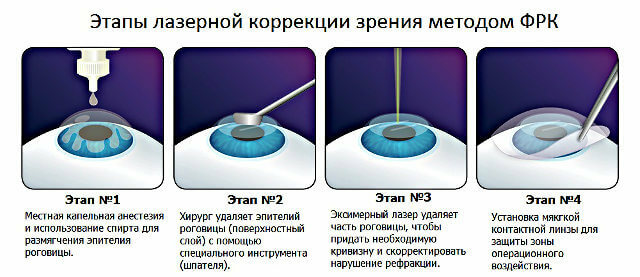
Operational methods are allowed only in case of injuries, after which diplopia has developed. During the operation, the muscle of the eye is trimmed or pushed back to compensate for the functioning of the other muscle.
If double vision occurs with diplopia, also use optical correction. To improve vision, wear prismatic glasses up to 6 diopters. in each eye.
Exercises for diplopia
The most effective method of therapy, if there is double vision, is considered set of exercises. It can be done at home.
Draw a line on a piece of paper and attach the image to the wall. A person must keep his gaze on this paper, while turning his head in different directions. Focusing your attention a person develops motor muscles and learns to focus on a specific object.
Gymnastics must be done every day, 2-6 times at different hours. It is effective in all stages of the disease and is suitable for prophylaxis to improve visual acuity. The initial distance from the picture to the patient should be 50 cm, gradually increase it.
There are exercises developed by T.P. Kashchenko. They involve training with prisms and consist of three stages:
- excitement of double vision;
- the formation of bifixation - a reflex capable of combining 2 pictures into one;
- consolidation of the achieved result.
For each stage, its own tasks have been developed, which should be carried out in the hospital under the supervision of a specialist. Kashchenko created a method for fusion images using binocular images.
It is based on the combination of sequential objects containing identical details and belonging to both eyes.
Also, to eliminate visual impairment, sometimes they resort to surgical intervention. Operative treatment is prescribed when other therapeutic methods have not brought a positive effect. What operations can be performed:
- recession of the eye muscle - in the process of intervention it is moved back, the crossed fascia is attached to the sclera;
- muscle resection - shortening its length to compensate for the functioning of the affected muscle.
Read also:Conjunctivitis
There is also charging bates. It consists of two sessions - for the eye muscles and the cervical region. The complex is carried out 30 minutes before eating and after a long time at the computer.
This exercise includes a palming exercise. The bottom line is to bring your palms up to your eyes to create "dark warmth." Before completing the task, the patient should relax, remove glasses. Then you need to blink. The exercise is performed in a sitting position.
It is necessary to move only with the eyes, the head remains motionless. It is important to avoid undue stress. Each task is repeated more than 5 times, gradually increasing to 20. There is a half-minute break between the task.
The person blinks his eyes and at the same time:
- slowly looks up and down, keeping attention on a point in the lower and upper plane for 2 seconds;
- repeats actions, but to the left and right;
- the gaze moves diagonally, right-down and left-up, focusing it for 2 seconds at the extreme points;
- repeats previous actions, looking up-right and left-down;
- gently rolls his eyes clockwise;
- then counterclockwise;
- imagines a square, begins to draw his eyes along its sides clockwise, then counterclockwise;
- accommodation training - the patient stretches his arms forward, lifts his thumb up, looking at it, slowly brings it closer to the eye and touches the nose;
- squeezes her eyes shut for a couple of seconds and opens her eyes.
Folk remedies for the treatment of diplopia
As a supplement, folk remedies can be used. They are based on the use of natural ingredients. Such treatment will reinforce the primary therapy prescribed by the doctor. Recipes:
- Valerian infusion. How to cook: combine 50 gr. dried leaves and 30 gr. valerian root. Pour one liter of white wine. Let it brew for 3 days, sometimes shaking. Then they filter and consume 1 tbsp. l. 30 minutes before eating.
- Pollen. At the pharmacy, they buy a flower product and drink 1 small spoon 2 times a day. The course is 1 month.
- Natural vitamins. Mix the fruits of rose hips and viburnum in equal proportions. 1 tbsp. l. pour in water and cook for 10 minutes. The resulting broth is drunk 100 grams before meals twice a day.
- Eyebright. Take 50 gr. herbs, pour 500 gr. boiling water. Insist 5 hours, then filter and take 100 ml 3 times a day.
- Blueberry. 40 g of leaves are poured with a glass of boiling water, filtered and half a glass is drunk twice a day.
- Calendula decoction. 20 g of flowers are poured into 0.5 l of hot water and brewed for 2 hours. Then it is filtered and taken all day.
Read also:Glaucoma symptoms and treatment
Drug treatment for diplopia
There is no specific drug for the treatment of diplopia, since double vision occurs due to some particular condition or disease, for this needs to be clarified through diagnostic measures, what is at the head of diplopia and, starting from this, prescribe drugs for treatment.
To normalize blood pressure indicators, take the appropriate pills, with a deterioration in cerebral circulation - nootropics. They will improve the nutrition of the brain.
Steroids are prescribed for hormonal problems. They can also carry out plasmapheresis - to remove blood plasma while preserving its cells. This is done for problems associated with the breakdown of the main protein of the nerve sheaths.
Antibiotic treatment is prescribed for infectious processes occurring in the brain. With botulism, an anti-botulinum serum is administered. If a patient has myasthenia gravis, then he is prescribed drugs that improve neuromuscular conduction.
What can you do if you see double to quickly pass
At home, with diplopia, you can use eye drops (betaxolol and diclofenac) before going to a medical institution. Betaxolol lowers intracranial pressure. Diclofenac will relieve pain and puffiness in the eyes, due to this, vision will normalize.
Sometimes double vision is temporary. In case of alcohol intoxication or a strong hangover, the help of a specialist may not be required, it is enough to wait until the level of alcohol in the body decreases. However, if double vision does not go away for a long time, it is necessary to seek help from specialists.
What other diseases can you see double in your eyes?

Binocular duality appears due to neurological problems, pathologies of the motor muscles of the eye, injuries, tumors, inflammatory processes, metabolic, vascular disorders.
Common causes of double vision are:
- epileptic seizures, migraine, sudden increase in intracranial pressure, traumatic brain injury, stroke;
- ARVI, diphtheria, tetanus, infectious diseases that adversely affect the state of the nervous or muscular system.
- ocular myositis, bilateral paralysis of the muscles of the eyes against a background of neurological abnormalities, myasthenia gravis, congenital anomaly, in which there is no facial expression, diffuse toxic goiter, other diseases that damage motor muscles;
- tumors of a malignant and benign type, purulent inflammation of the orbit, hematoma, fracture of the walls of the orbit;
- diabetes, spinal palsy, multiple sclerosis, other pathologies leading to a violation of the innervation of the muscles that move the eyeball;
- damage to the optic nerve, bulging of the internal carotid artery, tumors that compress the optic nerve;
- inflammatory processes in the brain - meningitis, encephalitis;
Monocular bifurcation can occur due to:
- irregular shape, abnormal structure, corneal scars;
- optic nerve injury;
- refractive errors;
- cataracts;
- retinal dystrophy.
Conclusion
In case of unpleasant symptoms of bifurcation, it is recommended to visit an ophthalmologist, he will tell you what to do. Diplopia occurs for various reasons, the main thing is to establish the initial ailment, the causes of the violation and start treatment in a timely manner.