Rubella in a child: symptoms and treatment, photo prevention
Rubella is considered the most common infectious disease among children. The name appeared due to a reddish rash on the body. It occurs in a child most often as a result of untimely vaccination.
A child who has suffered rubella develops stable immunity, which excludes re-infection. But if the infection passed away in childhood, then there is a risk of catching rubella already in adulthood. And if children almost do not feel its effect, it is much more difficult with adult patients, since this pathology is accompanied by unpleasant consequences and complications.
Content
- What is rubella?
- Rubella causative agent
- Routes of transmission of rubella virus
- Incubation period
- How rubella begins: the first signs in a child (mechanism of development of the disease)
- What rubella looks like: a photo of children with a rash on the body
- Symptoms of typical rubella in children
- Complications of the disease
- How is rubella diagnosed?
- Rubella treatment
- Rubella prevention
- Rubella vaccine
- Vaccines
- To summarize
What is rubella?
Rubella, also called disease 3, is an infectious disease caused by a virus.
It occurs mainly in childhood, as measles and piggy.
Rubella causative agent
The causative agents of the disease - viral infections of the genus Rubivirus are activated in the spring and summer, when kids go out to play on the street, ride in transport and in public places with their parents. It is then that pediatricians most often encounter infected patients.
This virus does not tolerate environmental conditions well and dies under the influence of:
- ultraviolet radiation;
- high temperatures;
- various disinfectants.
And when the temperature drops, viral microorganisms, on the contrary, feel great.
Infection is transmitted by airborne droplets from sick children both at the stage of exacerbation and at the stage of recovery with a decrease in the main symptoms.
After the rash has disappeared the child is contagious for about a week, as shedding of rubella virus through the nasopharynx continues. The virus spreads not only through sneezing and coughing, but also through direct contact. In some situations, infection is possible through the skin with a damaged top layer.
Routes of transmission of rubella virus

There are congenital and acquired forms of rubella.
Today, among children it is common acquired form diseases.
There are several ways in which acquired rubella is transmitted:
- the ingress of viral bacteria on the mucous membranes of the mouth and respiratory tract;
- the pathogen is able to localize in the pharynx and lymph nodes located in the cervical and occipital regions;
- spread through the circulatory system of the entire child's body.
In parallel with the course of the disease, immunity is activated and the process of antibody production occurs.
Congenital form rubella is very rare, the virus is transmitted from mother to child during pregnancy, is a severe form of disease, in rare cases leads to fetal death.
Incubation period
The minimum duration of rubella course is approximately 3 weeks, and in more difficult cases, recovery takes 1.5 months.
Incubation is the interval from the moment the infection enters the body until the first manifestations of the disease are detected. However, the mother's baby seems completely healthy.
To one of first signs rubella also includes the proliferation of peripheral lymph nodes. It appears at the end of the incubation period and precedes the occurrence rubella rash.
Rubella proceeds with certain violations:
- skin blemishes, which, merging with each other, are formed into large areas. First, the area behind the ears is affected, then the rash spreads over the face and entire body;
- fleeting temperature increasewhich is sometimes difficult to knock down;
- swollen lymph nodes in the groin and armpits;
- symptoms that characterize a cold appear;
- irritability to light, tearing, discomfort in lighted rooms.
How rubella begins: the first signs in a child (mechanism of development of the disease)
The duration of the disease is divided into 4 stages of development:
- the incubation period lasts from 1.5 to 4 weeks;
- the prodromal period is the shortest: from a couple of hours to a day;
- stage of skin manifestations (the child becomes covered with a red rash), lasts at least 5 days;
- the recovery stage lasts about 1-2 weeks.
Read also:Amniotic fluid embolism
The initial stage (prodromal period) - the interval from the onset of infection to development skin rashbefore spreading swollen lymph nodes. They are felt under the skin in the form of painful seals of 10 mm.
The height of rubella is characterized by even more severe rashes (cm. photo below). They are formed immediately over the entire surface of the skin, without itching and persist up to 5 days, with accompanying increased temperature.
At the stage of recovery, all skin manifestations disappear without a trace. Catarrhal phenomena in the nasopharynx fade away. However, the virus lasts another 12 days in the body.
What rubella looks like: a photo of children with a rash on the body
The page below shows rubella in children in the photo, which shows skin rashes, and the appearance of compacted lymph nodes in the back of the neck and armpits:
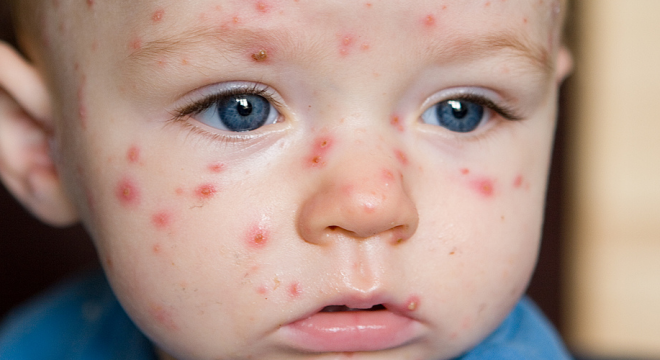 Rubella spots on the body


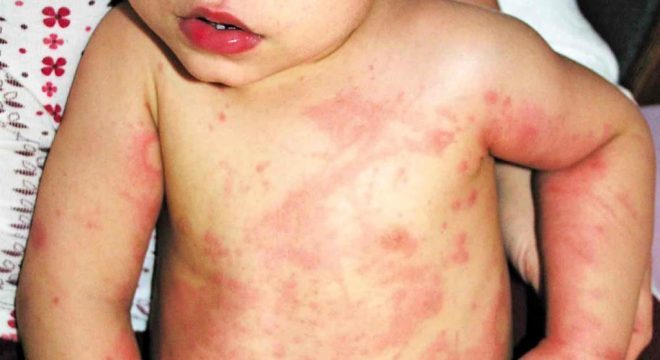 Rash on the body with rubella
The initial stage of rubella is accompanied by a rash in the ears, anterior neck, cheeks, lips and nose, after a couple of days they appear on the shoulders, collarbones, back, abdomen, go down to the inguinal and femoral zone. Across a day or two the rash loses saturated shade, almost completely disappearing; the longest marks remain on the gluteal region and on the inner thighs, as well as in the places where the limbs are bent.
Average period of rashes is 5-7 days, after which convalescence manifests itself: the child's physical condition improves, if previously he lost his appetite, he returns along with activity. The reduction of the lymph nodes takes the longest period: they return to normal after 10-15 days from the moment the redness disappears.
Symptoms of typical rubella in children
The typical or common form of rubella is characterized by certain factors:
- decreased appetite;
- intolerable pain in the head;
- fever;
- pain in the muscles, throat;
- rhinitis, cough;
- excessive watery eyes, redness and inflammation of the eyes;
- hypersensitivity to bright light.
The central defining symptom of rubella is recognized specific rashwith an individual characteristic:
- small rash from light pink to deep red;
- initially it is localized only on the scalp, body and face;
- the rash slowly spreads and affects the arms, legs, joints and buttocks;
- the rash never covers the feet and palms - this is the main distinguishing feature of rubella;
- the occurrence of several foci of rashes with subsequent merging with each other determines the complicated form of rubella;
- localization of lesions on the mucous membranes of the pharynx (noted in atypical form);
- itching on the affected skin.
Based on the consequences of pathology, rubella is isolated in an uncomplicated and complicated form.
Complications of the disease
Complications are rare and appear in severe cases. In severe rubella, the following complications may occur:
- joint inflammation, provoked by the penetration of the virus into the joint tissues;
- thrombocytopenic purpura - decrease in blood clotting;
- hemorrhagic rash - many small hemorrhages, similar to bruises, on the surface of the body, discharge of blood in the urine;
- encephalitis, meningitis - the rubella virus enters the brain, resulting in inflammatory processes.
The main signs of encephalitis:
- a noticeable deterioration in well-being;
- hypersomnia, coma;
- convulsions;
- paralysis or incomplete loss of movement.
Encephalitis is almost always fatal.
Other forms of rubella occur with less complications, and, I repeat in children, they occur very rarely.
Read also:Sudden Infant Death Syndrome: what is this disease, causes, symptoms, how to prevent
Atypical rubella.
This form proceeds more calmly - the rash is not observed, the patient's well-being is normal.
Its symptoms are similar to those of acute respiratory infections. It is rather difficult for a doctor to diagnose.
Rubella infection can be assumed if the patient had contact before going to the doctor (i.e. e. if the child touched, played) with the infected.
Despite the easy tolerance, this species is more dangerous for others, because due to obscurity the clinical picture, possible precautions are not followed, which can cause outbreaks epidemics.
Subclinical rubella.
It is almost impossible to diagnose the subclinical form of pathology, since it has no defining signs. It is believed that this type of rubella is much more common in practice. The pediatrician will be able to establish the correct diagnosis only after examining the baby who was in contact with the patient.
How is rubella diagnosed?
A full range of diagnostic procedures is needed for correct diagnosis and exclusion of diseases with similar symptoms: allergies; scarlet fever; adenovirus and enterovirus infection; measles; Infectious mononucleosis; lichen pink; hives; infectious erythema.
Only an experienced pediatrician can make a correct diagnosis.
This usually happens based on certain diagnostic procedures:
- visual examination and questioning of the mother of a small patient - initial methods that identify rubella infection and establish the frequency of manifestation of its symptoms;
- neurological examination to establish muscle tone and skin surface sensitivity indicators;
- a blood test, since with rubella, the content of white immune cells decreases (a number of tests are carried out with intervals of 2-3 days, which will allow you to get acquainted with the dynamics and find out the degree of complication);
- magnetic resonance imaging is used for severe disease; it is aimed at studying the state of the structure of the brain and determining all possible consequences of rubella in the presence of neurological factors.
Since rubella is becoming less common and the goal is to get rid of it forever, each case of its occurrence must be laboratory confirmed.
The main ways of this confirmation are:
- research of the virus by a special method PCR in scraping from the mucous membranes of the throat and nose;
- detection of class M antibodies in paired sera by ELISA.
Rubella treatment

The main treatments for rubella are isolation of the infected baby, bed rest, and control of symptoms.
Rubella can also be treated at home, only seriously ill children are hospitalized. The child must comply bed rest.
Drinking plenty of fluids is recommended. There are no specific medications for rubella, and the course of treatment is determined based on its type and degree of complexity.
About 1 in 2 children infected with the rubella virus show no signs of the disease. And even if rubella occurs with symptoms in children, they are rarely severe. About in 1-2 weeks complaints usually go away completely.
Since a specific treatment has not yet been developed, pediatricians recommend:
- bed rest within 3-7 days;
- good nutrition, taking into account the age characteristics of the child;
- application disinfectants (arbidol, isoprinosine), immunomodulators (interferon, viferon) and immunostimulants (cycloferon, anaferon);
- detoxification therapy - plentiful drink;
- reception of askorutin 500 mg 3 times a day (replenishes vitamin deficiencies);
- anti-inflammatory drugs for children: Paracetamol, No-shpa, Nurofen (used to relieve fever, headache);
- to drain sputum and get rid of the virus as soon as possible, expectorant drugs for children (NOT antitussives!) are recommended.
Principles of rubella treatment in children under 1 year of age:

The cure comes outpatient, parents receive a sick leave, which is valid for 21 days, i.e. during the period as long as the child is considered a carrier of the virus.
During this time, the child is isolated from other children to prevent the spread of the infection. Basic requirements for a successful cure:
- the child is placed in the infectious diseases department with the possibility of regular ventilation of the room;
- bed rest is established within a week, it is important that the child drinks a lot of water and eat right.
Read also:Prader-Willi syndrome
Rubella prevention
The only main option for preventing ailment is vaccination. Since 1997, rubella vaccination has been compulsory for all children. Initially, it was carried out once, and since 2002 - twice: per year and at 6 years old. The effectiveness of double vaccination is 96% - immunity lasts up to 20 years.
The risk of rubella infection can be minimized by means of certain preventive measures:
- routine vaccination;
- use of a monovaccine;
- exclusion of contacts with virus carriers;
- correct, balanced nutrition;
- strengthening immunity with vitamins.
Rubella vaccine

Measles vaccination has now proven its worth. high efficiency in preventing infections and in a marked reduction in rubella-related deaths.
Distinguish between monovalent measles vaccines, including one component, and multivalent, containing several components and not only against measles.
For example, multivalent measles vaccines include:
- Measles, rubella.
- Measles, rubella and mumps.
- Measles, rubella, mumps, chickenpox.
The effect of them is identical, so its choice is due only to preference and convenience.
Before vaccination, the powder must be diluted. The resulting drug should be placed in a dark vessel, since it is not stable under the influence of the sun's rays.
The solution is allowed to be taken only within 6 hours and then provided it is stored in the refrigerator, otherwise the vaccine is considered spoiled. To make vaccination easy, preliminary preparation is necessary:
- in the presence of a chronic disease, allergy or neurological syndrome, it is important to observe the person's condition, and to get the vaccine after complete remission of all pathologies;
- before vaccination, you need to bathe thoroughly, empty the intestines and reduce the amount of food consumed, while remaining with a slight feeling of hunger.
After the vaccination, it is important to stay close to the medical institution for about half an hour, so that in the event of an allergic manifestation, specialists can provide the necessary assistance in time.
Vaccines

The vaccination program is helping to reduce rubella infections in developed countries.
One injection containing a live weakened strain of the virus is able to strengthen the immune system as well as after natural infection in 95% of people.
In Russia, both domestic rubella vaccine and effective imported drugs are applicable:
- Belgian "Priorix»Includes viral strains of measles, rubella and mumps and is intended to protect the body from such infections.
- «Ervewax»(Of the same production) - a one-component rubella vaccine, which almost does not cause side effects, is ideal for immunizing young children.
- French "Rudivax”, Which includes the attenuated rubella vaccine virus, is also indicated for the prevention of infection. Immunity after its introduction can last up to 20 years, which makes it more effective.
To summarize
Rubella is a very common viral disease that affects children of primary school and preschool age, and for its treatment apply a set of measures, expressed in the creation of conditions in which the virus dies faster (isolation, drug therapy, antiallergic and anti-inflammatory drugs).
Modern medicine does not know a universal cure for this disease, therefore, when the first signs of malaise appear in a child, you must immediately contact a pediatrician. With rubella timely seeking medical help is important and compliance with all the prescriptions of specialists, since it is not rubella itself that is dangerous, but its various complications.