Edwards syndrome: photos of patients, causes, symptoms and treatment
Edwards syndrome, or trisomy 18, is one of the most severe congenital diseases.
This disease is provoked by a violation in the rows of chromosomes.
The syndrome causes numerous diseases of organs and systems in the human body.
Interesting fact: among sick children, girls with Edwards syndrome are 3 times more likely than boys.
Content
- What is Edwards Syndrome?
- Causes and provoking factors
- Symptoms of the disease
- Types of Edwards syndrome
- Diagnostics
- Syndrome treatment
- Drug treatment
- Surgery
- Home remedies
- Prophylaxis
- Forecast
- Related Videos
What is Edwards Syndrome?
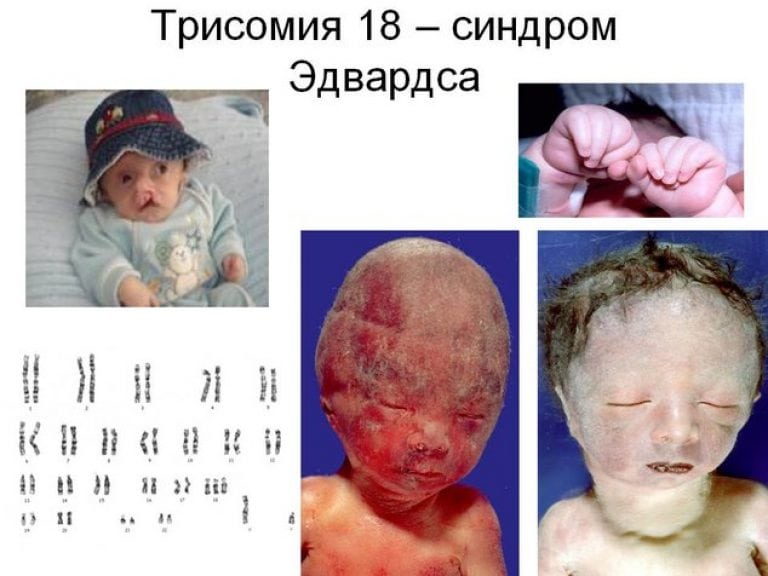
As you know, the normal set of chromosomes in the human body is 23 pairs, or 46 pieces that a child receives from his parents at conception.
In the presence of Edwards syndrome in the 18 pair of chromosomes, the child, in simple words, appears extra chromosome, say, a copy of it (hence the name of the syndrome - trisomy 18).
Sometimes it manifests itself partially, but this is very rare - in about 5% of cases.
Causes and provoking factors
To date, it is not fully understood why this disease can occur in children.
Many scientists are of the opinion that the occurrence of this syndrome is completely accidental; other experts argue that there are still factors that can affect the emergence of chromosome 18.
Among them, the following causes of the syndrome are distinguished:
- hereditary factor;
- the age of one of the parents is over 45 years old;
- the mother's use of alcohol, drugs, smoking cigarettes and taking drugs that can affect the immune system and the endocrine system of the unborn child and the woman herself;
- genital tract infections in parents during conception;
- radioactive radiation to which the mother was exposed during pregnancy or shortly before her.
All these factors are indirect, due to the fact that in some children with this syndrome, the parents never even had symptoms similar to those indicated earlier.
For this reason, specialists should consider each specific case of manifestation of this syndrome in children individually.
Symptoms of the disease
The syndrome manifests itself in all children in completely different ways: some have only the main symptoms of the disease, others - their absolute majority is manifested.
The degree of manifestation of existing symptoms is also different in patients.
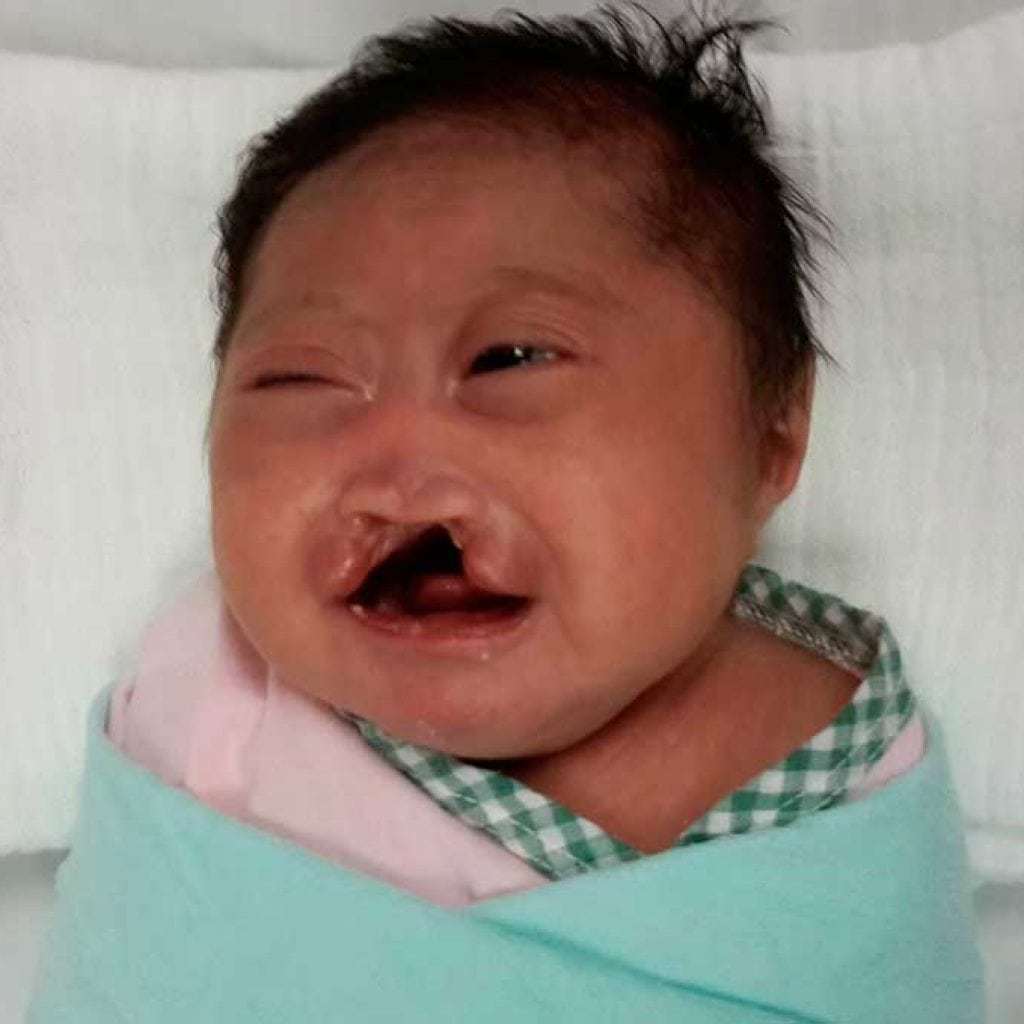


So, outwardly, Edwards syndrome manifests itself as follows:
- the child has a small head compared to the body;
- narrow eyes (see. photo above);
- poorly developed lower jaw;
- distortion of facial features and shape;
- elongated auricles. Some parts of the ear (lobe, auditory canal) are also often missing;
- wide and shortened chest;
- the upper lip is very small, the mouth is small;
- strongly widened bridge of the nose, sometimes "depressed" into the skull;
- irregular feet;
- high sky with a cut (cleft palate);
- low forehead, nape strongly protrudes;
- strabismus.
Read also:Prader-Willi syndrome
In addition to visual signs, there are also internal ones, which are much more serious in nature:
- heart disease;
- the presence of hernias;
- lack of reflexes typical for small children;
- underdevelopment of the cerebellum;
- doubled ureters;
- renal failure;
- small body weight, about 2 kg at birth;
- dementia develops with age;
- muscle dystrophy;
- oncology of various organs.
Types of Edwards syndrome
Depending on the type of chromosomal defect in the 18 pair, there are three main types of Edwards syndrome.
I. Complete trisomy 18. The most severe manifestation of the syndrome and, unfortunately, the most common (90% of cases). This type assumes that all cells in the body have a copy chromosome.
II. Partial trisomy 18. This type of syndrome is extremely rare. This trisomy consists in the fact that the cells of the body contain only a certain part of the chromosome. This can happen due to improper cell division.
It so happens that this chromosome fragment is incorporated into the structure of another chromosome. In this case, the number of manifestations of the disease will be much less in number.
III. Mosaic trisomy 18. It is also a rather rare form of Edwards syndrome, but it manifests itself in a completely different way from the previous forms of the disease.
In this case, the failure occurs only later than the fusion of the male and female germ cells, in the process of division.
After this failure in the 18 pair of chromosomes, a copy-chromosome appears, which becomes the cause of the further development of Edwardson's syndrome.
Diagnostics
If the described syndrome is found in an unborn child, it is an indication for terminating pregnancy.
This is due to the fact that children with trisomy 18 cannot live a full life, and their health is weaker and weaker every day.
To detect a disease during pregnancy, a number of studies and tests are carried out:
- Cordocentesis. For analysis, fetal umbilical cord blood is taken. This method is used for a period of more than 20 weeks.
- Amniocentesis. To conduct a study of amniotic fluid. The procedure is allowed starting from the 14th week.
- Biopsy. The study is carried out after 8 weeks. For this, a small part of the placenta is taken, because it is almost the same as the tissue of the fetus.
Read also:Down syndrome: what does the extra chromosome carry?
Typical symptoms of the syndrome Edwards are also detected using ultrasound, but only at a later date. The signs are as follows:
- heart defects;
- deviations in the work of the musculoskeletal system;
- change or deformation of the bones and tissues of the skull;
- developmental delay;
- hernia.
Syndrome treatment

Unfortunately, there is no cure for this syndrome.
The therapy that can be given is usually aimed at relieving the onset of the symptoms diseases and prevention of the occurrence of concomitant diseases, which make up a really huge list:
- pneumonia, Chronical bronchitis, asthma;
- chronic otitis media;
- oncological diseases of various organs (for example, throat cancer);
- sinusitis;
- high or low blood pressure.
It can be noted that most concomitant diseases become chronic. To prevent this from happening, doctors try to apply various kinds of therapy, if possible.
Drug treatment
Medical treatment is most relevant for Edwards syndrome in newborns. Therapy includes antibacterial, anti-inflammatory and, most often, hormonal drugs. They prevent the development of certain diseases, making life easier for the child.
Hormone therapy improves the functioning of the thyroid gland in the body, which is also important for a patient with such a diagnosis.
Surgery
Surgical intervention for such a serious illness is considered irrational, as it can lead to complications or a critical condition. Therefore, doctors carry out surgical treatment for trisomy 18 only in case of complications of any other diseases in a sick child.
Home remedies
Considering the fact that even medical treatment of this disease is ineffective, it makes little sense to talk about treatment at home. Parents can make decoctions from various herbal preparations in case of increased emotionality or aggressiveness of the child. This will help him calm down.
In addition, decoctions are often used that can strengthen the immunity of a sick child, who, due to his illness, becomes very vulnerable to viral diseases.
Prophylaxis
It is not possible to prevent this syndrome - one cannot predict that a child will be born with trisomy 18. But, despite the hereditary nature of the disease, parents can still do something to reduce the risk of the disease in an unborn child.
Read also:Children's stomatitis: how it can be cured at home
First of all, partners must undergo a complete examination to identify pathologies in their own body.
You should also pay attention to the age at which attempts are made to conceive a child - it is desirable that he does not reach 40 years; in this case, the risk of other diseases in the child and complications in the mother will decrease. And, perhaps, one of the main aspects that has not yet been touched upon earlier is proper nutrition and the elimination of the harmful effects of bad habits on the body of the expectant mother.
Forecast
The vast majority of children with Edwards syndrome die in the womb due to the fact that the woman's body rejects the fetus. In case the child is born, the prognosis is very disappointing. Most children with this disease live up to several months.
In the event that a child is not born with the most serious form of the disease, the likelihood of living to 10 years of age increases dramatically.
If a child has lived for several years with Edwards syndrome, complete inactivity and weakly broken mental abilities can be noticed behind him. Unfortunately, nothing can be done about it, no matter how his relatives look after him.
Many parents try to teach something to their sick child - it is absolutely useless. Even that small percentage of patients who reach a fairly mature age with this disease, knows very little.
In most cases, such people can raise their heads on their own, recognize only a few a person from the closest circle (those who are most often nearby), independently eat, sometimes - move.
If a child or already an adult begins to walk, he strongly bends his feet inward, "clubfoot", as they say.
It is worth noting that the practice of maintaining muscle tone is not suitable for all children. For some patients, this helps to improve the general condition; for others, it will only harm in view of the fact that they may have problems with the musculoskeletal system and pain in the spine.
For this reason, it is necessary to consult with the child's doctor in order not to harm him.