What teeth are cut first in children and at what time, photo, how to help the child
The very first months of the baby's life are marked by an absolutely toothless smile - for boys and girls, it is equally cute. But finally, the first bulge appeared on the gum - the child's first teeth are being cut. A period in life that all parents will remember.
In this article, we will tell you what time the first teeth are cut in children, which teeth are cut first in the baby, what symptoms are characteristic and how to help the child.
Content
- When the first teeth begin to climb in babies
- What factors can affect the growth of teeth in children
- How to find out when the first teeth are being cut, what signs indicate this?
- Photo gallery (children whose first teeth are erupting)
- When to see a doctor?
- When a child has a toothache, how to help with teething?
- Children's pharmaceuticals
- The colors of the first teeth, which should alert
- Related Videos
When the first teeth begin to climb in babies
The table shows at what age the first teeth are cut in children and in what sequence (to understand the table, please look at the photo below):
| Baby age | Cutting point |
|---|---|
| 6-7 months | Lower central incisors |
| 8-9 months | Upper central incisors |
| 9-11 months | Upper lateral incisors |
| 11-13 months | Lower lateral incisors |
| 12-15 months | Upper small molars (molars) |
| 12-15 months | Lower small molars (molars) |
| 16-18 months | Upper canines |
| 18-20 months | Lower canines |
| 24-30 months | Lower large molars (molars) |
| 24-30 months | Upper large molars (molars) |
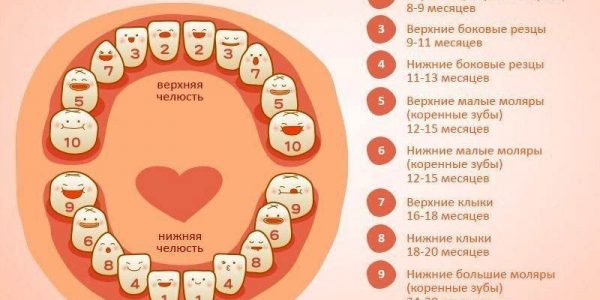 A detailed photo that will show you the scheme of teething in children from the table above.
As doctors note, the first teeth in babies begin to break through at 6-9 months. If the deadline is somewhat delayed, parents should show the child to a pediatrician and a dentist. If we talk about the fact that the timing of the appearance of teeth may be atypical - this may indicate certain disorders in the baby's body:
- if the teeth are climbing 2 months later than the normal period, this may indicate the course of an infectious disease in the body, a failure in metabolic processes and the work of the digestive tract;
- when the teeth climb 2 months earlier than the established time - this may indicate a malfunction in the endocrine system;
- if the first teeth in infants are cut incorrectly, outside the gums, this indicates an incorrect position of the tooth axis. In this case, surgeons will have to intervene, using special bales and prostheses for its correct direction.
In the presence of certain suspicions of a pathology or its identification, it is best to show the child to a pediatrician and pediatric dentist.
What factors can affect the growth of teeth in children
In boys and girls, teeth begin to cut in time differently, but in any case, it is worth taking into account the factors affecting these periods.
- Hereditary predisposition and baby's diet - with a lack of calcium in the body, supplemented by a genetic program, the baby's teeth will begin to grow with a delay.
- Climate and region of residence - in boys and girls living in hot regions, teeth begin to erupt earlier than in children who live in a temperate climatic zone.
- Boys and girls cut their teeth at different times. - in the latter in particular, they begin to climb earlier, starting to break through at 6-9 months.
Read also:Shereshevsky-Turner syndrome - causes, symptoms, diagnosis and treatment
Nevertheless, the question of when the baby's teeth begin to climb should be considered with an individual positions - if they began to grow later or earlier, then this should not be immediately considered a deviation from norms.
How to find out when the first teeth are being cut, what signs indicate this?

When teething, a child may exhibit some or all of the following symptoms: but there are times that not a single sign of a baby will appear during teething - everything is strict individually.
The first signs of the appearance of teeth in a child are as follows:
- redness and intense swelling of the gums, they will itch and hurt;
- the child sleeps restlessly and can cry, pull anything into his mouth that comes under his arm;
- a slightly sour characteristic odor appears from the oral cavity;
- the baby has abundant and intense salivation;
- there is some swelling of the cheeks.
It is also worth understanding that these are the very first and less alarming symptoms during teething may not be present, or may show themselves as more severe symptoms.
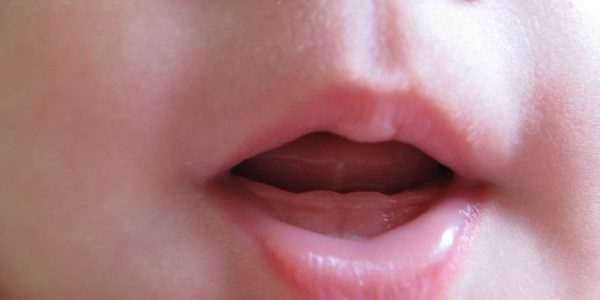
Photo gallery (children whose first teeth are erupting)
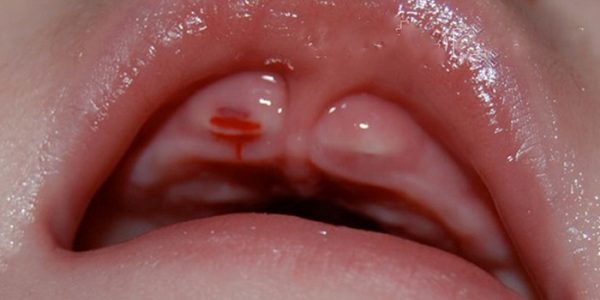


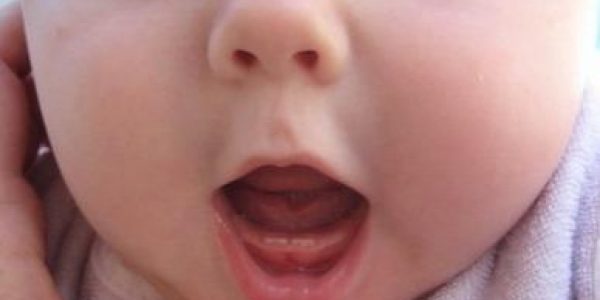
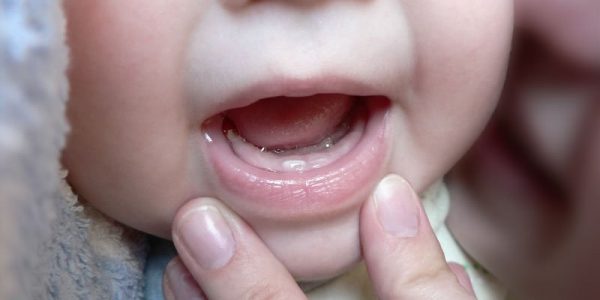

When to see a doctor?
If any of the above symptoms appear, it is better to call the pediatrician at home or come to an appointment at the clinic and show the child to the doctor. He will conduct research and rule out or confirm any other cause of such negative symptoms, which may or may not be associated with the teeth.
However, there are more dangerous symptoms in which you cannot do without a pediatrician. In particular, doctors attribute several basic symptoms to dangerous signs that should never be ignored:
- The physiological process is accompanied by severe coughing fits. In particular, excessive salivation and a large amount of saliva will drain down the throat and provoke coughing fits in the child. Attacks of the baby's cough reflex will intensify when lying down - it becomes moist and obsessive, it will interfere with sleep and eating. Parents may suspect an infectious lesion of the body - a cold, and in this case, his attacks will last more than 2-3 days. It may be accompanied by shortness of breath and shortness of breath - this may indicate an inflammatory process in the upper respiratory tract.
- Profuse discharge from the nasal passages - normally they should be clean and transparent, like water. Such symptoms most often disappear after 2-3 days - it is enough to rinse the nasal passages with a salt solution. If an infectious process develops, nasal discharge will be quite abundant, their color will become yellowish or greenish, and last more than 4 days.
- Excessive salivation in a baby can provoke a stool disorder - getting inside the digestive tract, it accelerates intestinal motility and provokes the appearance of diarrhea 2-3 times a day. When an infectious process occurs in the body, diarrhea will bother the child more than 3 times a day, interspersed with mucus and blood. So blotches in the feces of blood can talk about intestinal infections and disorders of the digestive system.
Read also:Streptoderma in children: symptoms, home treatment
In such cases, it is worth showing the child to the dentist. It is also worth showing the baby to a specialist and in case of not only prolonged diarrhea and threats dehydration, but also with the opposite phenomenon - constipation. With a weakened child's immunity, during teething, he may develop oral diseases.
Most often, the following pathologies show themselves negatively:
- Thrush - it is provoked by a fungus from the genus Candida and is attributed to fungal diseases that develop against the background of a weakened immune system. In this case the child's gums and tongue will be covered with a whitish bloom, shows itself itching and decreased appetite, increased pain.
- Development stomatitis in a child – sores and wounds can cover the mouth, giving the baby a lot of anxiety.
In such cases, it is worth showing the child to the pediatrician - this will eliminate any negative consequences, give advice on how to alleviate the general condition of the baby at this stage of its development. This will help both the baby and the parents, and all negative symptoms can be overcome easily and without much difficulty.
When a child has a toothache, how to help with teething?
Teething is a difficult process and parents need to help the baby to transfer it without problems and unpleasant sensations. There are a number of tips that can help your child get through this period:
- Light massage of the gums - it will help relieve pain and improve blood flow. They spend it before going to bed, thoroughly washing their hands and lubricating their fingers with vegetable oil - they do all the movements smoothly so as to prevent injury to the gums.
- Give your baby a teether toy to play. Most often, they are presented on the shelves of children's stores made of silicone or rubber - the baby gnaws at them, providing additional massage of the gums, which will help alleviate the condition.
- Cool wipe to soothe sore gums - it is enough to soak a linen napkin in cool, but not cold water and let the child chew. Instead of clean, cool water, you can take a chilled broth from a chamomile flower - it will help relieve inflammation and soothe the gums. You can also give your baby a pacifier or a chilled teether made of gel formulations.
These time-tested ways to alleviate the condition of the baby can be supplemented with more modern means, taking into account pharmaceuticals.
Children's pharmaceuticals

Here is a list of some of the drugs that are popular in pediatrics:
- Dentinox - prevents irritation of the gums and oral mucosa in children. Dentinox has a local anesthetic and anti-inflammatory effect and therefore reduces painful symptoms and inflammation of the gums when teething in children.
- Calgel Tooth Gel - effectively helps with pain during teething in children. It can be taken from 5 months of age.
- Gel Kamistad - excellently helps with painful teething in infants.
- Children's gel Pansoral - anesthetic herbal antiseptic preparation for topical use. Designed for babies from 3 months. It relieves pain and inflammation with a bang during the eruption of the first milk teeth, allowing the child to more easily and calmly endure the complex and painful process of tooth growth.
Read also:Rubella in a child - causes, symptoms and first signs, treatment, prevention, photo
Dental special gels do not negatively affect the process of natural teething, relieve pain.
This is achieved due to the menthol and lidocaine contained in the preparations - in the process of their use it is worth observing for the reaction of the child's body, since drugs can provoke allergies and thereby worsen the general condition baby.
The main thing to remember is that such a helium composition works no more than half an hour and can be used no more than 4-5 times a day, for a maximum of 3 days.
If the baby's pain syndrome is strongly pronounced, anesthetic compositions can be used. But before choosing one or another drug, you should consult a pediatrician.
Important! During the period when the child's teeth are being cut, it is worth removing all small objects from his environment, since the baby pulls everything into his mouth and can swallow a dangerous object, injure internal organs or suffocate. Also, all toys should be regularly disinfected.
The colors of the first teeth, which should alert
It is the color of the enamel of the first teeth that can indicate certain pathological processes occurring in the baby's body:
- blackish tint talks about excessive drug abuse and foods high in iron. Somewhat less often, such a shade may indicate the course of a chronic process of an inflammatory nature of origin in the baby's body.
- brownish tint of teeth, with yellowness - a mother who is breastfeeding a baby abuses the intake of antibiotics, or the child himself is stuffed without measure of this group with drugs.
- yellowish tinge of teeth, with a greenish coating - indicates a blood disease, and a reddish tint indicates a congenital metabolic disorder, the production of a special pigment porphyrin.
When the first teeth appear in a child, they must be monitored. Even the first, one tooth must be cleaned; you can use a clean bandage for mechanical cleaning or a special silicone nozzle.
Gradually, you can get into the habit of using baby paste and a brush with soft, natural bristles. They change it every month - up to 2 years old parents brush the baby's teeth, after that they teach the child himself to the procedure. Teaching a child such a hygienic procedure is in the format of a game - a brush in the form of a funny dinosaur and pasta with a banana flavor will help with this.
Parents should regularly examine the baby's oral cavity - this will help to identify at the very beginning any problem with the teeth and take timely measures, avoiding serious complications.