Angelman syndrome in children: what is it, photos, symptoms, treatment
Angelman's disease (parsley syndrome) - an orphan disorder of a genetic and neurological nature.
This pathology was first isolated and described in the specialized literature by the English physician Harry Angelman in 1965, which led to one of the names of the disease.
Other designations of the disease are terms such as "Parsley syndrome" or "happy doll syndrome".
Why dolls and what does it mean? These names are due to specific motor skills, behavior and facial expressions (for photos of children, see. below), which are typical for people with Angelman disease. Below - we will consider them in detail.
Content
- Causes of Happy Doll Syndrome
- Angelman syndrome symptoms
- Diagnostics of the Angelman syndrome
- Possible complications of Parsley syndrome
- Angelman's disease treatment
- Correction of the psycho-emotional state of patients and socialization.
- Related Videos
Causes of Happy Doll Syndrome
The cause of the disease is the deletion of the ubiquitin protein ligase E3A (UBE3A), located on the 15th chromosome. Usually genes are passed to the child from parents in a pair combination - one copy on the maternal side, the other on the paternal side.
The cells of the body, as a rule, use information from both copies, however, only one copy is activated in individual genes.
In the case of Angelman syndrome, the disorder occurs when the maternal copy of the UBE3A gene is missing or damaged. Occasionally, the reason for the development of Parsley syndrome is the inheritance of two copies of genetic information only on the paternal side, and not from both parents.
According to various statistics, the disease affects 1 child per number of newborns from 12,000 to 20,000 babies. In most cases, Angelman syndrome in children occurs against the background of the absence of this condition in the family history.
There are no differences in the number of patients by gender - the syndrome affects both men and women in equal proportions.
Angelman syndrome symptoms


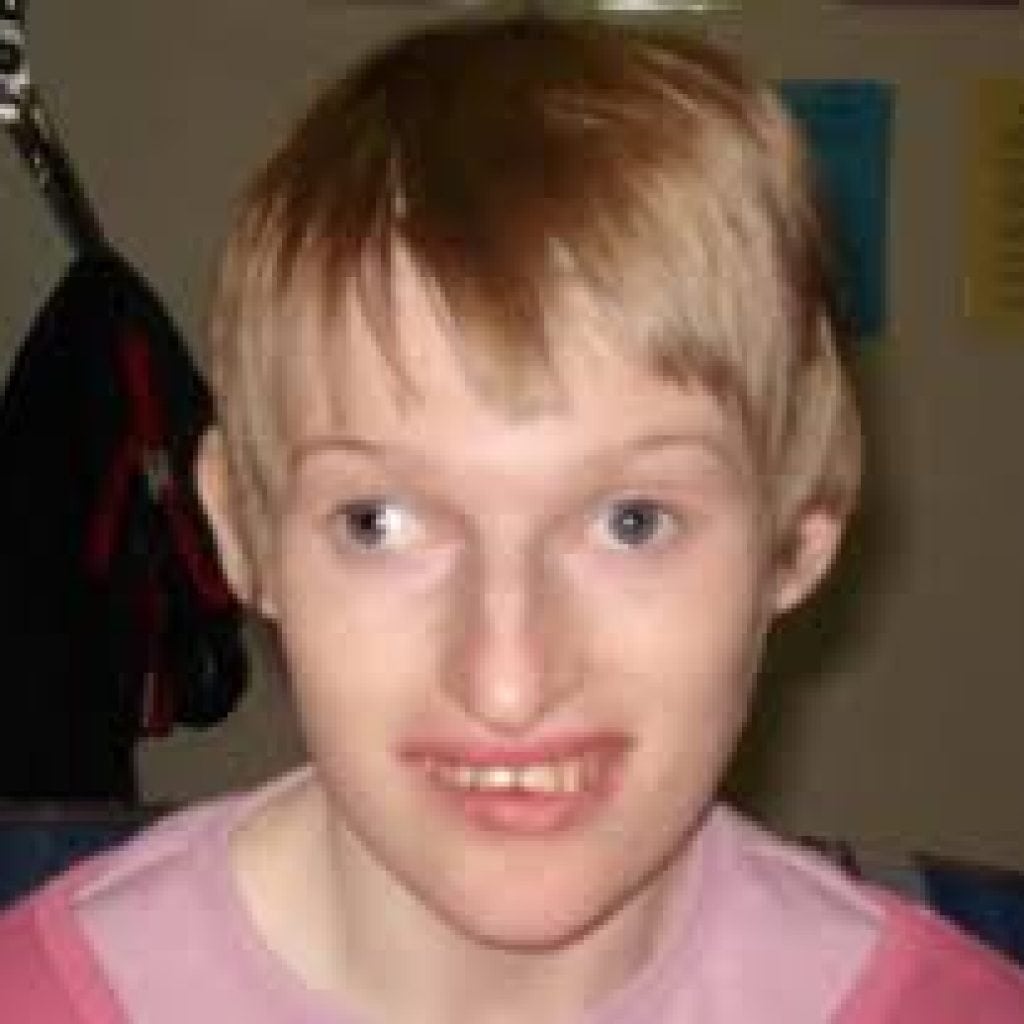
Manifestations of the disorder in the psycho-emotional sphere:
- developmental delay, including no babbling and crawling for a period from 6 months to 1 year;
- depressed learning;
- lack of speech or minimal speaking skill;
- unmotivated frequent laugh / smile;
- personality type can be described as joyful, exalted.
Symptoms of the disorder at the physical level:
- seizures of epilepsy, which usually occur between the ages of 2 to 3 years;
- Difficulty walking / moving, constrained or sharp angular movements due to inability to control voluntary movements (ataxia);
- unusual behavior, such as sudden flapping of the arms, walking with raised arms, and / or stiff legs;
- small head size with flattening in the occipital area (microbrachycephaly);
- light-colored hair, skin and eyes (hypopigmentation);
- sometimes children have a wide mouth, sparse teeth, and a protruding tongue. In most cases, the facial features of the patients are not unusual.
Read also:Streptoderma in children: symptoms, home treatment
Separately, one should dwell on the features of speech development and motor skills, typical for people with the syndrome Angelman.
Most children with this disorder have an extremely poor vocabulary, which can be limited to a few words (up to one or two dozen). This leads to significant difficulties in the socialization of a child who has Parsley's syndrome.
Moreover, children with such a disorder - as a rule - understand not only simple commands, but also are able to assimilate information in a volume that significantly exceeds their ability to communicate and express thoughts.
As for motor skills, in addition to the manifestations described above, “Parsley” children can often hold their hands raised and bent at the elbows and wrists, and periodically wave your hands in moments of excitement or walking time. It is this similarity with the movements of a puppet, coupled with their angularity and stiffness against the background of frequent exaltation of patients, that became the reason for the name of the disorder as the syndrome of the happy doll.
They may have both decreased muscle tone of the trunk (hypotension) and increased muscle tone. limb tone (hypertension), as well as abnormally exaggerated reflex reactions (hyperreflexia). Some children develop small hand tremor and legs. These disorders can manifest themselves at age from 6 months to 1 year.
Some milestone motor skills, such as walking, are delayed.
In cases of relatively mild illness, children may begin to walk at 2-3 years old. In more severe cases, upright walking is slowed down and occurs in jerks - "rigid", which also resembles the movement of a puppet. Some kids don't walk until old from 5 to 10 years. Approximately 10% of patients are unable to move without assistance.
Diagnostics of the Angelman syndrome
Diagnosis of a condition associated with happy doll syndrome is based on detailed analysis of medical history, meticulous clinical assessment and identification of characteristic manifestations disorders.
Approximately 80% of cases diseases can be confirmed with a specific blood test based on DNA methylation.
Read also:Perinatal encephalopathy (PEP) in children: what it is, causes, symptoms and treatment
This method allows you to detect a failure of the genetic program, but does not make it possible to identify whether it occurred, for example, due to a deletion of a chromosome or a defect in the center of imprinting.
Fluorescence in situ hybridization is effective in detecting the characteristic deletion (observed in 70% of cases of the syndrome) of chromosome 15q11-113.
Mutation analysis of the UBE3A gene reveals up to 10% of personswho have Angelman syndrome, who tested negative on the basis of DNA methylation.
Possible complications of Parsley syndrome
Below is a list of complications, the likelihood of developing which against the background of Angelman's disease is quite high:
- Feeding problems. Difficulty coordinating sucking and swallowing movements can result in difficulties in feeding the baby. To help your child gain weight, it is recommended that you consult a pediatrician who will select a high-calorie diet option.
- Hyperactivity and attention deficit disorder. Children-"Parsley" tend to quickly switch from one type of activity to another, while their concentration of attention is characterized by a short period. An indirect symptom of the disease is the tendency of children to put their hands in their mouths or hold toys in their mouths. Hyperactivity - usually - diminishes as you get older and does not require medication.
- Sleep disturbances. Patients with this condition often experience sleep-wake disorders and often need a shorter sleep period than most people. These disorders can increase with age. Taking appropriate medications and behavioral psychocorrection helps to normalize sleep.
- Rachiocampsis (scoliosis). In some patients, acquired right- or left-sided S-shaped scoliosis develops over time.
- Obesity. Some children develop an increased appetite, which - as they get older - can lead to obesity.
- Ophthalmic disorders. In some cases, strabismus occurs.
Angelman's disease treatment
To date, therapy for Angelman syndrome is aimed at eliminating / alleviating symptoms and has a supportive nature. There are no specific drugs or methods of genetic correction that can cure the disease. In most cases, patients with this syndrome have relatively good general physical health, and it is possible for children to receive standard pediatric care, including immunization.
In cases of the development of seizures, the use of anticonvulsants is recommended. As a rule, such manifestations of the disease can be adequately controlled with a single drug. However, sometimes relief of such symptoms requires a combination of several medications.
It is important to note that there is no single anticonvulsant drug that is effective for most cases of Angelman syndrome.
Therefore, it is necessary to consult with the attending physician, who will prescribe the most effective remedy / set of funds, based on the individual characteristics of the patient.
Read also:Rickets in infants: causes, symptoms and treatment
In case of sleep disorders, it is recommended to use behavioral therapy methods and strictly follow procedures to normalize rest. Taking sedatives over a period of time may be helpful.
Elimination of feeding problems is possible using various methods and means. For example, breastfeeding difficulties can help correct special nipples for babies with suckling problems.
Eliminate gastroesophageal reflux drugs that stimulate the movement of food through the digestive tract (motilitics). In some cases, surgical correction of the esophageal sphincter, the valve that connects the esophagus to the stomach, is recommended.
Various laxatives are used to relieve constipation.
Ankle braces and braces are effective in mastering walking skills. Acquired scoliosis is observed in about 10% of Angelman syndrome cases. To eliminate it, it is possible to use braces or organize a surgical intervention. In addition, strabismus is usually surgically treated.
Correction of the psycho-emotional state of patients and socialization.
One of the key factors in the treatment of Angelman syndrome is the reception of timely adequate
- Physiotherapy
- Ergotherapy
- Communication therapy
- Behavioral therapy
Most people with happy doll syndrome will experience the consequences of significant developmental delays, they will continue to have limited speech and difficulty motor skills.
However, the methods that use the listed therapy options allow such people to reach their maximum potential in their development. And the sooner these methods are connected, the more favorable the prognosis.
With aging, patients with Angelman disease do not experience behavioral regression and reduction of acquired skills.
Separately, it should be noted the importance of developing communication / speech abilities. Above is the extremely meager set of words used by "Petrushki".
Sometimes their speech is not developed at all. But the peculiarity of these patients is that, as a rule, the possibilities of their understanding / interpretation of the information received significantly exceed the mastered set of means of expression.
Therefore, an effective way of socialization and increasing the level of communication for them is the development of alternative methods of communication - for example, sign language.