Prostate adenoma in men: symptoms and treatment of prostate adenoma
Prostate adenoma (abbreviated BPH) are now more often called «benign prostatic hyperplasia "(" BPH ").
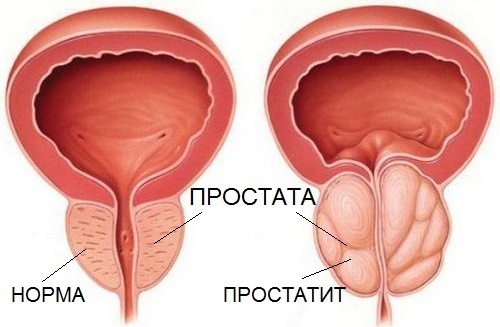
The initial stage of the disease is the appearance of a small nodule or group of nodules on the gland. With the course of the disease, they rapidly increase in size and quantity. Unlike cancer, an adenoma does not metastasize to other organs, that is, it is a benign tumor. This urological disease is most often diagnosed in men over 50 years of age.
Content
- Causes of occurrence
- Symptoms of the prostate adenoma
- Obstructive and irritative syndromes of benign prostatic hyperplasia
- Stages of the disease
- Diagnostics
- Treatment of prostate adenoma in men
- Medication (medications)
- Diet
- Surgery
- Complementary and alternative home treatments
- Prophylaxis
- Forecast
- Related Videos
Causes of occurrence
Causes of adenoma prostate in men have not been clarified so far. The only thing that has been proven and cannot be doubted is a direct link between age and the presence of a disease.
With age in men, the function of producing testosterone, which is the main male hormone, is impaired, and begins in large quantities produce estradiol estadiol (a hormone that can stimulate an increase in the rate and intensity of proliferation of prostate cells glands). Thus, the closer the critical age of 50 years, the higher the likelihood of diagnosing prostate adenoma in men.
It has been proven that the following factors provoke the onset of the disease; their presence significantly increases the risk of disease:
- lack of mobility, a sedentary lifestyle and excess weight - these circumstances contribute to the accumulation of excess adipose tissue - in which estrogens are produced, disrupting the balance of testosterone and estrogen in the body men;
- poor heredity - if among the closest relatives there were patients with diagnosed prostate adenoma, then the risk of the disease increases;
- frequent inclusion in the diet of the wrong food, abuse of fast food and semi-finished products, the content in the diet of a large amount of food with spices, fried and fatty foods.
Symptoms of the prostate adenoma
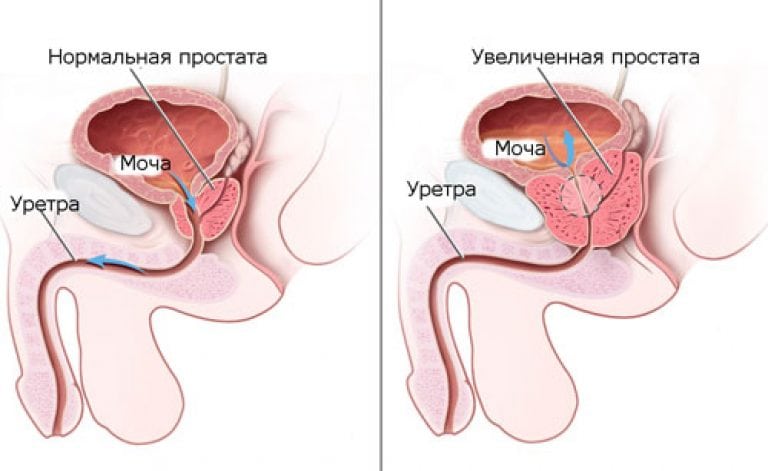
In men, the symptoms of the disease are varied. Their development and manifestation is influenced by the progression of the disease, the age and social status of the patient, as well as his mental and somatic state.
The first characteristic symptom of the disease is considered to be a delay in the initial stage of urination and the manifestation of false urges to it. Together with these symptoms, an intermittent stream of urine is usually observed.
Over time, anxiety symptoms begin to intensify: the patient complains of problems with coping. To urinate, it is necessary to strain the muscles of the peritoneum. Residual urine is observed in the bladder cavity - the amount that did not come out due to a decrease in the tone of the muscular membrane of the bladder (detrusor). It consists of mutually intertwining layers, forming a single muscle. Normal contraction of this tissue is an important indicator of male health.
In the absence of treatment at this stage of the disease, this symptom becomes predominant. This process is characterized by a decrease in the amount of urine emitted from normal to extremely poor, the urine stream is sometimes reduced to a drop-shaped stream. In some cases, the detrusor tension drops so much that the volume of fluid in the bladder becomes critical - more than a liter.
Often, treatment is complicated by the fact that many patients consider the listed symptoms of prostate adenoma normal for their age and do not rush to seek specialist advice. But against the background of subsequent problems due to sexual dysfunction, men still go to see a urologist.
Read also:Peyronie's disease (fibroplastic induration or curvature of the penis)
Obstructive and irritative syndromes of benign prostatic hyperplasia
- 1. Irritative:
Such signs are also called irritation symptoms. These include frequent urination or empty urge to urinate, urinary incontinence. Often the patient is forced to go to the toilet at night - to get up 2 or 3 times because of the need. Such signs depend on the severity of the disorder of the muscular membrane of the bladder.
Now, science knows for certain that as a result of age-related hormonal changes in the body, oxygen starvation of the muscles of the pelvic organs progresses strongly. This condition is called bladder instability.
The listed irritative symptoms complicate the quality of a man's life; with proper diagnosis and timely quality treatment, they are the least dangerous.
The difficulty is that the patient can simultaneously observe both irritative and obstructive symptoms of the disease. The classical clinical picture is characterized by the presence of both groups of signs.
- 2. Obstructive:
With the manifestation of symptoms of prostate adenoma in men, the presence of a chronic inflammatory process in the prostate has a great influence on the formation of the clinical picture of the disease. With an edema of the tissues of the prostate gland, deterioration of the erectile function of the penis is often observed. Chronic prostatitis often manifests itself as urinary disorders. The presence of this syndrome increases the number of postoperative complications in patients with different stages of the development of the disease.
The possibility of making an accurate diagnosis is often complicated by the fact that the clinical picture is also formed by pathological processes in the body that are not associated with BPH. It follows from this that not every patient needs surgery, taking into account the fact that patients with moderate obstructive symptoms after surgery usually do not improve their condition comes.
Stages of the disease
Experts divide the development of prostate adenoma into three stages:
- Compensated stage usually manifests itself in a slight increase in the organ. The changes have minor consequences: the boundaries of the prostate are clearly delineated, palpation does not provoke painful sensations. The density of the organ is preserved in its normal form. The median groove is revealed on palpation. The patient has no residual urine retention.
- Subcompensated stage. It is characterized by a strong enlargement of the prostate, up to the point where it begins to have a strong effect on the function of the bladder. Symptoms are as follows: portioned and incomplete emptying of the bladder, the walls of the bladder swell and become much thicker the walls of the organ in a normal state, with an overflow of the bladder, partial urination often occurs, which does not give in control.
Urine often becomes cloudy, turbid and sometimes sediment. In some cases, the urine contains a suspension of blood.
- Decompensated stage. This is the extreme degree of development of prostatitis. Patients have a critical volume of residual urine, urination is extremely difficult and occurs dropwise, the muscles of the bladder are extremely weak due to a constantly enlarged condition. This stage is often complicated lack of hemoglobin in the blood - anemia. The patient's breathing has a characteristic urine smell.
Diagnostics
After listening to the patient's own complaints, the doctor proceeds to take anamnesis and begins to study the state of health of the body. The first method used in drawing up the clinical picture is palpation and visual examination.
To make an accurate diagnosis, the specialist resorts to an ultrasound scan. It can be transrectal - to identify the exact problem area of the prostate, or include external examination of the bladder - to determine the stage of development of the disease, you need to know the amount of residual urine.
Read also:Treatment of urinary incontinence in elderly women with folk remedies, drugs
The patient needs to pass several tests:
- primarily spend general urine analysis and blood. It provides information about the presence of chronic inflammatory processes in the body and clarifies the picture of the patient's general health;
- On the level of PSA (specific antigen) in the body - the level of its content in the body clearly shows the presence or absence of malignant cells in the neoplasm;
- on the creatinine level. This analysis is a qualitative indicator of the state of the upper urinary ducts;
- the uroflowmetry method is a qualitative way to identify problems with urination and their causes.
Treatment of prostate adenoma in men
According to research results, the treatment of prostate adenoma can be of the following types:
- medication;
- minimally invasive (another common name is HIFU therapy);
- surgical. (variations are possible here - transurethral resection of the prostate gland, laser intervention or vaporization).
Medication (medications)
Various medications are an effective method of combating the disease in the early stages of its development. The most famous types of medications used in the treatment of prostate adenoma are considered to be:
- Alpha-blockers - their main function is to improve the discharge of urine with prostate adenoma and to alleviate painful sensations when urinating;
- blockers. Medicines of this type inhibit the production of the toxic hormone dihydrotestosterone - it adversely affects the process of its increase, accelerating this process many times over. Medicines, blocking the effect of this substance, make it possible to decrease it somewhat. In some cases, this process is irreversible and persists.
Diet

With benign prostatic hyperplasia, the patient's diet should be carefully monitored. In addition, compliance with the following rules serves as a good prevention of this disease, and many others. It is necessary to use more often:
- a variety of fresh fruits, berries and vegetables;
- foods containing fiber;
- foods rich in unsaturated fatty acids;
- raw pumpkin seeds - they contain many substances useful for the male body.
And, on the contrary, you should reduce or completely abandon:
- red meat and rich broths on the bone;
- offal and viscera;
- easily digestible ("fast") carbohydrates;
- legumes and peas;
- canned food, semi-finished products;
- alcohol;
- sweets, in particular chocolate in any form;
- hot seasonings and spices.
The patient's diet must meet the main rule - you need to eat like any adequate person who is not indifferent to his state of health.
Surgery
With prostate adenoma, it increases in volume - to a greater or lesser extent. To what extent there has been a change in the size of the organ, corresponds to the deterioration of the patient's condition and, accordingly, to a change in his treatment plan.
Indicators of a universal scale of correspondence between the size of the tumor and the need for an operation are considered to be:
- 30-55 mm - surgical treatment is not required. It is possible to carry out conservative treatment based on taking medications;
- 40-60 mm in diameter - conservative treatment can be successful, but in combination with surgical removal of part of the prostate, possibly with the help of laparoscopy;
- 60-80 mm - in such a scale of enlargement of the gland, operations are performed in 100% of cases.
Absolute and urgent indications for surgery include:
- inability to relieve natural need even after catheterization of the urethral valve;
- stably recurring extensive hematuria;
- chronic or acute renal failure;
- chronic inflammation of the urogenital ducts, or the acute development of similar conditions;
- diverticula of the pelvic muscles;
- a stone in the bladder or one (both) kidneys.
Read also:Blood in the urine of a woman, men: what can it be, how to treat it?
Complementary and alternative home treatments

Often, so-called alternative therapies are used in the treatment of prostate adenoma. They are domestic or non-traditional. Sometimes these methods give good chances.
Among the recipes of folk healers and connoisseurs, the following are the most popular:
- infusion of birch leaves. 2 tablespoons of fresh or dried leaves are poured with 0.5 liters of boiling water, infused for two hours and taken half a glass three times a day before eating.
- decoction of burdock root. To do this, 2 tablespoons of the roots are steamed in boiling water for three to four hours and drunk 0.5 cups several times a day.
- onion heads. Sometimes, to relieve the symptoms of inflammation, it is enough to eat one head of fresh onions;
- pumpkin seeds. It is necessary to consume the refined seeds of this plant every day.
The application of these methods should not be independent - individually, they will not bring the desired result, and they may do a disservice. - with self-medication, you can skip the development of the disease and skip the stage at which you can still solve the problem without surgery. However, by combining alternative and traditional remedies prescribed by specialists, a good treatment result is possible.
Prophylaxis
To prevent the onset and development of prostate adenoma in men, you need to adhere to a healthy lifestyle. It will be helpful to take the following measures:
- engage in physical education. A few minutes of exercise a day will help prevent congestion;
- adhere to the correct diet;
- monitor body weight. The risk of developing prostate adenoma is directly proportional to the increase in body mass indices and the appearance of excess body fat;
- visit a specialist urologist annually for examination;
- avoid hypothermia;
- try to defecate at the first urge, do not create situations in which the bladder or intestines are full.
Forecast
The prostate gland in men is treated if the problem is detected at an early stage. But with neglected cases, when the disease was not recognized for a long time, the quality of life deteriorates sharply. Do not lose sight of the moral and ethical side of the issue.
With timely access to a specialist, correct diagnosis and strict adherence to the treatment plan, the prognosis is very favorable.
But when a disease is detected in its late stages, experts sharply give a positive prognosis. Diseases are complicated by concomitant chronic infections of the genitourinary system, the formation of stones, sand and other deposits in the bladder and kidneys.
Do not forget that there is always a risk of degeneration of a benign tumor into a malignant one - prostate cancer. It is this risk that is the fundamental factor in the importance of timely diagnosis and treatment of benign prostatic hyperplasia.
Prevention and timely detection of diseases of the genitourinary system, including benign prostatic hyperplasia, is an important part of maintaining the health of the male body. It should be remembered that only careful care of your own health, maintaining a healthy lifestyle and the need for strict adherence to the doctor's prescriptions significantly increases the chances of a life free of disease and disorders.