The colon: where it is and how it hurts
Not everyone has heard of the colon, but this does not diminish its important role in the digestive system. It consists of transverse, ascending, descending and sigmoid parts. In general, its length can reach one and a half meters, in the abdominal cavity it is in a curved form. How to recognize that it is she who hurts? What disease can be symptomatic of unpleasant sensations? The answers to these questions are in this article.
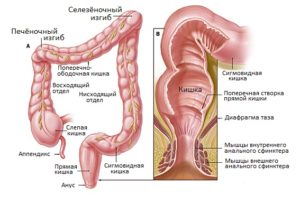
Colon sections
Structure:
- Ascending, the length of which is 10-25 cm. This is the beginning of the colon, located on the right of the abdominal cavity, is a continuation of the cecum. It may vary depending on the position of the person's body. In the vertical position, its base is directed downward. It becomes transverse, forming a hepatic bend.
- Transverse - the length is 45-60 cm. In its location, it comes into contact with the stomach, liver, gallbladder, resembles a loop in shape. The transverse part forms the splenic bend. Stretches to the right of the costal cartilage to the left hypochondrium.
- Descending - the length varies from 10 to 25 cm. The descending colon is located on the left side of the abdominal cavity. Its continuation is the sigmoid part of the digestive system.
- Sigmoid - the length ranges from 20 to 50 cm. The origin is the iliac edge of the posterior ridge from above. It forms two loops, one is located with the convex part down. The second loop, distal, is located upward on the psoas muscle. The final part of the colon goes into the straight section.
Content
-
1 Colon Pain Causes
- 1.1 Diseases
- 1.2 Oncological diseases
- 2 The meaning and work of the organ
- 3 Survey methods
- 4 Disease prevention
Colon Pain Causes
You can understand that problems have begun in the colon part of the intestine by the following signs: discomfort near the anus, pain in the lower abdomen, constipation, flatulence, the presence of blood discharge and pus in kale. All these symptoms can be the beginning of serious diseases, which only a doctor can identify and prescribe treatment for.
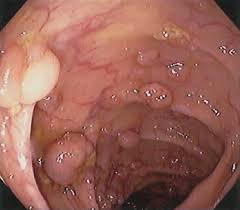
Colon polyposis
Diseases
- Polyposis. Polyps or lipomas form on the lining of the colon. Their sizes range from a few millimeters to several centimeters. The first symptom of the disease is problems with stool, as the growths interfere with the passage of feces. Large polyps can cause hemorrhage in the intestinal area. Treatment is performed surgically or with cytotoxic drugs.
- Hirschsprung's disease. This is a hereditary disease that develops in early childhood. The sections of the intestine, located above the colon, hypertrophy, preventing it from emptying on its own. The disease develops as a result of the formation of ganglion cells. The patient is assigned an operation, removing the inflamed hypertrophied department.
- Diverticulosis. The disease is congenital and acquired. It occurs as a result of protrusion of the mucous membrane through the muscle mass of the intestine. Feces get stuck in them, forming inflammation of the mucous organ. Sometimes the symptom of the disease does not appear for a long time, but sooner or later it makes itself felt. The patient has vomiting, diarrhea, the lower abdomen is very sore. In the early stages of inflammation, the temperature rises. Treatment is carried out with medication, with the development of complications - in a hospital hospital.
- Crohn's disease. It occurs as a result of immune inflammation on the walls of the gastrointestinal tract, forming fistulas, ulcers and abscesses in the mucous membrane. Crohn's disease is a hereditary and chronic disease that can also be triggered by smoking. Antibodies are formed in the mucous membrane, they can ascend and spread throughout the digestive system, as well as in the stomach and esophagus. The patient immediately loses weight, is disturbed by sharp pains, inflammation in the anus, nausea and bouts of diarrhea. Treatment is medication, supportive therapy. During the period of acute development, a surgical operation is prescribed to remove the inflamed area.
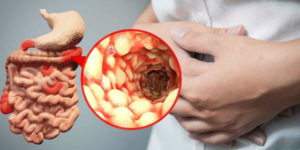
Crohn's disease
Oncological diseases
A tumor in the colon appears as a result of an advanced form of the disease and inflammation. An important role is played by hereditary predisposition. Obesity, a sedentary lifestyle, unbalanced diet, frequent constipation - all this can be the beginning of the acute development of oncology. Symptoms are quite similar to other ailments, these are colic in the lower abdomen, diarrhea, mucus and blood in the stool. As cancer develops, complications are exacerbated. Treatment depends on the form and stage of the disease. An operation is performed to remove inflammation. If metastases are found, chemoradiation therapy is prescribed.
- Adenocarcinoma. Common form of cancer. Neoplasms affect the mucous area and organ cells, rapidly spreading metastases.
- Signet ring cell carcinoma. The disease is formed as a result of the accumulation of cricoid cells filled with mucus, unrelated to each other.
- Squamous cell carcinoma. The tumor is formed from squamous epithelial cells. Dangerous oncology, the risk of death is high. Such a diagnosis is extremely rare.
- Undifferentiated cancer. Oncological formation consists of cells that do not secrete mucus and are not components of the glands. They are separated by the connective tissue stroma, forming strands.
- Unclassified cancer. Malignant tumors that do not fit any description of other forms of cancer. It is rare.
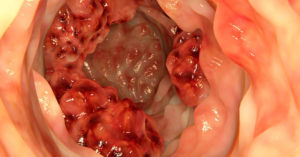
Colon cancer
The meaning and work of the organ
The colon covers the small intestine. The ascending part occupies the right angle, the transverse is located on top of the abdominal cavity, descending to the left, and the sigmoid at the bottom to the left. Does not participate in the digestion process. Digested food comes from the small intestine. In the ascending one, the absorption of liquid, vitamins, microelements begins, gradually forcing them to descend through the rest of the parts. A substance is released from the thin section - chyme, under the influence of which solid feces are formed.
Survey methods
Constant sharp pains in the lower abdomen, malfunctions of the digestive system can be a sign of a disease. It is necessary to consult a gastroenterologist who will prescribe examinations. The sooner the disease is detected, the more favorable the outcome of the disease.
- Irrigoscopy. X-ray, in which the required section is filled with a suspension. With this study, you can find: fistulas, tumors, ulcers and polyps.
- Colonoscopy. It is carried out using a special apparatus that allows you to examine the intestine from the inside. This is the most accurate research method. During the colonoscopy procedure, you can remove a benign tumor, take a biopsy, remove a foreign object, and stop bleeding.
- Examination with a rectal speculum. Examination is performed using a rectal speculum, inserting it into the anus by 10-15 cm. The examination is not carried out for severe pain, inflammation or spasm of the sphincter.
Disease prevention
Prevention of diseases of the colon, as well as the gastrointestinal tract, is primarily in the normalization of nutrition. It is recommended to consume more fiber, plant foods, protein, and plenty of water. Minimize your intake of trans fats, fast-digesting carbohydrates, fast food, and other heavy, fatty foods. Obesity also has a negative effect on the digestive tract.
Smoking, alcohol have a negative effect on all systems of the body, as well as on the digestive processes, forming disturbances. There is also a genetic predisposition to diseases, such people need to be examined twice as often. Older age is also at increased risk. At the first signs of pain symptoms, visit a gastroenterologist or therapist. He will prescribe the necessary examinations to make a diagnosis and prescribe the correct treatment.