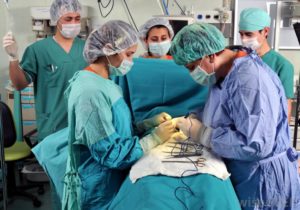
Acute appendicitis surgery and surgical diseases
Acute appendicitis is the general name for the negative state of the human body, which manifested itself in as a result of the inflammatory process in the appendix (appendix), and requires immediate treatment.
An appendectomy by invasive surgery is almost the only way to avoid negative consequences, especially if the emergency was ignored and led to a dangerous stage development.
Modern surgery classifies acute appendicitis as a common cause of surgery, second only to acute cholecystitis in terms of the number of operations performed.
The stages of the disease and acquired complications involve the use of certain subtleties, therefore, in the treatment protocol will certainly indicate the characteristics of the condition and the degree of damage to the worm-like appendix.

Content:
- 1 Surgery and disease treatment
- 2 Abdominal surgery and appendicitis
- 3 Uncharacteristic symptoms
- 4 Anatomical features of the structure or location
- 5 Stages of acute appendicitis
- 6 Temporal landmarks and complications
- 7 Useful video
Surgery and disease treatment
The literal translation of the common name of a particular branch of medicine means "doing by hand", or "Handicraft", but the original semantics of the name of a separate branch of medicine has long lost its meaning.
Today, surgeons are the elite of modern medicine, people with comprehensive knowledge in almost all branches of medical knowledge, capable diagnose the disease at an early stage for barely noticeable signs, advise therapeutic treatment, carry out an operation and decide on the necessary pain relief.
Surgical instruments have become not only a scalpel dissecting the tissues of the human body, but also laser beams, micro-instruments equipped with video cameras and even chemical methods of elimination pathologies.
Surgical diseases are negative conditions in which another method, except for the operative one, is impossible, acquired a new meaning, implying both minimally invasive techniques, and previous operations with the removal and excision.
The list of pathologies in which the surgical method is used is extensive, and the concept of surgical diseases still includes:
- traumatic injuries, starting with burns and frostbite and ending with ruptures of internal organs;
- congenital developmental anomalies and defects resulting from an abnormal course of pregnancy and genetic abnormalities;
- surgical infections, the elimination of which is possible only through surgery;
- certain parasitic infestations, such as echinococcosis and ascariasis;
- oncological pathologies;
- necrosis processes associated with prolonged circulatory disorders and soft tissue necrosis.
Separately distinguish between conditions that are in the competence of a pediatric surgeon and abdominal surgery, in the field activities, which are pathologies of internal organs located in the abdominal cavity, as well as diseases affecting its walls.
The incidence of inflammatory processes requiring urgent surgical intervention prevails over all other statistical data.
Abdominal surgery and appendicitis
Abdominal surgery, as a separate area for the treatment of surgical diseases, was highlighted due to the high frequency of referrals for surgical treatment of gastric ulcers and 12 duodenal ulcer, cirrhosis of the liver and diseases of the gallbladder (formation of calculi and acute inflammatory process), pathologies of the pancreas and inflammation of the vermiform appendix.
Many-sided, capable of disguising itself as other pathologies of the digestive organs, acute appendicitis, surgery considers it exclusively his prerogative.
Its treatment is mainly carried out by surgery, but behind the external simplicity of the operation, which every surgeon does in his life many times, there are possible professional difficulties.
This is due to the variability of its symptoms, size, location, stages of development, which the pathology acquires without timely treatment.
The possibility of complications, which are very likely in the last stages of the disease, when negative processes acquire a course that threatens death.
Treatment of acute appendicitis can be very difficult even for an experienced surgeon if the course of surgical pathology deviates from the usual scenario.
And there can be a lot of reasons for such complications.
Uncharacteristic symptoms
Over the past hundred years, practicing surgeons and scientific researchers have described more than 120 symptoms of appendicitis, in their opinion, allowing to determine the disease accurately.
Nevertheless, uncharacteristic symptoms are almost always present, due to a number of reasons that can mislead not only the patient, but also an experienced surgeon:
- localization: the appendix can be located in the pelvic region, and in the gallbladder, liver, in front of the stomach, with a mirror-like arrangement of internal organs;
- the stage of development at which the appeal for help took place;
- the size of the appendix, which can be from 2 cm to 30;
- the etiology of inflammation (from parasitic invasion to small parts of children's toy cars that blocked the lumen of the appendix;
- the presence of developed complications;
- other inflammatory processes (especially in women) developing in the abdominal cavity.
It is traditionally believed that inflammation of the appendix is accompanied by pain on the right side, but there are a variety of factors that can significantly complicate the preliminary diagnosis, especially if the patient was taking pain relievers, and the clinical picture smeared.
The diagnosis of appendicitis, sounding banal for patients, is perceived by surgery as a number of possible conditions that require both caution in diagnosis and variable tactics during the operation.
Anatomical features of the structure or location
Difficulties in diagnosis and treatment are associated with the individual characteristics of the patient's body.
The mirror arrangement of organs, which is not so common, was often misleading in establishing a reliable diagnosis, if this was not indicated in the medical history.
With inflammation of the appendix caused by negative processes in the female reproductive organs, the symptoms of a longer process are sometimes able to suppress the blurred clinical picture of appendicitis.
Symptoms of irritation according to Razdolsky, which are felt when tapping the abdominal wall and cause soreness in the right side, may be completely useless with a retrocecal arrangement appendix.
Due to its specificity, it accounts for the largest number of deaths.
The retroperitoneal pocket, caused by adhesions or other possible complications, completely isolates the appendix, and there are practically no symptoms.
Other options can complicate the situation, for example, the location of the appendix under the liver. It happens that the appendix is connected to the liver, kidney, or muscles.
At the same time, his mesentery is short or absent, and at the base there is also an inflection that contributes to the rapid development of the inflammatory process.
Practical surgery faces difficulties in carrying out the operation and in the event that the patient's treatment took place at a negative stage of development, which threatens to lead to complications, or has already provoked them flow.
In this case, much depends on the professional skill and speed of the surgeon's response.
Stages of acute appendicitis
There are 4 stages of the development of the disease: catarrhal, phlegmonous, gangrenous and perforated.
In the classical course of the disease, each of them can be identified by concomitant symptoms, but acute appendicitis does not always proceed so smoothly:
- the catarrhal stage, lasting no more than 16 hours, is accompanied by symptoms resembling food poisoning (diarrhea, vomiting, nausea and severe pain symptom;
- the phlegmonous stage, also known as acute phlegmonous appendicitis, is outwardly similar in symptoms to the catarrhal stage, only they intensify and become difficult to tolerate;
- gangrenous may be accompanied by external relief of the condition, but this is a deceptive picture caused by the death of nerve endings that have stopped the supply of pain impulses to the brain;
- perforated does not always stand out as a separate one, its peculiarity is that the walls of the appendix are not completely are destroyed, but only partially, but this still leads to the spilling of the purulent contents of the appendix into the abdominal cavity.
In some sources, there is a classification based on a different criterion.
Distinguish between acute appendicitis without complications, and phlegmonous, perforated and gangrenous are called destructive, because that they lead to the destruction of the walls of the appendix, the destruction of blood vessels, nerve endings, closely located organs.
Complicated appendicitis in this classification is the second type. This is a somewhat simplified approach to the development of the disease, because phlegmonous appendicitis, inevitably flowing into gangrenous without proper treatment, differs from gangrenous not only in the stage of development, but also in surgical tactics.
If at the phlegmonous stage the purulent process is only developing, then in the gangrenous stage the process of necrotization of the walls of the appendix, nervous endings and even complete death, leading, as a result, to the development of peritonitis, and this is a much more complex and lengthy process, not always crowned with success.
Temporal landmarks and complications
The time for seeking help from a surgeon in a state of acute abdomen, when the patient is in a state of indecision, is engaged in self-diagnostics and swallows pills by guests, in fact Little.
The catarrhal stage, in which you can do without complications and quickly leave the hospital, lasts only 16 hours in the standard course, but it can be accelerated by provoking factors.
According to practical experience, it can last from 6 to 12 hours, and after half a day it can turn into phlegmonous.
The development of a purulent process, fraught with complications after a day or two, turns into gangrenous, and at the end of the specified period, perforation or perforation leads to the spillage of purulent contents into the already affected by inflammation abdominal cavity.
Even the most experienced surgeon cannot indicate specific terms, because these are averaged terms, deduced from typical cases and just a clinical picture.
It happens, but not often, a tendency to reverse development, when it is possible to do without surgery, but this, as a rule, over time turns into chronic appendicitis, with its negative manifestations in the variants of expected permanent exacerbations.
To prevent chronic appendicitis, permanent treatment, or one-time removal, is necessary.
Any appendicitis classified as destructive can cause severe complications that are fatal:
- phlegmonous appendicitis, accompanied by fibrin prolapse, can form an appendicular infiltrate with the participation of the omentum and the loop of the small intestine;
- retroperitoneal location of the appendix results in retroperitoneal phlegmon;
- purulent exudate, having encased itself, causes the development of abscesses of various localization;
- rarely, but there is portal vein thrombophlebitis caused by purulent processes;
- rupture of the appendix with purulent contents leads to severe abdominal sepsis.
Any of the above complications can be fatal if not provided on time surgical aid, and the patient is still swallowing pills, in the hope that everything will resolve and the treatment will not required.
Remove the catarrhal process at an early stage of inflammation, or eliminate a severe infection of the abdominal cavities are processes of varying duration and complexity, from which the surgeon does not always manage to get out the winner.