How appendicitis hurts: where, duration, how it starts and what to do
People are increasingly suffering from various diseases of the gastrointestinal tract. The manifestation of diseases is influenced by the deteriorating environmental situation in the world, poor unbalanced nutrition, a lot of bad habits, and a sedentary lifestyle.
More and more often in the office of the therapist and surgeon the phrase sounds: "Appendicitis hurts ..." This is a disease that manifests itself against the background of inflammation of the appendix (appendix). The disease itself cannot hurt, therefore it is correct to ask: “how and where does the appendix hurt” so that the doctor would give a clear answer to the question.
The manifestation of the disease is quite diverse, the symptoms are extensive (more than 40). Naturally, the main and sure sign is pain. When the stomach begins to ache, it is required to note the area of localization and the nature of the pain.
Stomach problems affect the body differently from inflammation. With diseases of the gastrointestinal tract, it can get sick and stop, then not get sick for a long time (several days, a week). The inflamed appendicular process, on the contrary, hurts for a long time and constantly. In order not to endanger life, it is shown to undergo a full examination. It is possible to get rid of appendicitis only by surgery. Appendectomy (removal of the appendix) accounts for 70% of urgent surgical procedures.
Content
-
1 Symptoms of appendicitis
- 1.1 First stage
- 1.2 Second stage
- 1.3 Third stage
- 1.4 Stage four
- 2 Soreness after removal
- 3 Coping with pain after appendectomy
Symptoms of appendicitis
The appendix can be located on the right side or in the area of the left. In this case, the localization of pain is wandering. The pain is constant, pronounced. In the acute stage, suppuration of the appendicular process is possible, which forces an urgent operation to remove the appendix to slow down the process of the transition of inflammation to other organs.
With appendicitis, pain occurs sharply, against the background of good health, sometimes the patient wakes up at night from a sudden attack of pain. Most often, soreness occurs in the lower abdomen on the right side, but it can manifest itself in the navel and the upper part of the abdominal cavity, gradually (within 3-4 hours) descending into the iliac part of the peritoneum (Symptom Kocher). The pain is quite bearable, the intensity is constantly increasing, reaching acute.
Depending on the location of the appendicular process, the localization of pain occurs in different places:
- In the right iliac region. The right side and bottom of the peritoneum hurt. Sometimes the navel and the area around it hurt a lot. Pain relievers will not work to soothe pain.
- Behind the stomach. The localization of the pain syndrome is blurred. Starts off as a bloat, it seems like intestines hurts. Sometimes a pain reliever helps, but the effect lasts no more than an hour.
- In the pelvic area, in contact with the ureters, genitals. The nature of the pain is acute, pricks in the lower abdomen, there is a frequent urge to urinate. In women, gynecological ailments are possible against the background of suppuration of the process of the rectum in the area of the ovaries and uterus.
- Close to the kidneys, sometimes the liver. Soreness is observed in the lumbar region, radiates to the back.
- The process is on the left side of the abdominal cavity. The rarest type of location, with acute appendicitis difficulties arise in diagnosis. Painful sensations are manifested in the abdomen, the left side hurts.
Soreness progresses depending on the stage of the disease, starting with a slight manifestation in the form of swelling, ending with an acute, cutting. Everything symptoms indicate appendicitis.

First stage
The catarrhal stage lasts the first 10-12 hours, manifests itself as a dull, low-intensity pain in the iliac region and around the umbilical ring. Possible nausea, a single vomiting stream, increased urge to urinate, frequent loose stools, a gradual increase in body temperature above 37 degrees. There is general weakness, dry mouth with white bloom on the tongue, the soreness becomes more pronounced, more paroxysmal.
This is the best time for surgery. On examination, the softness of the abdominal cavity is observed; when probing the right area, the patient experiences an increase in pain.
Second stage
Phlegmonous stage of appendicitis falls on the end of the first day after the first signs of pain appear. The pain is localized in the lower abdomen on the right, becomes stabbing, nausea takes on a constant character, a beaten heart rate (mainly an increased heart rate). The body temperature rises to 38 degrees. The abdominal muscles on the right are tense, the diagnosis is confirmed.
Third stage
The gangrenous stage includes 2 and 3 days of inflammation of the appendix. There is an imaginary relief of pain syndrome (pain is dulled by the general fatigue of the body).

Soreness manifests itself in the lower abdomen. Intoxication of the body becomes pronounced (constant nausea, diarrhea, vomiting is possible). The body temperature becomes lowered (below 36 degrees). The bloating is very noticeable, the soreness increases with percussion.
Stage four
The perforated stage appears at the end of the third day. Sharp, throbbing pain becomes cramping, sometimes radiating to the intestines. Frequent vomiting, a brown coating appears on the tongue, the temperature rises to a critical level. Bowel movements do not work, laxatives do not help. Peritonitis (blood poisoning against a ruptured appendix) may develop. The pain is paroxysmal, strongly pronounced, sometimes radiating to the lumbar region. It is strictly forbidden to endure for a long time; if delayed, a lethal outcome is possible.
The time frame of the stages of the disease is conditional. In each case, the development of the disease proceeds differently (both a sharp course and a little expressed, latent).
The only solution was the surgical removal of the inflamed appendicular process.
Soreness after removal
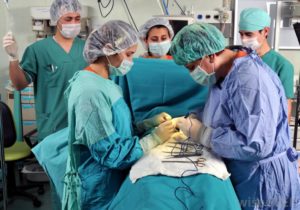
Any surgical intervention brings painful sensations after the procedure. After the operation, the internal tissues heal slowly, which causes pain. Painful aching, subsides gradually, localized in the right side. It may take several months after the appendix is removed to regain a pain-free life as usual. After appendicitis, other manifestations are possible:
- Sharp cutting pain. Indicates seam divergence. This is possible with sharp physical exertion on the press (a sharp rise from bed, severe cough, lifting heavy objects).
- Drawing pain, cramping sharp manifestations in the abdomen are present. This indicates the formation of adhesions. More often it manifests itself under the seam and on top of it, pulls the intestines.
- Soreness in the right side, which manifests itself during physical exertion, subsides during rest. Often, alternating problems with stool become parallel symptoms (diarrhea is replaced by constipation). Indicates the formation of a postoperative hernia.
- Increasing pain that does not stop for a minute, with an increase in body temperature. On the wound, there is noticeable compaction (swelling of the seams). Signals the development of the inflammatory process (abscess of tissues and organs).

In this case, it is not the appendicitis that is to blame, but unqualified surgery, the ingress of bacteria into the wound, or the wrong behavior of the postoperative patient.
For all manifestations, it is necessary to urgently contact your doctor. To reduce the chances of developing hernias and to prevent sutures from spreading, you need to follow the surgeon's recommendations, eat right (if you cut out the appendix, you must follow a strict diet). The diet is aimed at improving intestinal motility, which will prevent the development of improper bowel movements (bloating, flatulence, constipation).
Coping with pain after appendectomy
The operation to remove the appendix takes 1 hour on average. With possible pathologies, the surgical intervention is delayed up to 2-3 hours.
After the appendix is removed, pain is a normal symptom. The wound heals, the nerve endings send signals to the brain, it signals pain.
For severe pain, the doctor may prescribe narcotic analgesics, sold exclusively by prescription. Drinking is permissible in limited small doses. In extreme cases, the doctor will increase the dosage. Such drugs cause complications, self-administration is prohibited.
Pain relief is prescribed if the pain is abnormal. Otherwise, side effects will appear: nausea, increased sedation, delayed rehabilitation.
If the pain is tolerable, mild, it is possible to take non-narcotic analgesic drugs. Change of diet is possible. Each patient needs an individual approach. When handling complaints, be sure to indicate the manifestations of pain in detail.
Appendicitis is a dangerous disease. In case of untimely access to a medical institution, complications (peritonitis, abscess) are possible, up to a lethal outcome! Life is one, it is worth taking a closer look at your health.