Appendicular infiltrate: treatment, causes, diagnosis and clinical presentation
National clinical guidelines, according to which the process of therapy and diagnosis takes place, contain types complications of acute appendicitis. An acute inflammatory process inside the appendix, called the appendix, affects the organ and adjacent sections of the intestine, the adipose tissue of the peritoneum. Appendicular infiltration is inflamed tissue that occurs as a complication acute appendicitis (intermediate period) surrounding the appendix, cecum, peritoneum, small intestine (welded tangle of organs).
The occurrence of this ailment is observed in 1% of all cases of acute illness. Older children and adults are most affected. As a rule, the infiltration has boundaries that are clearly visible during examination.
The MKB-10 code does not contain a separate cipher for appendicular infiltrate. The wording of this ailment is carried out according to the following codes:
- K35 and K38 - diseases of the appendix as a vermiform appendix.
- K38 - other organ diseases.
The presence of a tumor is detected by palpation by a doctor. To confirm the diagnosis, the patient is sent for additional examination with medical equipment.
It is worth noting that infiltration can occur as an attempt by the body to protect itself from a purulent process that occurs in an organ or at some distance from it. Through appendicular formation, the abdominal space is protected from the spread of inflammation. Suppuration affects the tissue of the infiltrate and does not go further. The complexity of the inflammation depends on how the appendix is located.
With a normal lateral arrangement, the purulent area is easy to cut off. But medical statistics say a medial position is usually observed. Development pattern: the abscess is not isolated, and there is always a risk of violation of the integrity of the formation (peritonitis) and complications. A secondary abscess spreads through the body through the lymphatic tract.
Content
-
1 Clinic of the disease
- 1.1 Abscessing
- 1.2 Without abscess formation
- 2 Causes of the disease
- 3 Diagnostics
-
4 Treatment
- 4.1 Conservative therapy
- 4.2 Surgical intervention
Clinic of the disease
The first thing that the patient feels with inflammation of the appendix is an acute pain syndrome, concentrated in the umbilical zone. It is possible that the onset of symptoms may occur later due to the consumption of antimicrobial and antiviral drugs.
Pathogenesis is observed on the 3rd or 4th day, after the first signs of the disease. The inflamed tissue that forms the infiltrate is formed, covering a certain area. During this period, the pain syndrome decreases, the body temperature is kept at around 37.8.
A blood test at this point shows an increased content of leukocytes.
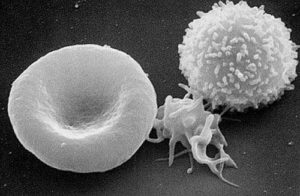
Leukocytes in human blood
The pulse is quickened. When examined by a doctor, the place of concentration of the infiltrate is well palpated. In this case, the patient feels pain when pressed, the inflamed area is allocated with an increased volume. In the future, the body temperature increases, reaches 38 degrees and above, the pain syndrome becomes more intense.
The syndrome and the clinic of the disease stand out:
- The syndrome of abdominal pain is localized on the right, in the region of the iliac fossa. There is no return of pain to other parts of the body. Well defined by palpation of the inflamed area.
- Syndrome of endogenous intoxication of the body. The human body cannot regulate temperature, the heart rate is unstable, and tachycardia occurs. In the blood, the content of leukocytes increases, which indicates an expanding inflammatory process. Also, an indicator of the erythrocyte sedimentation rate serves as a confirmation of inflammation. Upward change in the quantitative content of stab neutrophils. The composition of the blood changes and the content of lymphocytes in it decreases.
AI development can be of two types:
- Absolute.
- Without abscess formation.
Abscessing
Strengthening the inflammatory process leads to a significant increase in body temperature. The abscessing process is manifested by signs of body poisoning. The pain gets more intense. Abscess formation is characterized by a deterioration in the patient's condition, despite the conduct of drug therapy. Sweating, chills - and a cavity of heterogeneous consistency appears on the ultrasound scan.
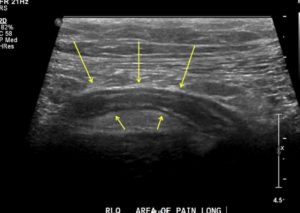
Appendicitis on ultrasound
Without abscess formation
When appendicitis passes without abscess formation, a process opposite to the inflammatory one is observed. The tumor resolves within forty days. This is possible if the treatment was adequate and started on time.
External signs of the formation of an infiltrate appear on the third day. Patients complain of constant pain that lasts all these days. The body temperature does not drop and remains high. There is a classification of AI by density:
- Dense. On the right side of the abdomen, the smooth surface of the tumor is clearly felt, and its contours can be determined. The stomach itself and the surrounding space remain soft. Such infiltration is treated with medication, diet, therapy using UHF equipment, bed rest.
- Loose. A soft consistency is felt at the location of the tumor. The complexity of diagnosis lies in the tense state of the walls of the peritoneum. A loose state is formed from hyperemic joints and swelling of adjacent tissues. At the same time, it is difficult to determine the boundaries of the formation, which does not give a clear understanding of the possibility of cutting off the affected area during the operation.
Lack of therapy leads to the development of sepsis:
- The temperature rises;
- Pulse and breathing quicken;
- Cold sweat appears on the body;
- The skin turns pale, the number of leukocytes increases.
Causes of the disease
The etiology of AI development is different. The main version is obstructive theory (stagnation). Medicine identifies several main factors that provoke the formation of inflammatory tissue:
- The patient's immunity is weakened and therefore cannot prevent the inflammatory process on its own.

- The location of the appendix. The presence of the appendix in front of or behind the blind intestine leads to the fact that the diagnosis is not made, and the necessary therapy is not available.
- The peculiarity of the course of organ inflammation.
- The appearance of the disease. The causative agent of the disease that provoked appendicitis is determined. Causes: Escherichia coli, coccal infection, non-clostridial flora.
- Antibacterial medications. Medicines or viruses-pathogens, incorrectly prescribed by a doctor, are resistant to the drugs taken.
- Violation in the process of removing the appendix.
Often the medical history states that patients are late in seeking medical help. As a rule, a person suffers pain for a day and only then goes to the hospital. Only in 10% of cases the patient immediately goes to the doctor.
The consequence of not treating OA manifests itself in two stages:
- The first is early neoplasm. The tissue around the appendix becomes inflamed as early as the second day after the onset of pain.
- Late stage - appendicular infiltration begins to appear only on the 4th-5th day.
In children and adults, there are two stages of tumor development:

- The first 10 - 14 days, the neoplasm increases and captures only a limited space. Further spread is stopped by the peritoneum.
- After two weeks of tumor growth, a reverse process is observed, which can develop in one of two ways: complete resorption of the neoplasm (one month) or transition to a periappendicular abscess, which is suppuration around the body an unremoved appendix.
Diagnostics
Making a correct diagnosis is important to prescribing adequate treatment. Differential diagnosis takes into account the peculiarities of the manifestation of the symptoms of the disease and the possible coincidence with other diseases:
- An ailment similar in its characteristics to appendicitis is Crohn's disease. As a result of development, the walls of the colon swell, spasmodic phenomena, stenosis occur, the contours of the intestinal section become blurred.
- Actinomycosis of the blind section. Among similar symptoms, a distinctive feature is distinguished: the skin turns blue in the affected area.
- The ovarian cyst is twisted. An experienced physician, upon examination (bimanual palpation) of the patient, will be able to distinguish appendicitis from an anatomical disorder of the position of the organ. Also, the method of laparoscopic examination is used to confirm the diagnosis.
- Tumor formation or cancer in the cecum. The growth of the tumor occurs with a gradual increase in the intensity of pain. At the same time, the temperature remains at around 36.6 degrees. In the analysis of blood, anemia and delayed erythrocyte sedimentation are noted.
- Acute nonspecific mesenteric adenitis. The difference lies in the enlargement of the lymph nodes and the occurrence of Sternberg's symptom.
Diagnosis of the disease includes collecting an anamnesis of the disease, clarifying complaints, the nature of the pain syndrome, when it began. However, not all patients in fear of surgery talk about pain, which complicates the diagnosis process.

The doctor palpates the disturbing area of the body. This method does not always give positive results. The anatomical position of the appendix, the layering of fat mass on the abdomen lead to the need to use other examination methods:
- Blood analysis.
- Conducting an ultrasound examination (ultrasound), which gives the most complete picture of the processes taking place inside the body. If necessary, use Abdominal CT scan.
Treatment
The doctor tries not to perform surgery unless absolutely necessary. Initially, they seek to carry out conservative treatment, which consists in taking medications and using medical therapeutic equipment.
All efforts are aimed at suppressing the inflammatory process at the source of the disease. When the inflammation subsides, then the swelling of the tissues resolves within a month or one and a half.
Treatment is carried out in two ways, depending on the course of the disease.
Conservative therapy
During hospitalization, the patient is assigned to bed rest (a nursing process is carried out), as well as a diet aimed at preventing further inflammation. Ice is periodically placed on the patient's stomach, which leads to a slowdown in the activity of pathogenic microorganisms and the impossibility of their reproduction.
For the first five days, doctors try to stop the inflammatory process with the help of drug treatment:
- Medicines with antibacterial action: Ceftriaxone, Tsiprolet, Amoxiclav, Doxycycline.

- Anti-inflammatory drugs that do not contain steroids: Nimesil, Nurofen, Nimegesic.
- A therapy aimed at relieving the symptoms of intoxication of the body. As a rule, solutions are used that cleanse the blood and remove toxic substances. Introduced intravenously using a dropper: glucose, sodium chloride, Gemodez.
- Drugs that remove concomitant symptoms: vitamins, antispasmodics, sorbents, probiotic drugs (eliminate dysbiosis).
With positive results, suppuration of the infiltrate stops. The patient is observed until complete recovery. Surgical removal is not performed. In order to avoid the occurrence of a relapse after treatment, a second examination is prescribed after three months.
The diet for appendicular infiltration is gentle and should not contain:
- Spicy dishes, smoked meats, spices.
- Reduce or eliminate coarse fiber from the diet. Also remove vegetables and fruits rich in it.
- Alcoholic drinks and soda are strictly prohibited.
At discharge, the patient is re-examined.
If the medicines do not give a result for four days, the patient's condition worsens and the suppuration increases, an operation is prescribed.
Surgical intervention
Surgery is performed by laparotomy. The abscess is opened, the contents are drained and the appendix is cut off. Also, an abscess is punctured and the internal contents are removed through a puncture needle.
A drainage system is installed that removes the remnants of the purulent process, supplying antiseptic and antibacterial solutions inside. Removal occurs when the selection stops. Physical activity is contraindicated after surgery.
The tactics of treating a chronic type of appendicular infiltrate is to carry out medication therapy. After the exacerbation is removed, the source of the disease is promptly removed.