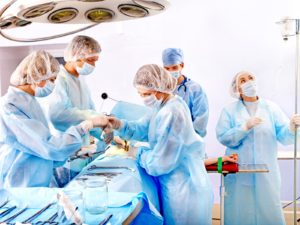
Types of operations for the removal of appendicitis
Removal of appendicitis is a surgical procedure in which excision of the appendix is performed.
Ignore the disease can not be, because the consequences can be dangerous.
Timely operation - laparoscopy - will help avoid pathologies, the appearance of adhesions. In addition, the postoperative period is faster.
How is the disease diagnosed?
Contents:
- How is the disease diagnosed?
- Conducting operation
- Modern methods of appendicitis removal
- Adhesions - a consequence of surgical intervention
- Recovery period of the patient
Diagnosis of appendicitis lasts a short period. It is important for the doctor to know exactly the cause of the patient's "acute abdomen", since the symptoms of the disease may be similar to other diseases of the abdominal cavity. The patient is examined in the hospital.
First of all, the doctor should interview the patient, listen to his complaints, find out how long the pain syndrome lasts, in which side, what symptoms are manifested, what temperature the patient has.
When examining a patient, it is important to pay attention to the gait and posture in which he sits or lies. Body temperature can be increased. Be sure to evaluate the appearance of the abdominal wall.
At palpation, the specialist will pay attention to the places where the patient feels pain. With appendicitis, acute pain manifests itself in the right side. Performing percussion, the doctor reveals the nature and strength of pain.
When examining blood, urine, the number of leukocytes, ESR is estimated. Women can be tested for pregnancy. Such tests show the presence or absence of inflammation, adhesions.
A more accurate picture will show other types of examination: X-ray, ultrasound, CT.

If the appendicitis clinic is not pronounced, the body temperature is normal and there are no clear indications for the operation, then an additional diagnosis is performed - laparoscopy.
An anesthesiologist must also conduct a patient examination before surgery.
Carrying out operation
The operation to remove appendicitis can take about 30 minutes, but on condition that the patient has no complications.
If the patient has all the symptoms of a purulent stage of the disease, then the procedure goes to 1 - 1.5 hours. If the wall of the appendix is ruptured, pus may leak into the peritoneum.
In this case, the surgeon rinses the organs and establishes drainage, otherwise complications will occur.
During an appendixectomy in the traditional way, the patient is made a small incision on the right side. The surgeon should cut not only the skin, but also the abdominal wall.
Next, the doctor must examine the appendix. Carefully examined organs that are located near the appendage.
The doctor must ensure that there are no concomitant diseases. Only after this, the appendix is removed.

For removal of the appendix, the surgeon cuts the connective tissue, which results in the detachment from the intestine.
Then the intestine is sewn with special threads, which eventually dissolve. The detected abscess must be dried using drainage.
After a classic appendectomy, the patient's body temperature may rise slightly, there will be a small suture on the right side, the rehabilitation will take longer than after laparoscopy.
The patient must lie for the first few days, any physical activity is prohibited at this time.
Modern methods of appendicitis removal
The operation to remove appendicitis by the method of laparoscopy is less painful than traditional, because the cuts the surgeon does not perform.
Rehabilitation after the procedure does not last long, and the risk of complications is minimal. A few hours after the end of the operation, the patient can be discharged home.
Such patients lie in the hospital for a short time, because complications do not arise after the operation, the temperature quickly normalizes, and no drainage is necessary.
Video:
During the operation, several punctures are performed with special tools. After removal of the appendix on the patient's body, small traces will remain, through which the bacteria can not enter the abdominal cavity.
The doctor should have experience in performing similar operations, otherwise there is a risk of internal bleeding - recovery will take a long time, a high body temperature is possible.
Removal of the process using the method of transluminal appendectomy is a modern method of removal of the appendage.
The procedure is carried out by flexible instruments that are inserted into the lumens of the vagina or stomach.
After the operation, there are no visual traces on the body or defects. Recovery after surgery is very fast.
Patients are not in hospital for long, because recovery is rapid, the temperature is normal. Drainage after surgery with laparoscopic and transluminal methods is not set.

Modern methods of removal of the appendix are relevant only if the patient has symptoms of the initial stage of appendicitis.
If the walls of the process break through and pus leaves the abdominal cavity, the patient needs a traditional operation with the washing of internal organs.
Adhesions - a consequence of surgical intervention
Almost 30% of patients after surgery showed the appearance of adhesions, if patients constantly lie in bed.
Most often they are formed between the intestine and other organs located side by side.
The appearance of adhesions is due to the fusion of the walls of the organs with each other. The prerequisites for the appearance of this pathology is the peculiarity of the organism - the tendency of the peritoneum to adhere.
If in the inflammatory process part of the peritoneum sticks to the organ where the pathological process occurs, the inflammation does not spread further.
The formation of adhesions would be a good protective function of the body, if not for the deformation of internal organs and, as a consequence, the violation of their functions. Spikes compress vessels, narrowing of the gastrointestinal tract occurs.
The choice of treatment of pathology depends on the stage of development - the symptoms are different for each stage of the disease. At the beginning of the formation of adhesions, they can be treated with medical preparations.
Video:
Only the doctor must prescribe medication, it is forbidden to independently carry out the treatment.
If the presence of adhesions interferes with the patient, causes pain, and the body temperature rises, they should be removed. The most preferred type of surgery is laparoscopy.
To prevent the formation of adhesions after the operation, the patient must move. The patient should try to be more in an upright position, while the load should be moderate.
In this case, movement occurs in the internal organs. Physical stress should be moderate, it is necessary to follow all the doctor's recommendations. So you can avoid the appearance of adhesions.
Recovery period of the patient
Restoration after surgery lasts until the seams are removed. How long rehabilitation will last depends on many factors: what kind of operation was conducted, are there any complications, whether spikes or other causes have appeared.
In the middle and late rehabilitation period, it is necessary to monitor the patient's bowel movements and urination. These functions should be normalized.
In addition, body temperature, seam status, and appetite of the patient are monitored.
Video:
Drainage is established for the patient to prevent a purulent inflammatory process. The doctor sets the tube in the right side of the abdomen, its ends are out.
Drainage makes it possible to wash the wounds with an antiseptic.
It is not recommended to refuse to install drainage, as it is only put in cases where there is a threat of complications.
The patient at this time is in hospital under the supervision of specialists. Most drainage is kept for several days.
While in the hospital, the patient usually tolerates it normally. If appendicitis was removed in the late stages, then drainage will need to be worn longer.
The patient may have pain after removal of appendicitis, then the doctor will prescribe medications that help to remove pain. If the pain persists after discharge, there may have been complications.
You can not walk to the patient right after the operation, it should take several days. Only then will the body recover faster.
Often, patients are interested in how long it takes to reach the point where the doctor removes stitches.
Most often they are removed on the 7th-9th day, but only if the patient does not show symptoms of complication, body temperature is normalized. Drainage is removed after a few days.
After the hospital patient is completed, exercise should be done carefully.
Otherwise, unpleasant consequences may occur, such as complications, the appearance of adhesions, the seams in the right side may part.