Methods of treatment of pancreatic necrosis of the pancreas
There are various complications of acute pancreatitis, one of the most dangerous - pancreatic necrosis or death of organ tissues.
It is because of fears of this pathology that doctors recommend radical surgical treatment of cholelithiasis - the main cause of the development of acute pancreatitis.
The role of the pancreas in the digestive system
Contents:
- The role of the pancreas in the digestive system
- The dangers of the queen of digestion
- Some details about the pancreatonecrosis
- How not to die from pancreatic necrosis?
The pancreas is the key organ of the digestive system. The very term "system" implies the interconnection between all its elements, and the absence of at least one of them leads to malfunctions, even small ones, that lead to new complications.
Take, for example, the gallbladder - an organ that does not belong to the vital. In it, the bile produced in the liver during storage is "insisted" and fermented.
After cholecystectomy, operations to remove the gallbladder, bile directly enters the duodenum, where it participates in the process of digestion.
It would seem that nothing has changed. But it was not there.
The bile of the liver has a significantly lower concentration, leading to a number of significant changes.
First, the body can no longer digest large amounts of food, and it does not always cope with fatty foods.
Secondly, low-concentration bile is worse than bactericidal function, which can lead to binge of pathogenic bacteria in the duodenum and cause in it a destructive process that can sweep adjacent organs and cause various symptoms of impaired digestion.
So it turns out that even after removing the organ without which a person is able to survive and has high chances for a full life, negative consequences are inevitable, therefore, it is necessary to change the way of life, nutrition and so on.
What can we say about such a vital organ as the pancreas!
Queen of digestion it is called in the sense that it is the pancreas that produces the basic enzymes for the breakdown of fats, proteins and carbohydrates derived from food.
The body daily produces about two liters of pancreatic juice, which contains 22 enzymes. Without them, the cells would not receive the necessary building and repair materials, food, energy.
The mutual influence of the organs of the digestive system indicates even their proximity.
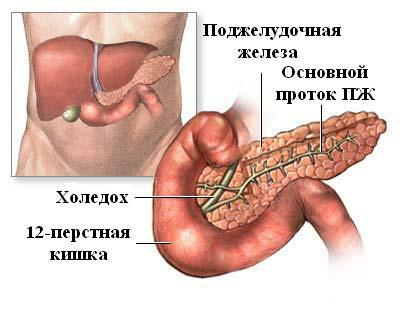
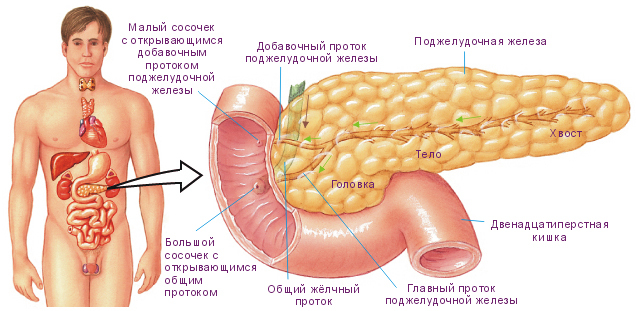
The pancreas is located immediately behind the stomach( "anatomically," it was called anatomics, which studied the structure of the human body on corpses), as if embracing, the pancreas envelops the duodenum, the pancreatic duct passes near the common bile duct, and they together flow into the duodenum.
Dangers for the "queen of digestion"
Doctors consider the pancreas to be one of the most "tender" organs.
Complications in the condition of the body can cause various medical measures: puncture, radiology.
An adverse outcome for the condition of the pancreas can cause even operations on adjacent organs.
Classification of major pancreatic diseases includes pancreatitis, cancer, cystic fibrosis, diabetes and pseudocysts. Pancreatitis is an inflammation of the pancreas.
Video:
This is not a separate disease, but a condition that is typical for various health problems of the body.
Chronic and acute pancreatitis may not be related to each other. Acute can act as a complication of chronic, and this is a completely different diagnosis than exacerbation.
Pancreatic necrosis of the pancreas is the most unfavorable outcome of acute pancreatitis.
The most dangerous destructive acute pancreatitis, the signs of which include a change in the structure of tissues, that is, foci of necrosis.
Fatal outcome occurs approximately in half of cases( according to different data, death from pancreatonecrosis occurs in 30 - 70% of patients), which forms an unfavorable prognosis.
The chances of surviving the patient are higher the earlier he will get qualified treatment. For this, it is important to present the symptoms and signs that characterize acute pancreatitis.
There is a very severe pain in the upper abdomen, often surrounding the belly, which gives back or scapula.
Intensity of sensations is the signal of the body that the situation is serious. Symptoms include nausea and vomiting, after which the patient does not get better, unlike gastrointestinal pathologies.
Severe symptoms arise because the enzymes of the pancreas are activated prematurely and begin to digest the tissues of the organ.
The consequences of tissue death are the poisoning of the entire body with toxic substances that are carried by the bloodstream.
Acute pancreatitis causes a variety of reasons. The main - the consequences of alcohol consumption( about 70%), in second place( 25 - 30%) are bile duct diseases, in particular cholelithiasis.
The diagnosis of acute pancreatitis and, consequently, pancreatic necrosis in women is more common than in men, as a rule, the disease falls on the age of 30 to 60 years.
Pancreatonecrosis is an acute pathology, the outcome of which depends on how quickly to begin to treat it. No other diagnosis of the pancreas can cause such a rapid lethal outcome.
Some details on pancreatic necrosis
Classification of pancreatic necrosis depending on the extent of pancreatic damage includes the following stages:
- shallow focal;
- medium-weight;
- is large-focal;
- subtotal;
- is total.
Depending on the stage, the forecast may be more or less favorable. If small focal pancreonecrosis can be successfully treated, then with the total pathology of the patient, it is almost impossible to save.
Another classification divides pancreatic necrosis into a sterile and infected one, depending on whether the infection has hit the affected pancreatic tissue.
Infected pancreonecrosis is harder to treat, the forecast is worse.
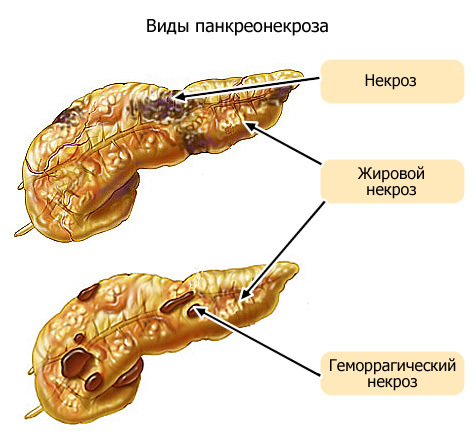
Sterile pancreatic necrosis happens:
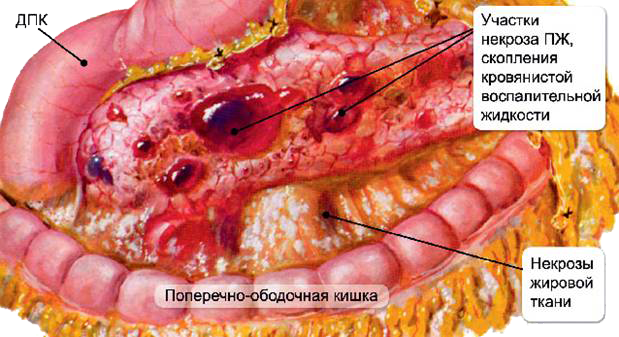
- hemorrhagic - accompanied by bleeding;
- fat;
- mixed.
Fatty type of pathology is easiest to treat, however, the most common case is a mixed variant of the disease, in which treatment complicates bleeding from the affected parts of the pancreas.
Hemorrhagic pancreatic necrosis develops rapidly, its symptoms are more acute and severe.
The fatty version gives the patient and doctors a little more time, the symptoms grow over the course of four to five days.
Symptoms of the disease often occur after large-scale celebrations with abundant food and plenty of alcohol.
This increases the tone of the sphincter of Oddi - the valve, which is on the way to the duodenum of the joint ducts of the gallbladder and pancreas.
The pressure in the ducts increases. Against this background there is a rapid release of enzymes of the pancreas and bile, because the body received a signal that they are necessary.
This picture looks particularly frightening if you know that the enzymes of the pancreas are activated by contact with bile.
Since bile is partially or completely blocked in the duodenum, where it should occur, it is thrown into the pancreatic ducts.
Enzymes that process fats are activated first and destroy the membranes of pancreatic tissue cells. Then enzymes that break down the proteins join.
The consequences are predictable - the pancreas slowly begins to die.
Depending on the stage of this process, treatment can be more or less successful, and the consequences for the patient's further life are more or less large-scale.
How not to die from pancreatic necrosis?
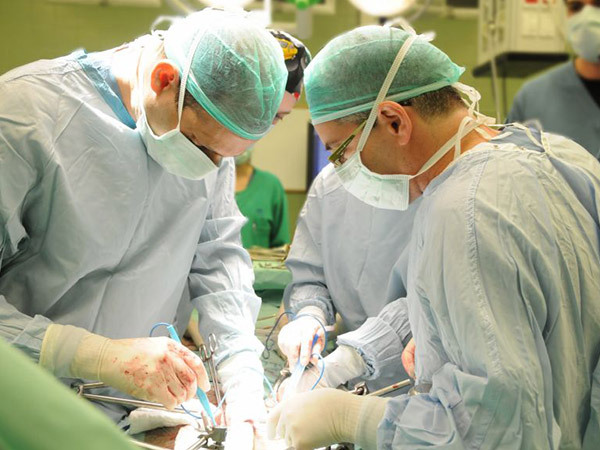
Treatment of pancreatic necrosis may be conservative or surgical. Operation is necessary in most cases of destructive acute pancreatitis.
For example, infected pancreatic necrosis, especially total, is an indication for an emergency surgery.
To surgical operation in some cases resorted not immediately, but in the event that conservative treatment does not work, and the patient's condition, despite all the efforts, worsens. However, in some cases, doctors can try to do without it.
Conservative treatment includes mandatory starvation: in the first few days after an attack a patient can receive all the substances necessary to the body only intravenously.
In violation of the patency of pancreatic and bile ducts, intravenous "nutrition" can last several weeks. In the same way, dehydration of the body is prevented.
Treatment of pancreatic necrosis is always an individual process, as the picture of the disease can be significantly different. However, the strategy has common features.
It is necessary to relieve the suffering person from pain, and also to eliminate the causes of violations - to clear blood and lymph from the circulating poisonous substances causing shock and sepsis.
Earlier treatment of acute pancreatitis necessarily presupposed antiferment preparations in order to eliminate the causes of self-digestion of the organ.
However, the effectiveness of this approach has not been confirmed, so it is no longer used. The hormone somatostatin, on the contrary, is increasingly used in pancreatic necrosis.
It reduces the burden on the kidneys and increases the patient's chances of surviving. If the pancreatic necrosis areas are infected, doctors use antibiotics.
In the necrosis foci in the gland cavity fluid accumulates, and there is a kind of operation for its removal - drainage.
The doctor necessarily takes this liquid for analysis to determine the degree of cell damage, the presence of pathogens of infection, the chemical composition.
Drainage can only give results if the necrotic areas are small. With extensive lesions, fragments of the gland are removed, up to an operation to remove the organ - pancreatectomy.
Often necrotic process continues even after surgery, with deterioration, repeated surgical intervention is required.
Video:
Regardless of whether treatment of pancreatonecrosis was limited to conservative methods or an operation was performed, a person's life will never be the same again.
If he expects to live longer, he will have to give up alcohol, smoking and abundant food, especially greasy.
Symptoms of inflammation of the pancreas will bother until the end of life, and the treatment strategy will depend on the manifestations of the disease.