What is tooth granuloma and how to treat it: causes and symptoms of the pathology, methods of diagnosis and treatment
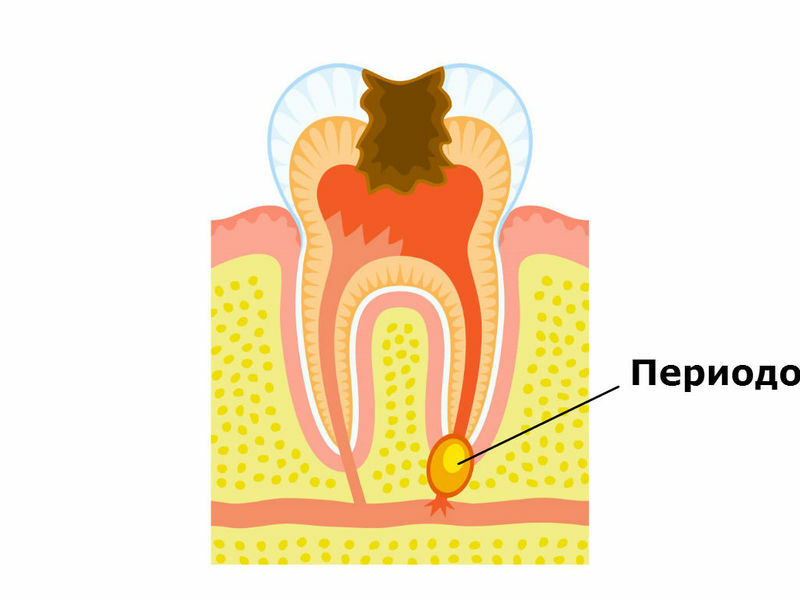
 One of the unpleasant diseases of the oral cavity is a tooth granuloma.Near the root of the tooth is formed a cavity with purulent contents.In a shallow purulent sac all conditions for the development of an infection that without timely treatment can harm the tooth and its root are created.
In time to diagnose granuloma is problematic.Due to the small size of the granuloma, there may be a false idea of its safety for humans, however, this small formation can provoke a whole group of complications.
Those who have experienced unbearable pain due to flux or phlegmon, will understand that any dental disease must be treated without fail, because granuloma can lead to more serious problems such as fistula, cyst or sepsis.Among other things, against the background of dental granuloma may aggravate some of the heart and kidney diseases.
Because of what the tooth granuloma
appears  The tooth granuloma can appear for many reasons.This is a common cold, accompanied by an increase in temperature and a decrease in immune defense.Its contribution is excruciating physical exertion,
Doctors do not write off such a disease as periodontitis.Many of them agree that inflammation of the peri-toothed tissues of can serve as the beginning of such an unpleasant phenomenon as tooth granuloma.
The tooth gums that frame the patient are infected, which creates a favorable environment for purulent processes.Hit pathogenic microbes into the root of the tooth, possibly even in the early stages of periodontitis.This can lead to the rapid formation of a tooth ulcer.
And one of the causes of granuloma can be pulpitis.According to statistics, he is one of the main provoking factors.When is inflamed the root nerve of , the risk of a purulent sac, called granuloma, increases immediately.
It should be noted that jaw injuries have a connection with the nucleation of granuloma.During traumatization of the jaws and tissues to them adjacent, conditions are created for spreading the infection to the root of the tooth.
Medical errors often cause a tooth granuloma.Failure to observe the sterility of the instrument and the dentist's inattention can lead to many undesirable consequences.During medical manipulations and removal of the nerve, an infection can be introduced that will give impetus to the appearance of a similar pathology.
Mechanism of formation of granuloma and its forms
The process of forming a granular nodule consists of four stages, each of which has its own specifics:
-
 At the first stage cells called "young monocyte phagocytes" accumulate in the damaged tissue.
 - Further, these cellular structures begin to mature and transform into macrophages.The inflammatory focus in the form of a nodule at this stage was called a macrophagal granuloma.
- In the third stage, macrophages, together with monocytic phagocytes, are transformed into epithelioid cells.The formed formation is called epithelioid cell granuloma.
- At the final stage, epithelioid cells are merged with macrophages, resulting in the formation of giant cells.They are called Pirogov-Langhans cells.Now the granuloma is designated as giant cell or epithelioid-cell.
Once the granuloma is formed, in its place in some cases develops necrosis.The fabric on such site dies off.In some situations, is caused by sclerosing the inflamed tissue of .On the site of the inflammatory focus appears connective tissue.
Like any other disease, the granule exists in several forms:
- Simple form.This is an early stage in the formation of granuloma, where it is only a separate process that does not connect with other areas.
- Complicated form.It is detected after untimely treatment.If at the initial stage the gingival tissues do not germinate deep into the granuloma, then the chronic form is marked by this phenomenon.
Clinical development of the disease
 It often happens that a serious and serious illness does not manifest itself for a long time.It is inherent in dental granuloma.A person for a long time does not notice any obvious symptoms of , does not feel any discomfort in the aching tooth, while the disease is gaining momentum.
Sudden acute pain and severe edema of gums can make you think about the presence of granuloma.Find out whether, indeed, the tooth was subjected to the insidious effects of granulomas, only an experienced dentist who can examine the pathology on an X-ray image is able to.
The main symptoms inherent in tooth granule:
- strong toothache, aggravated by chewing food;
- gingivitis, not typical for all cases;
- can sometimes be marked by bleeding gingiva, in particular, when cleaning teeth;
- discoloration of tooth enamel, usually darkening;
- slight tooth displacement;
- protrusion of the jaw;
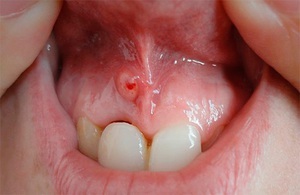
- appearance of purulent discharge in the tooth region;
- with a complex form of the disease is possible high body temperature.
It is worrying that these symptoms, which indicate the development of granuloma, only appear on the progressing stage of the disease.
Diagnostic methods
 It is not always possible to detect tooth granulosis during a preventive examination in the doctor's office due to the small size and the absence of obvious symptoms.Externally affected chewing organ, can not differ in any way from healthy teeth.
The presence of granuloma can be evidenced by a clinical picture, manifested by pain syndrome due to overgrowth and suppuration of the focus of infection.To clarify the diagnosis of , the patient is sent to the radiograph .In some cases, use a modern diagnostic device - radiovisiograph.
Treatment of tooth granule
 Granuloma is successfully treated with conservative methods, in separate episodes with laser therapy, when tooth extraction is not required.Most often it is required to produce professional endodontic treatment of tooth channels , which includes cleaning, antiseptic rinsing, setting of a new seal.
The dentist must ensure that the sealed channels are sealed and bacteria can not penetrate there.Later the doctor monitors the condition of the tooth and surrounding tissues.
After six months, the patient is assigned control X-ray image of , on the basis of which they make a conclusion about the success of therapy.In the event that the growth of the neoplasm ceased, and the focus of inflammation subsided, the treatment is stopped.With the continued growth of pathology, there is a possibility of the appearance of a cyst, which should be removed by a surgeon in a stationary setting.
When the treatment of the tooth canal fails to produce the proper result, the uses the surgical procedure.Through the outer wall, through the bone, access to the dental root.Next, the granuloma is scraped.Carefully treated with antibacterial solutions the place of its attachment, sutured mucous membrane.
In some cases, the root tip is infected, so it has to be cut off.As a result, the bone is restored, and the life of the tooth is not reduced.Sometimes you can not do without complete removal of the root of the tooth .To date, this is a very common dental surgery.
To do this, the required root is removed together with the crown, and the prosthesis is placed if the remaining roots are able to withstand the required loads.Many dentists use antibiotics to treat tooth granulomas.As practice shows, this does not solve the problem entirely, but only slows the inflammatory processes.
The main thing in treatment is to eliminate the source of inflammation of so that the disease does not return again.A separate place in the treatment of granuloma is physiotherapy.For example, depophoresis has a healing effect in the curvature of teeth, when the channels have a complex structure.
The therapeutic effect is due to the effect of weak electric currents on the suspension of copper hydroxide, by which inflammation decreases.Depophoresis has good permeability to all parts of the tooth.
If the tooth granuloma is removed and the pain does not pass and it is impossible to touch the tooth, should be visited again by the doctor .Often after surgical treatment, patients complain of toothache.
Painful sensations can accompany a person for a very long time, so you need to make sure that there are no inflammations, and the nature of this pain is residual, not related to other problems of the oral cavity.
Methods of traditional medicine for the treatment of granules
 If the time to recognize the granuloma of the tooth, then automatically increases the likelihood of recovery with the help of only recipes of traditional medicine.We must not forget that folk remedies are not a panacea, but sometimes the doctor can advise for additional natural therapy to reinforce the effect of medications.
Before using the prescription, you should definitely consult with your doctor to avoid individual intolerance and allergic reactions.With the tooth granuloma, the following recipes have proved themselves well:
- The tincture of propolis and aureus should be mixed in equal proportions.Each drug infusion take 10 ml.The resulting solution rinse the oral cavity twice a day for 5 minutes.
- Take 40 grams of sage, 40 grams of chamomile ordinary, 60 grams of eucalyptus mixed and pour boiling water, insist for two hours.Such an antiseptic infusion is suitable for a two-time rinse.
- Separate the egg white from the yolk and mix with 30 grams of sea salt, add 400 ml of water.Rinse mouth after each meal.
- 3 grams of oak bark, 40 grams of calendula flowers, 30 grams of hazelnuts pour hot water.Cool down the mouth after eating.
- 40 grams of celandine tincture is mixed with 40 grams of glycerin and 40 grams of vegetable oil.The mixture applied to the cotton swab is applied to the diseased area.
- 40 grams of chamomile, 40 grams of sage, 40 grams of marigold mixed and poured into a mixture of 500 ml of vodka.Put in a dark place for a week.Then the resulting infusion filter and rinse their mouth after eating.
Consequences of untreated tooth granule
Even considering the fact that the inflamed area is rarely more than 5 mm, the tooth granuloma can give such complications:
-
 Cyst.Cystic tooth formation consists of a granulation tissue that is surrounded by a capsule.It comes to replace dead tissue and conceals in itself no less danger than granuloma.
 - Fizz.The fistula duct connects the inflammatory focus to the cavity for the removal of mucus, pus, serosa-fibrous fluid.
- Period.Inflammatory reaction affects the periosteum.
- Osteomyelitis.Inflammatory process is found in the bones of the jaw.
- Infectious inflammatory processes in internal organs
- Septic blood infection
Granuloma is very insidious and dangerous disease , since at first it flows without obvious signs and is fraught with many complications.But if you pay proper attention to oral hygiene and attend preventive examinations, the chances of encountering this disease will be reduced to a minimum.