Symptoms of chicken pox in children
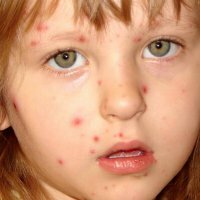
Chickenpox is an acute infectious disease, accompanied by a bubble rash and fever. The chickenpox is transferred, mainly, in childhood. About half of the cases occurring between the ages of 5 to 9 years of age, less sick kids 1st-4, as well as 10, 14 years. About 10% of cases of chickenpox are in persons 15 years and older.
Chickenpox has an incubation( latent) period, which can last from 10 to 21 days. During this period, the varicella zoster virus multiplies intensively and, gaining sufficient strength, defeats the protective system of the child's body.
Sometimes chickenpox in children, the symptoms of which most often appear on the 14th-16th day after infection( for 1-2 days), the harbingers of disease manifests as fever, malaise, melkopyatnistoy red rash on the abdomen, breasts, Which quickly disappears. Further, the child's body temperature rises to 38-39 ° C and almost simultaneously a characteristic rash appears on the face, trunk and extremities, often accompanied by itching. Eruptions can also be noted on the scalp, mucous membranes of the eyes, nasopharynx, mouth, external genitalia.
pale pink small patches quickly turn into papules and vesicles( blisters), surrounded by a zone of redness and filled with a clear liquid. Vesicles after 1-2 days are opened and dried, the formed crusts disappear without the appearance of scars in 1-3 weeks.
to chickenpox in children is characterized by multiple "podsypanie" for 4-for-5 days, so already on the second day can be seen in the sick child skin rash elements in different phases of development.
At the end of the rash period, body temperature will return to normal.
The forms and symptoms of chickenpox
Chickenpox can be mild, moderate and severe.
- With a mild form of chickenpox, children develop single, less developed vesicles on the background of normal body temperature or with a slight increase in the temperature without disturbing the general condition. At moderate form
- chickenpox accompanied by such symptoms as intoxication slight, moderate fever, rash and abundant slack skin itching. As the vesicles( vesicles) dry up, the body temperature normalizes and the general condition of the child improves.
- In case of severe form, children have a high body temperature( up to 40 ° C), a marked impairment of health, internal organs, vomiting.
- Often and hemorrhagic form of chickenpox in which the contents of the vesicles has bloody nature and gangrenous form of the disease, when around hemorrhagic bubbles evolving inflammatory reaction after appear necroses covered with blood scab at backsliding which remain deep ulcers that may face adjoining secondaryMicrobial infection.
- There is also a bullous form of chickenpox, in which, along with the usual chickenpox, large bubbles form.
Severe forms of chickenpox are found in children after corticosteroid therapy( with collagenoses, blood diseases, etc.).