Paroxysmal tachycardia
 Paroxysmal tachycardia is the process of the sudden onset of a heartbeat( paroxysm), characterized by a regular rhythm and frequency of strokes of more than a hundred per minute, as well as a similar sudden cessation of this attack. All this happens under the influence of ectopic impulses, which replace the normal rhythm of the sinus. Basically, these pulses are generated in the ventricles, atrioventricular connection and atria.
Paroxysmal tachycardia based on etiological and pathogenetic criteria is very similar to extrasystole, therefore several consecutive extrasystoles are considered as a short tachycardic paroxysm.
Paroxysmal tachycardia is an uneconomical work of the heart with ineffective blood circulation, so the appearance of paroxysms that develop as a result of cardiopathology, cause insufficient circulation. Practically 25% of patients with prolonged ECG monitoring can detect paroxysmal tachycardia in different forms of manifestation.
Basically, these tachycardias are such forms as ventricular, atrial and atrioventricular( atrioventricular), depending on the location of the characteristic impulses of the pathological property. But the supraventricular or supraventricular form is a combination of paroxysmal atrial tachycardia( PPT) and PJ( atrioventricular).
In addition, there are several types of paroxysmal tachycardia that are responsible for the nature of the course of tachycardia. It is acute, chronic or constantly recurring, as well as continuously recurring form. The course of the last arrhythmia can last for years and cause cardiomyopathy of arrhythmogenic dilated character and insufficient circulatory function.
Paroxysmal tachycardia is also recurrent as a result of re-entry in the SU( sinus node), and also acts as an ectopic and multi-focus form.
Generally, the process of development of sudden heartbeat is a repetitive pulse input and circulating excitation around the re-entry type. In rare cases, paroxysm appears as a consequence of the appearance of pathological automatism. However, despite all the processes of formation of this type of arrhythmia, always extrasystole is the first to develop.
Paroxysmal tachycardia causes
The immediate causes of an attack of paroxysmal tachycardia in young patients are etiological factors of a functional nature, which include various stresses, both mental and physical. It is known that any stress reaction is always accompanied by an increase in the blood of norepinephrine and adrenaline.
At the time of an attack in the form of paroxysms of tachycardia, and in some cases and before it begins, the amount of catecholamines in the blood increases significantly. But in the period between attacks these indicators are normalized. Thus, a significant increase in the blood catecholamines with simultaneous sensitivity to ectopic impulses is considered one of the principles of the formation of paroxysmal tachycardia.
Also many observations, both clinical and experimental, state that in the formation of paroxysmal tachycardia, especially of the supraventricular form, the nervous system in its current state can have a great value. For example, patients with Wolff-Parkinson-White syndrome after a concussion, without pathology on the part of SSS, suffered seizures of paroxysmal tachycardia. In addition, almost 30% of patients with vegeto-vascular dystonia and neurasthenia also have such attacks.
Quite often, paroxysmal tachycardia is thought to be a consequence of neural-reflex irritation, for example, with diseases of the digestive apparatus, kidneys, gallbladder, diaphragm. More rarely these irritations come from the mediastinum, genitals, pancreas, pleura, lungs and spine, causing at the same time a paroxysm of tachycardia.
For paroxysmal tachycardia of the ventricular form, the occurrence is characteristic of severe cardiac lesions. Developing ischemia in various organs, not only in the cardiac muscle, causes the formation of coronary atherosclerosis, which contributes to the processes of the onset of an exciting ectopic focus in the myocardium with very high automatism.
As a result of complications of myocardial infarction, paroxysmal atrial tachycardia can rarely appear, which is recorded in three percent of patients. In addition, almost half of the patients have short paroxysms. Much more often, ventricular paroxysmal tachycardia is detected( 20%).
Other pathologies such as postinfarction cardiosclerosis, chronic coronary insufficiency, angina pectoris, hypertension, various heart defects, myocarditis, severe infections can also cause the development of paroxysmal tachycardia. Against the background of allergies and thyrotoxicosis, this arrhythmia is very rare.
The factors contributing to the occurrence of paroxysmal tachycardia include drugs that take the leading place, affecting the attack. For example, preparations of digitalis cause this tachycardia, which is characterized by a severe course and quite often ends with the patient's death( about 70%).Also, paroxysmal tachycardia can occur when treated in large doses of Novocainamide and Quinidine. In this case, the ectopic focus is formed as a result of a violation of the balance between potassium, which is contained inside and outside the cells.
In addition, this type of arrhythmia very often develops as a consequence of cardiac surgery, with the use of electroimpulse therapy, as well as with the insertion of a catheter into the cardiac cavity. Sometimes paroxysmal tachycardia precedes VF( ventricular fibrillation).
Paroxysmal tachycardia symptoms
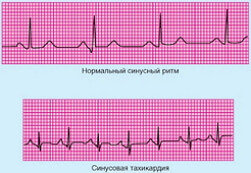
Symptomatic of paroxysmal tachycardia and begins, and ends always suddenly in the form of seizures of paroxysms, which last in some cases seconds, and sometimes - days. This type of arrhythmia is characterized by a heart rate of 120-200 beats. Per minute, which exceeds the rate almost twice.
Clinically, there are two types of paroxysmal tachycardia: the essential and extrasystolic, which are explained by the site of impulse localization, and also are supraventricular and ventricular. On an electrocardiogram these paroxysmal tachycardias do not differentiate.
The esentional form of paroxysmal tachycardia begins with an unexpected attack, which also ends, without previous and not following extrasystoles.
The extrasystolic form is a type of paroxysmal tachycardia, between the attacks of which extrasystoles are detected with a rare increase and the formation of extrasystolia a paroxysmes tachycardiques. As a rule, they run for a short time, and sometimes they can last for weeks.
For supraventricular tachycardia, a regular rhythm is characteristic, an unchanged QRS complex is noted on the electrocardiogram.
Patients make various complaints. Sometimes, with paroxysmal tachycardia, there is a feeling of minor ailment, much more often there is a very strong paroxysm with a feeling of constriction and chest pain, and then dyspnea manifests itself.
With prolonged seizures, shortness of breath is a regularity, and if the attack continues for several days, there is a development of blood stagnation in the liver.
With ventricular paroxysmal tachycardia, which has a more serious clinical significance, there is an abnormal rhythm, as with supraventricular. When calculating the pulse, the difference is determined by almost seven strokes, and there are no rhythm changes at the moment of pressing on the carotid sinus. The QBS complexes are changed, and the P-teeth, which have a normal frequency, are layered on these complexes, so they are very difficult to detect on the ECG.
Basically, the patient feels the beginning of heartbeat in the form of a push in this area, which passes into an accelerated heartbeat. An attack of paroxysmal tachycardia can cause a head spin, noise in the head and a feeling of contraction of the heart. Quite often, transient neurologic symptoms are noted in the form of hemiparesis and aphasia.
With this pathological condition, the phenomena of vegetative-vascular dystonia are noted. After the attack ends, the patient has polyuria, during which a large amount of urine is released, which has a low density.
In cases of prolonged course of an attack, a drop in blood pressure is noted, weakness and fainting develop.
It is quite difficult to tolerate paroxysmal tachycardia in patients with various forms of cardiopathology. So, for example, paroxysmal ventricular tachycardia, at which the heart rate reaches 180 strokes, can cause fibrillation of the ventricles.
Paroxysmal supraventricular tachycardia
This is a group of diseases including rhythm disturbances, which can originate from the atrioventricular node, sinus node and atrium. In the formation of reciprocal forms of this pathology, additional pathways may take part. As a rule, supraventricular arrhythmias have an insignificant prevalence in the ratio of two cases per one thousand people, and with a higher priority among women, almost twice.
As a rule, supraventricular paroxysmal tachycardia is classified into several types.
With sinus spontaneous tachycardia, the rhythm of the heart is constantly gaining, which is not caused by physical stress, emotional stress, the presence of any pathology, after the use of drugs or toxic substances. It is assumed that the reasons for its occurrence are the increased automatism of the SU and the disruption of its work in terms of the regulation of the neurohumoral nature. Clinically, this form of tachycardia manifests itself as an asymptomatic course in some patients, and complete loss of ability to work in others. Patients very often complain about the presence of frequent heartbeats, chest pains, lack of air, the appearance of dizziness and fainting. During the examination, in addition to the heart rate more than a hundred beats per minute, no significant other disorders are detected. This distinguishes spontaneous sinus tachycardia, as a kind of PNT from a sinus accelerated rhythm.
Sinus nodal reciprocal tachycardia is characterized by a paroxysmal frequency increase from eighty to one hundred and twenty beats per minute. Such heart rate at the time of the attack is mainly observed in patients who have sinus bradycardia as a source pathology. The reasons for the development of this tachycardia are the diseases of S.S.S.This kind of arrhythmia affects both sexes and occurs equally among adults and among children, but more often among middle-aged and elderly people. The symptomatology of paroxysms is little pronounced, and this is due to short-term, low rhythm of cardiac contractions and minor violations of hemodynamics. Paroxysm sometimes manifests itself in the form of palpitations, difficulty breathing or twisting of the head and is rarely characterized by loss of consciousness. In such patients, a pronounced sinus bradycardia is diagnosed without an attack.
Atrial focal tachycardia is characterized by the presence of an excitation focus, from which rhythmic impulses emerge into the center of both atria. As a rule, this focus is in the veins of the lungs and crista terminalis. This paroxysmal tachycardia is detected in patients with chronic pulmonary-cardiac pathology, infectious myocardial infarction, heart attack, cardiomyopathy, and rarely in the absence of heart disease. Provoke seizures of paroxysms hypokalemia, hypoxia, Eufillin, overdose of digitalis, alkalosis and acidosis, as well as overstretch of the atria. The symptomatology of this paroxysmal tachycardia consists of clinical manifestations of the underlying disease, but the acceleration of the rhythm of the heart only leads to an aggravation of the existing heart failure. Against the background of a high rhythm of the ventricles, blood pressure decreases, so dyspnea appears, and then swelling on the legs is detected. If there is a violation of electrolyte metabolism, intoxication with glycosides, the condition of the patient becomes even worse. The patient weakens, loses appetite, it vomits, vomiting opens and vision is impaired.
Atrial polytopic( multifocus) tachycardia is recognized when there are several P-waves on the ECG, which differ from each other and at the same time the heart rate changes. This arrhythmia occurs with a pulmonary pathology with existing impairments in the form of electrolyte imbalance and hypoxia. Glycoside intoxication can also contribute to this paroxysmal tachycardia. It is assumed that this arrhythmia appears as a result of the intensified automatism of SU.
Atrial-ventricular nodular tachycardia refers to the most common supraventricular tachycardia. The average age of the lesion is 32 years, the female sex is more often affected. This arrhythmia develops in the presence of cardiac malformations, ischemic heart disease, arterial hypertension, as well as in people who do not have cardiac pathology. The provocation of this pathology is: stress, smoking, alcohol, coffee, cardiac glycosides and physical activity.
Symptomatology depends on the duration of the attack, heart rate, the ability of the heart muscle to contract, the coronary circulation and the psychoemotional state of the patient. Many patients clearly determine the onset of the attack and its end. This is manifested by a strong heartbeat, a characteristic weakness, and then the coldness of the limbs is felt, the patients begin to sweat profusely, feel heaviness in the head, and sometimes they begin to spin, develop a peristalsis of the intestine that turns into diarrhea. In some cases, there is excitement, anxiety, chest pain and shortness of breath. With a decrease in CB, blood pressure decreases, symptoms of cerebral ischemia appear and a person loses consciousness. Sometimes there is a pulmonary edema and a cardiogenic shock.
Paroxysmal ventricular tachycardia
This type of paroxysmal tachycardia begins quite suddenly and also stops. Paroxysmal ventricular tachycardia is caused by the pathology of foci of automatism in the ventricles. At the same time, heartbeats reach more than a hundred beats per minute. Paroxysmal ventricular tachycardia occurs mainly among males( almost 70%).The causes of paroxysmal ventricular tachycardia are various pathologies such as IHD, cardiosclerosis after a heart attack, cardiomyopathy of alcoholic origin, heart defects, hypokalemia, stressful situations, myocarditis, cardiac glycosides, congenital pathology of the prostate, ventricular arrhythmogenic dysplasia, mitral valve prolapse.
Symptomatic pattern depends on low cardiac output and is characterized by a pale skin tone and low pressure. Heart rhythm, as a rule, is regular from 100 to 200 per minute, but more often - 150-180 beats per minute.
The electrocardiogram does not determine the tooth P and signs, which can reliably diagnose the ventricular paroxysmal tachycardia. There are normal, identical complexes of QRS on the background of altered complete captures of the ventricles, which indicate that a sinus impulse enters the ventricles.
Using the ECG study, distinguish certain types of this arrhythmia: stable at a heart rate of 140-250 beats. In minutes. With ventricular complexes of the same type;Repeated, in which episodes of paroxysms are represented by groups of three, five or ten QRS complexes;Slow - heart rate of 100-140 beats per minute, which lasts up to 25 seconds( almost thirty QRS).
As a rule, ventricular paroxysmal tachycardias are divided into bi-directional VT, pirouette, polymorphic and recurrent. All the arrhythmia data are characterized by a course, both without symptoms, and a vivid manifesto of clinical signs. They can begin with the appearance of frequent beating of the heart, felt by the patient himself, and the development of the expressed form of arterial hypertension, OCH, angina and states of syncopal nature.
For the diagnosis of ventricular paroxysmal tachycardia, methods of physical examination, ECG, Holter monitoring, electrophysiological examination inside the heart and through the esophagus, samples with physical exertion, as well as echocardiography are used.
Paroxysmal tachycardia in children
This type of pathology is characterized by changes in the rhythm of the heart in the form of sudden attacks of paroxysms with heart rate in older children more than one hundred and sixty strokes and in young children - more than two hundred, with the duration of characteristic attacks of several minutes and sometimes hours. In children, paroxysmal tachycardia is considered a common type of arrhythmia with a frequency of one sick child per 25,000.
The reasons that contribute to the development of this paroxysmal tachycardia in children include various cardiac lesions, electrolyte disturbances, and overstrain psycho-emotional and physical properties.
Very often the appearance of paroxysmal tachycardia in children is not due to cardiac pathology and is seen as a consequence of a panic attack.
The mechanism of occurrence in children of this arrhythmia is a circular wave or an increase in the automatism of the sinoatrial node, atrioventricular as well as atrial.
Children have supraventricular( supraventricular) paroxysmal tachycardia and ventricular tachycardia. With the first option, tachycardia is noted, as a result of changes in vegetative regulation in the work of the heart. The second option in children is rare enough and refers to such conditions that threaten the life of the child. But they are already developing in the presence of cardiac pathologies.
The symptomatic picture of infantile paroxysmal tachycardia is influenced by many factors, both pre-positional and provocative. These factors include: unfavorable pregnancy and childbirth, families with a high percentage of anomalies of the nervous system of a vegetative nature, psychosomatic pathologies and neuroses. And also the peculiarity of the structure of the conduction cardiac system and WPW syndrome form the basis of paroxysmal tachycardia. Typical seizures in the background of WPW syndrome appear in almost 55% of children, so an important point in this case remains confirmation of the diagnosis with the help of a thorough ECG study for this category of patients.
Basically, with paroxysmal tachycardia, there is a chronic infection, a hormonal imbalance, dyskinetic signs from the gastrointestinal tract and biliary ducts. In addition, sometimes there is a decrease in body weight, especially after ten years. About 60% of children suffer from hypertension and hydrocephalus syndrome, which also provokes the appearance of paroxysmal tachycardia.
Tachycardia paroxysms are mainly caused by emotional stress and only 10% is due to physical stress. Some children may even have a presentiment of an approaching attack with its onset and the moment of termination. This mainly applies to older children. This increases pulsation of the cervical veins, the child becomes very pale, sweating, light cyanosis of the lips and mucous membranes of the mouth, a slight subfebrile condition and chills. After the end of the attack, the child releases a significant amount of light urine.
All children suffer such paroxysms in different ways. Some treat them calmly enough, while others are characterized by intense anxiety, anxiety in behavior and complaints of a strong heartbeat. They have pulsation in the temples, the head is spinning, they do not have enough air, they are sick, there is weakness and circles under the eyes of a dark color.
Almost 40% of children develop paroxysmal tachycardia in the evening or at night, and one third of children - only in the daytime. The average attack can last forty minutes. At a paroxysm of a tachycardia till several days it is necessary to spend differentiation of the diagnosis between not paroxysmal and paroxysmal tachycardia. In addition, the attack, which occurred for the first time, is stopped almost in 90%, and subsequent paroxysms - only in 18% of cases.
Paroxysmal tachycardia first aid
Emergency care consists in the rapid establishment, at least roughly, of the causes of paroxysmal tachycardia. And this is very important at the first attack of paroxysm of tachycardia in the life of the patient. Based on the history, examination of his status, ECG of the study, a verdict is made about the presence of the diseases that provoked the attack, or their absence, and also does not exclude psychoemotional stress.
First of all, antiarrhythmic therapy with obligatory control of cardiohemodynamics is conducted. If the antiarrhythmic drug is ineffective, the repeated administration can be performed only after thirty minutes. If such an antiarrhythmic method of administration of up to three drugs does not yield positive results, then they proceed to an electrodefibrillation of the heart to prevent a progressive increase in heart failure or coronary, as a result of a sharp drop in blood pressure.
In the case of supraventricular paroxysmal tachycardia, at the outset, attempts are made to provide emergency care by applying basic "vagal" tests. However, this method can not be used for the elderly and with the presence of a syndrome of increased carotid sinus. In this case, do a sequential massage of this sinus for no more than 15 seconds first to the right, and then to the left. At the same time, it is necessary to control the work of the heart, to exclude asystole.
To perform the Valsalva test, the patient should inhale as much as possible and then exhale with the simultaneous closing of the mouth and nose, and the abdominal press in tension. It is advisable to repeat it up to three times.
In addition, you can try to press closed eyes for eight seconds, however, this method should be excluded when helping children to prevent detachment of the retina.
In some cases, it may be artificial to induce vomiting. But already with ineffectiveness of all these manipulations, intravenously injected with verapamil. In case of non-occlusion of the attack, after five minutes, this drug is administered again.
If patients took adrenoblockers during a daily attack, then verapamil is not used, since sudden stop of blood circulation is possible.
Further emergency care consists in the patient receiving Obsidan under the tongue thirty minutes after the ineffectiveness of the previous drug. If necessary, Obsidan is accepted in two hours.
This technique refers to the basic, giving a positive result in 80% of cases.
Paroxysmal tachycardia treatment
Patients diagnosed with paroxysmal tachycardia primarily need to be hospitalized, with the exception of idiopathic benign course options and with the possibility of rapid relief of a paroxysmal attack of tachycardia.
In the future, a full examination is performed to determine the cause, which triggered the attack, and then prescribe the treatment of paroxysmal tachycardia in the cardiology department. With a planned hospitalization, after the development of frequent paroxysms more than twice a month, an in-depth examination is carried out, the tactics of treatment are determined and surgical treatment can be prescribed.
Since paroxysmal tachycardia is characterized by the onset of seizures, before the beginning of treatment of the underlying disease, urgent measures are taken to stop them. In this case, use the Valsalva test, straining, the Ashner and Cermak-Goering trial;Wipe with cold water. These tests are able to stop only seizures, characteristic of supraventricular paroxysmal tachycardias. Therefore, the main method of treatment of paroxysmal tachycardia is the administration of anti-arrhythmic drugs.
At the very beginning of paroxysm, universal antiarrhythmics are introduced: Novokainamid, Propranol, Aymalin, Quinidine, Dizopiramid, Cordarone, Isoptin, Etmozin. With prolonged seizures, electroimpulse therapy is used.
Subsequently, the cardiologist selects further outpatient treatment according to a special scheme, which includes antiarrhythmic drugs, for a single patient. For patients with supraventricular pathology in cases of self-relieving seizures or using special samples, as a rule, anti-relapse therapy is questionable.
All preparations and their dosages are carried out strictly under the control of the electrocardiogram and the patient's condition itself.
In some cases, β-blockers are prescribed to treat paroxysmal therapy, which reduces the likelihood of ventricular fibrillation. Efficacy in treatment can be achieved in the combination of β-blockers with antiarrhythmic drugs.
To prevent recurrence of attacks, decrease in heart rate, their duration and severity, permanent oral administration of glycosides is prescribed.
The surgical method of treatment of paroxysmal tachycardia is used in the most extreme measures, when this arrhythmia is particularly difficult and all other therapies are ineffective. In this case, radiofrequency ablation of the heart, implantation of an electrocardiostimulator or an electrodefibrillator can be used.