What does the conclusion mean - normospermia?
Before talking about pathology, you need to know what the norm is. Normospermia is not a diagnosis, but a normal state of the ejaculate. To do this, it must meet certain parameters. These parameters are determined by the World Health Organization and are unified for the whole world. Clear quantitative indicators help to avoid subjective assessment of the condition.
Content
- 1 General
- 2 macroscopic parameters
- 2.1 Liquefaction
- 2.2 Viscosity
- 2.3 Appearance
- 2.4 volume
- 2.5 pH
- 3 microscopic parameters
- 3.1 agglutination sperm
- 3.2 cells other than sperm
- 3.3 Sperm Motility
- 3.4 Pot life
- 3.5 Quantity
- 3.6 Peroxidase-positive cells
- 3.7 Biochemical indices
- 4 Conclusion
General Information
Spermatozoa are produced in the appendages of the testicle and stored in it as a concentrated substrate. During ejaculation, this substrate liquefies with the secretion of the prostate and seminal vesicles, the amount of which will determine the total volume of the ejaculate.
If the spermogram shows abnormalities, it is necessary to repeat the analysis after 2-3 months. The fact is that, like in any living organism, the state of the reproductive system is constantly changing. In addition, the quality of the collected ejaculate depends on external conditions, such as:
- Whether the ejaculate is collected completely. In the first portion, the concentration of spermatozoa is higher than in the subsequent ones, so if it is lost, the result may be underestimated.
- Time elapsed since the last sexual activity. During ejaculation, the epididymis is not fully emptied. Accumulation of aging spermatozoa can distort quality indicators.
Therefore, the delivery of the ejaculate for analysis should be prepared: sexual abstinence should not be less than 2 days, but not more than a week;2-3 days before the study should avoid alcohol;Do not go to the sauna and do not take hot baths on the eve of the analysis( see more details about preparing for spermogram delivery).
If you need an analysis of the sterility of the ejaculate, you need to urinate before you do it, then wash your hands and penis with soap and dry them with a disposable towel.
Macroscopic parameters of
Visually determined 30-60 minutes after sample collection.
Dilution
Immediately after ejaculation, the ejaculate is quite dense. Being in the container, it becomes more and more watery, and after 15-60 minutes it turns into a homogeneous mass. Insufficient ability to dilute can limit the motility of spermatozoa.
Viscosity of
Viscosity is evaluated by dialing the diluted ejaculate in a pipette. Normally, it should be separated by separate droplets, with increased viscosity a thread is formed. Variations in viscosity may indicate impaired function of the secretory glands.
Appearance
Normally ejaculate grayish, homogeneous, slightly opalescent. Color can vary due to foreign impurities( pus, blood), transparency decreases with decreasing sperm concentration.
Amount of
The total volume of the ejaculate reflects the secretory activity of the prostate and seminal vesicles. The minimum allowable volume is 1.5 ml. The decrease in volume can speak both of incorrect collection of ejaculate, and of obstruction( obstruction) of the vas deferens. Excessive volume -> 5 ml is possible with an inflammatory process with the release of exudate( inflammatory fluid).That is why the volume of sperm as an independent indicator is not considered, but is taken into account only in conjunction with the rest of the data.
pH
The secret of seminal vesicles is alkaline, the secret of the prostate is acid. The pH reflects the ratio between their activity, and is normally above 7.2.Reduction of this index in combination with a small volume of ejaculate( oligospermia) and a reduced amount of spermatozoa can talk about obstruction of the vas deferens or underdevelopment of seminal vesicles.
Microscopic parameters
Agglutination of spermatozoa
Agglutination of spermatozoa - the growth of living spermatozoa among themselves.
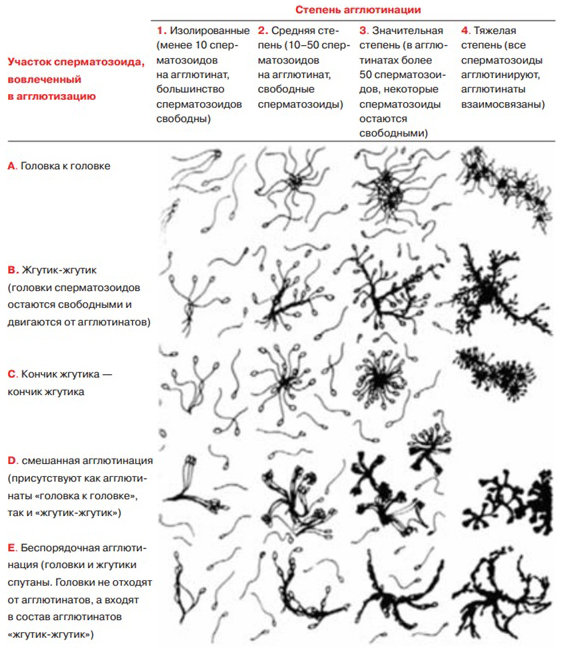
Fig.1 - Degree of agglutination of spermatozoa.
Most often indicates that the causes of infertility are immunological. In order to confirm this, tests for antibodies( MAR-test or test for the immunogenicity of mobile spermatozoa with adherent particles) are carried out. If more than 50% of mobile spermatozoa are covered with antibodies, one can speak of an autoimmune process.
Cells other than spermatozoa
Clinical significance is the content of cells of the genitourinary epithelium, leukocytes, immature germ cells. Immature sex cells can appear when the testicle tissue is damaged.
Leukocytes should be no more than 1x10⁶ per ml. An increase in their number indicates an inflammatory process.
Sperm motility
Determines the possibility of pregnancy. The mobile sperm must be at least 40% of the total, not less than 32% of the spermatozoa must actively move: linearly or in a circle with a large radius.
Pot life
Viability refers to the number of spermatozoa with an intact membrane. In norm more than 58%.
Quantity of
In 1 ml of ejaculate should be more than 15x106 spermatozoa. The entire volume of ejaculate should be> 39x106
Spermatozoa with a normal structure should be at least 4%.If this indicator decreases, they speak of teratospermia( teratozoospermia) - a violation of the formation of spermatozoa.
Peroxidase-positive cells
A peroxidase test is used to distinguish immature spermatozoa from leukocytes - both cells have a rounded shape. Leukocytes are able to release peroxide compounds - peroxidases, that is, the number of peroxidase-positive cells and the number of leukocytes. As already indicated, there should be no more than a million( 1x10⁶) in ml.
Biochemical indices
To determine the secretory activity of the prostate, seminal vesicles and epididymis, determine the content of certain chemicals in the sperm.
- The state of the prostate is indicated by the amount of zinc - normally> 2.4 μmol in the ejaculate.
- The function of the seminal vesicles reflects the level of fructose & gt;13 μmol;
- The secretory capacity of the testicular appendages characterizes the content of neutral alpha-glucosidase & gt;20 international units( IU).
Conclusion
Despite the fact that each parameter determining the normal state of the ejaculate - normospermia - has an exact numerical value, the result of the study is evaluated exclusively in the complex. Therefore, conclusions about the presence of this or that pathology and tactics of the patient's further management should be done only by the doctor.
See the video about the spermogram indicators
Recommended for viewing: