Asphyxia of newborns
 Asphyxia of newborns is the inability of a child with signs of live birth to breathe immediately after birth. Gas exchange in the lungs does not occur. In simple terms, asphyxia of newborns is suffocation. Most of these newborns are accompanied by acute cardiovascular disorders, suppression of unconditioned reflexes. The frequency of this condition is one - one and a half percent with a prevalence in newborns with a gestational age of less than 36 weeks. Most children with asphyxiated neonates develop severe neurological disorders.
Causes of neonatal asphyxia
In the pathogenesis of neonatal asphyxia, the duration of hypoxia experienced by the fetus in the womb is of great importance. If this is a short-term oxygen deficiency, compensatory mechanisms are included in the fetal organism, which do not give rise to persistent disturbances in cellular metabolism.
In the case of prolonged oxygen starvation, the compensatory mechanisms are not able to correct this state. The process of anaerobic glycolysis is included, a large amount of lactic acid and unoxidized products enter the blood, the accumulation of which causes acidification of the blood, which adversely affects the fetal physiological systems. The compensatory possibilities of the fetal organism during childbirth also decrease.
Several mechanisms of development of asphyxia of newborns can be distinguished. These are any violations of the functioning of the placenta, regardless of the causes of these disorders. The reasons can also be laid in the health of the mother and the developing child.
Allocate the following risk factors for neonatal asphyxiation:
- Mother's stay in severe anemia, chronic cardiovascular or respiratory failure, shock. These are the conditions in which the organism of the mother herself receives an insufficient amount of oxygen. Since the mother's blood can not fully provide the fetus with the necessary amount of oxygen, it develops chronic hypoxia.
- Adoption by the mother of medications prohibited during pregnancy can depress the work of the higher nervous centers of the fetus, cause developmental defects of the brain, cardiac and respiratory systems, the birth of a full-term immature child or the premature birth of a newborn. All these factors lead to insufficient respiratory efforts of the newborn.
- Persistent fluctuations in blood pressure in the mother, both upward and downward, lead to insufficient blood circulation in the placenta, leading to hypoxia of the fetus. Bleeding during pregnancy, multiple pregnancy, hypochlorous or polyhydramnios, miscarriage of the fetus, pregnancy, alcohol, drug use, smoking, maternal diabetes, stillbirth or death of newborns from previous pregnancies, all are risk factors for newborn asphyxia.
It is proved that smoking can suppress the respiratory movements of the fetus, cause at least 30 minutes of vasospasm of the uterus even after one smoked cigarette;Increases the risk of the birth of a hyperexcitable child because the adrenergic system of the fetus is activated.
The risk factors for asphyxia of newborns include the pathology of the placenta itself( premolars, premature detachment, edema, inflammatory changes), premature aging( calcifications, hemorrhages).
Asphyxiation of newborns can result in umbilical cord engorgement. If the child was in the breech presentation at the time of birth, then after birth, the head can transmit the vessels of the umbilical cord;A tight cord with the umbilical cord of the child's neck or other parts of the body;Prolapse of umbilical cord loops.
The age of the mother also plays an important role in the realization of the risk of developing asphyxia of the newborn. The most unfavorable for delivery is the age of a pregnant woman under 16 years old and over 35 years of age.
Prolonged hypoxia of the fetus during pregnancy leads to a slowing of the growth of cerebral vessels, the emergence of aspiration of amniotic fluid. Under normal conditions, the fetal gaps are closed, and the respiratory movements are shallow, so there is no swallowing of amniotic fluid. Under conditions of hypoxia, a reflex irritation of the respiratory center occurs, which causes the vocal cleft to open, the fetus makes deep respiratory movements, and the amniotic fluid enters the lungs of the child.
The composition of amniotic fluid is very aggressive for the child's lungs and as a result of swallowing, it is possible to develop an inflammatory reaction in the lung tissue, i.e., pneumonia, which complicates the primary spreading of the lungs after birth. Therefore, it is believed that aspiration of amniotic fluid always leads to the development of newborn asphyxia.
It should be noted that not always the risk factors for asphyxia during pregnancy are realized in neonatal asphyxia. When identifying such factors, adequate prevention of asphyxia of newborns should be carried out.
Prevention of asphyxiation of newborns is carried out by paying close attention to such a pregnancy with the use of funds that improve uteroplacental blood circulation. If such a woman has inflammatory diseases of the genitals, they treat them, which reduces the risk of infectious complications after the birth of the child.
Not only are risk factors during pregnancy predisposing to the development of newborn asphyxia. There are a number of factors predisposing to the development of newborn asphyxia and during childbirth. This is premature, rapid or delivery by an emergency cesarean section. Prolonged delivery( more than 24 hours), abnormal fetal presentations, use of vacuum extractor and forceps, prolonged anhydrous interval( more than 18 hours), use of general anesthesia during labor, high uterus tone, premature placental abruption, chorioamnionitis. On the part of the fetus is a bradycardia, an unstable heart rhythm of the fetus. At times, the risk of asphyxiation of newborns increases if the mother took drugs 4 hours before the birth.
Degrees of asphyxia of the newborn
Since 1952, the state of the child at his birth is estimated in points two times over Apgar. The scale includes five signs that are evaluated at the first and fifth minutes after birth. The list of these signs includes: skin color assessment;heart rate;breath;Muscle tone;Evaluation of reflexes. Each attribute is scored. The sum of the points is a conclusion about the severity of the condition of the child born.
For accuracy of fixing the lifetime of a newborn at the time of its birth, the agar timer is turned on.
A healthy child has an Apgar score of 7 to 10 points.
4 - 6 points is a sign of moderate-degree asphyxia of newborns.
1 - 3 points - is diagnosed with severe asphyxia of newborns.
Evaluation of breathing: 0 points - breath is not detected;1 point - a weak cry, bradypnoe;2 points - a strong cry( normal ventilation of the lungs).
HR assessment: 0 points - no;1 point - less than a hundred;2 points - more than a hundred.
Assessment of reflexes is carried out by the infant's reaction to the nasal catheter: 0 points - no reaction;1 point is a grimace;2 points - sneezing, coughing, screaming.
Evaluation of muscle tone: 0 points - low tone;1 point - there is an unbearable flexion of limbs;2 points - a high tonus, active limb movements.
Skin color evaluation: 0 points - blue or white;1 point - acrocyanosis( cyanosis of the extremities) on the background of pink skin color of the remaining parts of the body;2 points - pervasive pink skin coloring.
The Apgar scale does not fully reflect the acidosis and the severity of metabolic abnormalities. This should not be forgotten, and when diagnosing the condition of a newborn, it is not only based on data from this scale. It is also necessary to carry out a series of laboratory studies confirming the diagnosis of asphyxia( definition of CBS, biochemical blood parameters).25-75% of newborns with a normal Apgar score had marked manifestations of acidosis.
Important criteria for determining the severity of neonatal asphyxia is the adequacy of response to ongoing therapy, course and outcome in the early period of the newborn, which fully demonstrates damage to vital body functions.
Treatment of neonatal asphyxiation
Administration of medications is initiated if the heart rate is below 80 beats per minute plus no respiration, even after initial resuscitation.
The first drug that is introduced to help a newborn baby is an Adrenaline water solution. You can enter it into the vein and through the endotracheal tube. After the introduction of 30 seconds, the condition of the newborn is monitored, and if the heart rate exceeds eighty beats per minute, no drug therapy is performed, the ventilator continues to breathe freely, and indirect cardiac massage is stopped.
If, however, the introduction of Adrenaline did not give such an effect, the heart massage is closed against the background of the IVL and the adrenaline is repeated.
If there are signs of acute blood loss, the volume of circulating blood is replenished with an isotonic sodium solution.
At preservation of an acidosis, on a background of IVL its correction by 4% a solution of sodium bicarbonate is carried out.
If within 20 minutes after the start of resuscitation, the child does not have independent cardiac activity - this is the basis for stopping resuscitation.
In case if independent heart activity is established within 20 minutes, but there is no independent breathing, the child is transferred to a hardware IVL.
In the most favorable case, after the initial resuscitation, within 20 minutes, the baby's skin becomes pink, independent breathing and cardiac activity are established. Resuscitation measures stop.
After the resuscitation the child is transferred to the post of individual observation. Here the child is in a cab by a source of radiant heat. Continuous monitoring of vital signs of the body is carried out and the necessary treatment is continued.
First emergency care for newborn asphyxia
If the possibility of giving birth to an infant in asphyxiation is diagnosed, a resuscitation team is required to provide immediate care to the newborn immediately after birth.
Immediately after birth, the presence of signs of live birth is evaluated, if one of them is detected, the resuscitation of a newborn begins in asphyxia.
In only 0.5-2% of cases, newborns need closed heart massage, intubation of the trachea and administration of medications in the hall.
If there is a prognosis for the birth of a child with a high risk of asphyxiation of newborns, they begin initial resuscitation activities in the genus hall. The duration of these events should not be more than one minute.
The initial resuscitation measures are as follows. Aspiration of the contents of the respiratory tract immediately after the birth of the head. If the prenatal period revealed conditions that threaten the life of the child, then clamps should be placed on the umbilical cord, without waiting until the ripple stops.
Thermal protection is then carried out. The power of the source of radiant heat should be 400 W.The source should be removed from the child at a distance of 60 cm. Any deviation of body temperature from the required parameters, whether cooling below 36.5 degrees or overheating, leads to respiratory depression.
Give the newborn a special position. A roller is placed under the shoulders of the child, and the head end is lowered by 15 degrees. Then, aspiration of the contents of the oral and nasal cavity is carried out. At the final stage of the child's initial activities, wipe dry with a diaper, remove the wet diaper and cover it with a dry cloth.
In the absence of respiratory movements in the newly born child, as well as in the presence of shortness of breath, in addition to all of the above, direct laryngoscopy is performed, an endotracheal tube is inserted and the trachea is sanitized.
Next, the assessment of the presence of respiratory movements, palpitations, as well as the color of the skin. If the color of the skin is pale or there is diffuse cyanosis in the background of the initial resuscitation, if the child does not take the first breath, if he has a bradycardia, it is necessary to begin cardiopulmonary resuscitation before the end of the first minute after birth( before assessing the Apgar condition).
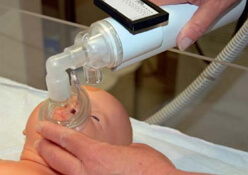
Ventilation is carried out by the Ambo bag in case the child does not take the first breath or has an irregular breathing. Through the face mask oxygen is supplied in a concentration of 60-100%.IVL is considered effective if the heart rate begins to exceed 100 beats per minute, if the child begins to breathe freely, and the color of the skin quickly turns pink.
If after IVL for thirty to sixty seconds, no signs of efficacy occur, and the heart rate continues to decrease, intubation of the trachea and forced ventilation of the lungs through the endotracheal tube should be performed.
Closed cardiac massage with forced ventilation begins with a decrease in heart rate below sixty beats per minute.
Then, again, signs of the effectiveness of resuscitation are evaluated. Indirect massage of the heart is stopped if the heart rate exceeds eighty beats per minute, otherwise the closed heart massage should be continued and the drug therapy started. Ventilation is continued until self-breathing occurs.
Consequences of newborn asphyxia
As prolonged hypoxia of the fetus does not remain without consequences, and asphyxia of newborns has its consequences or complications. The most unfortunate consequences are severe asphyxia of newborns. Early complications can be observed in the first hours and days after birth.
In the first hours after the birth of a newborn in a state of asphyxia, neurological disorders that develop as a result of oxygen starvation of the central nervous system are noted. Clinically, this manifests itself in the form of hand tremor. The tremor is shallow, intensified by the crying of the child, anxiety, screaming. There is hyperesthesia. Pathological reflex Ilpo( when tapping on the sternum twitching of the limbs), Moro reflex spontaneously arising. The child often belches. There are violations of sleep. Possible violations of muscle tone. A clinical picture of this nature is noted in asphyxiated infants of moderate severity.
Similar disorders occur spontaneously, are of an incoming character. Usually, if the resuscitation of a newborn with asphyxia and further withdrawal were adequate, then by the 4th-5th day the condition of the newborn becomes satisfactory.
If a child is born in a state of severe asphyxia, then during the first hours of life there is a weak reaction to the examination. Physiological reflexes characteristic of newborns most often can not be caused. The color of the skin is cyanotic, it turns pink slowly. Meconium departs during the birth. Heart tones are muffled. This clinical picture only confirms the presence of severe oxygen deficiency and serious disturbances of microcirculation.
In very serious condition, the baby is observed a picture of hypovolemic shock.
By the end of the first day there is a tremor of hands of a large-scale type. Signs of intracranial hypertension( swelling of the large fontanel), reduced muscle tone. Perhaps the absence of sucking and other unconditioned reflexes characteristic of newborns. By the end of the third day, the reflexes began to gradually revive. The hemodynamics begins to stabilize. Breathing becomes regular, there are stable swallowing and sucking reflexes.
Early complications include gastrointestinal disorders( dysfunction, paresis, enterocolitis);Renal manifestations in the form of functional renal failure due to vascular thrombosis, edema of interstitial tissue of the kidney, tubular necrosis;Pulmonary disorders are manifested by meconium aspiration syndrome, pneumonia, bleeding, a violation in the surfactant synthesis system.
On the part of the blood, the early effects of neonatal asphyxiation manifest themselves in the form of anemia, thrombocytopenia.
Late complications are observed at the end of the first week of life and later.
The first place among the later consequences is divided between infectious and neurological.
The most undesirable of neurological complications is the consequences of hypoxic encephalopathy. Its development is due to a prolonged energy hunger of neurons of the brain because of venous and arterial thrombosis, venous outflow from the brain and developed hypotension, blood perfusion in the brain cells is reduced. Suffer from severe asphyxia of the newborn, primarily the thalamus region, the basal and stem sections of the brain. As a result of hypoxic brain damage, it may be the development of infantile cerebral palsy, mental retardation.
In children after asphyxia of newborns, even in the absence of neurological disorders, the risk of strobism, sleep disturbances, and the increased frequency of glasses, learning difficulties( especially in the study of exact sciences, for example, mathematics)Attention.
Infectious consequences of asphyxiation of newborns include, such as pneumonia, sepsis, meningitis, necrotizing enterocolitis. Oxygen therapy also has its consequences. It manifests itself in the form of bronchopulmonary dysplasia, retinopathy.