Spermatogenesis - stages, scheme, hormonal regulation
Spermatogenesis is the process of formation and maturation of spermatozoa - male germ cells. It occurs in the testicles and lasts an average of 75 days. For the first time this process begins during puberty under the influence of male sex hormones and lasts until the end of life. In order for spermatogenesis to proceed normally, a temperature of about 34 ° C is needed, so the testicles are taken out of the body.
Fig.1 - Scheme of spermatogenesis.
content
- 1 Anatomical and physiological features
- 2 Step spermatogenesis
- 2.1 Step dividing
- 2.2 Growth Stage
- 2.3 Step
- 2.4 maturation step of forming
- 3 Hormonal regulation of spermatogenesis
Anatomical and physiological features
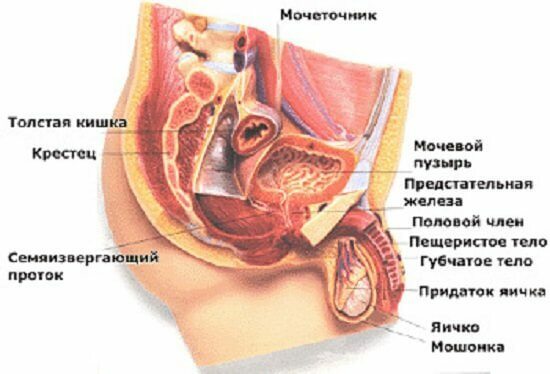
Testis covered dense tunica albuginea, which creates extending inwardlySepta, forming lobules. Inside each lobe there are from 1 to 4 seminiferous tubules - convoluted tubules with spermatogenic epithelium inside. It is there that spermatogenesis occurs.
On the basement membrane - the "basis" of the convoluted tubule - the spermatogenic epithelium is located in several layers, each of which, in fact, is a separate "generation"( generation) of spermatozoa. Between them are supporting cells - Sertoli cells. This is the "life support system" for the emerging reproductive cells. Sertoli cells supply future spermatozoa with nutrients and oxygen all the time, while dividing, growing and maturing spermatozoa. In addition, they indirectly regulate spermatogenesis, producing a protein that carries testosterone.
Stages of spermatogenesis
In the process of spermatogenesis, four phases are distinguished:
- Division.
- Growth.
- Maturing.
- Formation.
Fission stage
In the extreme row, near the basal membrane, there are spermatogonia - small rounded cells. In fact, these are stem cells for future gametes. Some of them are actively divided, "shifting" the daughter cells to the center of the convoluted tubule. At this stage, future germ cells contain a full set of chromosomes - 23 pairs. Some( those that remain in the basal membrane) continue to be actively divided, the rest begin differentiation( formation), turning into first-order spermatocytes, still having 46 chromosomes.
Stage of growth
Spermatocytes of the first order are larger than their "ancestors", and they have an active metabolism necessary to prepare for division. Proteins, enzymes are synthesized, DNA doubles.
Maturation stage
At this stage, the first order spermatocytes are divided twice. After the first division, second-order spermatocytes are formed, which have 23 pairs of chromosomes, which immediately divide, and this time each daughter cell-spermatide-receives only one chromosome from the pair. This double division, after which the cell retains only half the set of chromosomes, is called meiosis. As a result, one spermatocyte of the first order produces 4 spermatids. Half of them contain the X chromosome, which forms the female fetus, and the half contains the Y chromosome necessary for the male genotype.
The emerging reproductive cells are still strongly associated with Sertoli cells, providing them with food. Moreover, they continue to be connected and among themselves bridges from the cytoplasm. This allows full ripening and formation of cells containing only 23 chromosomes - an amount that is not sufficient for the normal existence of the cell.
The stage of formation of
The formation of spermatozoa from spermatids occurs in the central rows of the spermatogenic epithelium. Cells grow florets that "hang" in the lumen of the tubules. Most of the mitochondria, the "power stations" of the cell, are shifted into the flagella. They will provide energy of motion "tail" ensure that, in fact, the possibility of translation of the sperm without which the sperm loses its fertility.
But the device that provides the concentration of enzymes - the Golgi complex - on the contrary, moves to the front end of the head, thickens and creates an acrosome. It contains enzymes that "dissolve" the area of the egg's shell, so that fertilization takes place. Spermatozoa without an acrosome are not fertile.
Only after the maturation of the spermatozoa is broken the cytoplasmic bridge connecting the cells, and the full gamete becomes completely autonomous.
Mature spermatozoa move into the vas deferens, connects to the secretion of the prostate gland, which provides mobility and viability of the spermatozoa, and leaves the body during ejaculation.
See also: How many spermatozoa live in different media
Hormonal regulation of spermatogenesis
The main hormone regulating the rate of division of spermatogonia and spermatocytes is testosterone. Spermatogenesis is a process extremely sensitive to external influences and even a subclinical decrease in testosterone can cause infertility. And the simple administration of testosterone does not accelerate spermatogenesis, for this it is necessary to interfere with the level of regulatory hormones: chorionic gonadotropin and follicle-stimulating hormone( FSH).Only through the joint work of these hormones can fertility be restored.
Recommended for viewing: