What is the normal volume of the bladder in a man?
The urinary bladder is the organ of the urinary system, in which urine accumulated by the kidneys accumulates and flows into the ureteral cavity of the bladder. When a certain volume is reached, it is further removed from the body through the urethra.

Anatomy of the bladder
If the bladder is shortened, a small volume, then the thickness of its muscular wall can reach 15 mm, and in the filled state - it is essential to thin out and make 2 or 3 mm. Increased pressure in the cavity, due to the presence of urine, leads to the stretching of muscle fibers. The receptor field perceives and transmits this information through the structures of the nervous system, resulting in the formation of urge to urinate. The involuntary upper sphincter relaxes, the muscular wall of the bladder contracts, the consciousness-controlled lower sphincter also relaxes, and urine is released through the urethra.
Contents
- 1 Changes in bladder volume
- 1.1 Bladder enlargement
- 1.1.1 Acute increase
- 1.1.2 Chronic increase
- 1.2 Decrease in volume
- 1.1 Bladder enlargement
- 2 Approaches to diagnosis and treatment
Changes in bladder volume
The size of the bladder cavity can vary asFor natural reasons, and in pathological processes. Temporal enlargement of the bladder can occur with an arbitrary retention of urine, for example, if you can not urinate, with large amounts of fluid drunk. Decrease may occur with dehydration or nervous tension, leading to frequent urge to urinate. With the restoration of normal conditions, the volume of the bladder comes to normal, and does not require the intervention of doctors.
Pathological may be an increase and decrease in the volume of the bladder, acute or chronic( gradually developing).
Bladder enlargement
The bladder volume can increase sharply and chronically( gradually).
Basic development factors :
- mechanical obstruction to normal urine outflow;
- disorders of neuromuscular regulation of the occurrence of urge to urinate;
- undesirable side effects when taking medications.
Acute increase in
Acute urinary retention leads, as a rule, to a sharp increase in the volume of the bladder cavity, to the stretching of its walls.
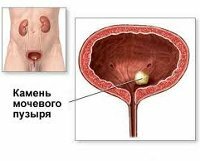
Stones can cause blockage of the ureter and, as a result, a sharp increase in the bladder volume
The main causes :
- stone formation in the bladder or urethra;
- acute prostatitis,
- long-term administration of large doses of hypnotics, the use of funds for general anesthesia and strong painkillers, ganglion blockers;
- traumatization of the spinal cord or brain, as well as their tumor lesions;
- occlusion or kink of the catheter( when placed or temporarily in the bladder cavity).
The formation of concrements is a manifestation of urolithiasis. However, in this case, the stone is not only in the cavity of the bladder, but it also blocks its lumen, getting stuck in the neck or in the urethra. Saline deposits can fall from the ureter or kidney, gradually increase in size, and can initially form in the bladder. The most common cause of blockage is the overlap of the urethral lumen due to its small diameter( up to 7 mm).In the neck, the stone should wedge in, lose its mobility, and with contractions of the muscular fibers of the bladder it is possible only for certain sizes of concretions( not more than 1 cm).
In severe acute prostatitis, if the swelling of the prostate gland is so big that it squeezes the urethra, it causes a sharp overlap urine flow with a sharp increase in the size of the bladder.
In this case, the main manifestations of :
- urine accumulation is not felt by the patient;
- sharply increases the volume of the bubble;
- with the overstretch of the walls and the inability of the sphincters to perform their closure function, the urine spontaneously flows outward through the urethra.
Given the possibility of blockage of the urinary catheter for prolonged periods( both in the hospital and at home), careful care is required. When putting the catheter, doctors always check the patency of it, introducing a small amount of saline and releasing the liquid.
Chronic increase in
The gradual increase in the volume of the bladder can be associated with organic pathological processes in the urinary system and in the body as a whole. Main causes
:
- endocrine disorders( diabetes, disrupt nerve fibers and nerve impulse transmission, reduced sensitivity to the increased volume of the bladder);
- of the prostate, bladder and urethral neoplasms;
- narrowing( stricture) of the urethra. As
benign( adenoma) or malignant( cancer) prostate tumors can press on the urethra from the outside, creating an obstacle to the normal release of urine from the bladder, raising the pressure therein and increase in size. If the tumor develops in the bladder, it grows inside it, and also affects the wall of the urethra, reducing its lumen, then the urine flow obstructs gradually, then the cavity of the bladder grows.
After 60 years, adenoma is the most common cause of this process. Alcohol intake, prolonged sitting or lying position, hypothermia can cause changes in blood circulation in the gland, increasing stagnant phenomena until the development of acute urinary retention.
Reduced volume of
Both functional and organic causes lead to a decrease in the bladder cavity.
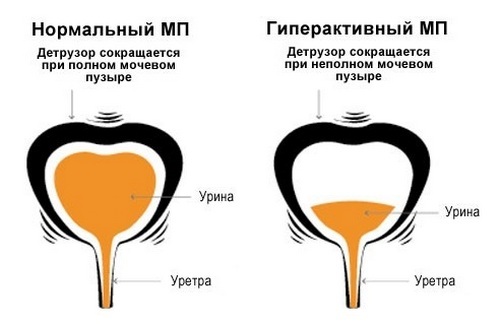
Overactive bladder can also be a symptom of prostate diseases
main factors chronic volume reduction:
- overactive bladder( state in which sharply increases conduction of nerve impulses that cause the appearance of the urge to urinate even when a slight tensile bladder wall and the small hisFilling);
- chronic inflammation( nonspecific bacterial, tuberculosis, schistosomiasis, after radiation or chemotherapy), in which the normal muscle fibers are replaced by connective tissue, and organ walls wrinkling occurs;
- long-term presence in the bladder of the urinary catheter and constant urinary diversion, regardless of its volume, which leads to loss of muscle tone of the walls of the bladder;
- age-related changes with predominance of fibrosis processes( replacement of normal connective muscle tissue).
Acute decrease in the volume of the bladder is less common.
Reasons for :
- after surgical operations( temporary, associated with changes in the sensitivity of drugs, excretion of urine with a catheter);
- psycho-emotional overstrain, resulting in increased sensitivity, impaired control of urination and increased emptying of the bladder.
Approaches to diagnosis and treatment of
Bladder size is determined by ultrasound( see Sonography of pelvic organs).If urine output is delayed, you can directly measure how much the bladder is enlarged, if you suspect a decrease in its volume, you should drink 1-1.5 liters of water approximately 40 minutes before the test, if possible, feel and hold the urge to urinate and determine the volume.
To diagnose the capacity of the bladder, its diagnostic catheterization is performed, in which it is possible to determine the volume of urine in the bladder cavity. In order to distinguish the acute delay in the release of urine from complete cessation, cystoscopy( including contrasting) and excretory urography are performed along with the catheterization to determine the functioning of the kidneys and confirm the reason for the absence of urine from the urethra.
Approaches to treatment depend on the causes that led to an increase or decrease in the volume of the bladder. Timely access to a doctor with the appearance of symptoms indicating a change in the size of the bladder and its volume, allows you to diagnose the pathology in time and take adequate measures.
Recommended for viewing: