
Whether it is necessary to worry in occasion of a liquid chair at grudnichka?
The liquid stool in the baby is a normal phenomenon. Babies who are breastfed are called babies.
Since in the first months of life the baby is not able to digest anything to feed the mother's breast milk, a loose stool with such food will be natural.
But it is important to know in which cases the liquid consistency of the stool should alert the parents, since in some diseases external changes primarily concern feces.
Signs of healthy chair
Contents:
- Signs of healthy chair
- reasons for changes in stool
- Treatment and prevention of liquid stool
Loose stools in infants breastfed will always be different from the rest of stool color, smell and consistency.
For example, the very first bowel movement after childbirth grudnichka will be dark green, sticky and stretching consistency, with characteristic lack of odor.
It is not to be frightened of such a stool, because from the baby in the first 3-4 days all the intestinal contents processed inside the womb will come out.
first stool grudnichka are called "meconium" and consist of undigested intestinal epithelial cells, prenatal hair, amniotic water, mucus, water and bile.

After full withdrawal of meconium, the digestive tract of the infant begins to digest and remove the mother's breast milk from the body.
This is typical for a toddler will loose stools( up to 8 times per day) in the first month of his life, until the digestive system is formed and becomes accustomed to the new working conditions.
The frequency of the stool may be greater, because the baby can not control the excrement.
To ensure healthy child, parents should always monitor its changes: if a bowel movement grudnichok behaves quietly, without crying, and the abdomen is soft, his health is not threatened.
Since the second month of life with breastfeeding, the frequency of bowel movements will gradually decrease, on average, up to 6 times a day.
structure stool grudnichka be liquid and mushy as solid faeces yet nowhere to take, and it would create major problems in the intestines of the baby, who has not yet formed.
Breastfed child with breastfeeding is characterized by feces of light yellow, golden and light green hues.
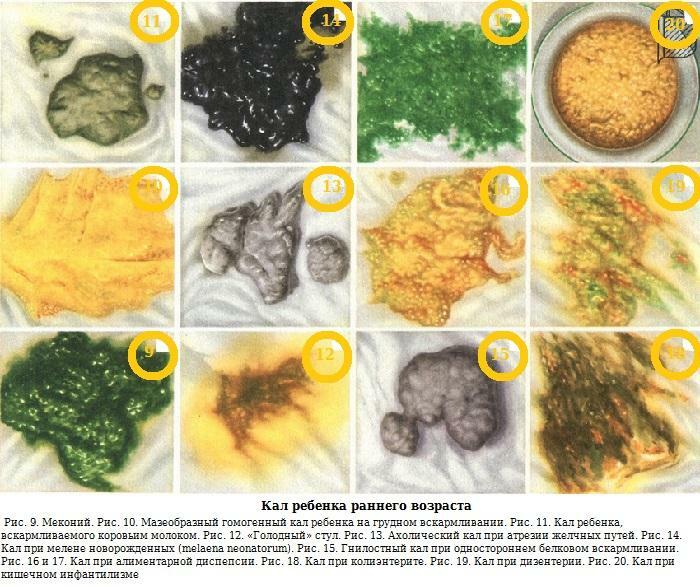
The mass itself should be free of mucus, blood clots, foam and other foreign substances. The smell of stool during breastfeeding will have a touch of sour milk.
If, for some reason, mother can not feed a newborn baby with breast milk, then special infant formula is used. Their use is called artificial feeding.
In this case, the feces will be completely different from the baby's feces on breastfeeding: the color will become light brown in color, the consistency will be denser, the frequency of bowel movements will decrease, and the smell will change to more repulsive and unpleasant than that of the baby on breastfeeding.
Reasons for stool change
When breastfeeding, a change in the color of the feces of a newborn can speak of a developing disease as well as of some aspects related to the vital activity of the nursing mother.
A liquid stool in a nursing baby can tell a lot if you learn to correctly recognize the signals sent by the baby's gastrointestinal tract.
Since the baby's body in the new habitat has just begun its adaptation, it is not yet able to fight many infections.
One of these is an intestinal infection that can appear regardless of the hygiene standards of the nursing mother and baby.
The baby can quickly get high fever, while he will constantly cry, the stomach will be puffed.
Another common reason why a baby can have a fastened loose stool is a dysbiosis.
This disorder is a consequence of the body's reaction to the treatment of a disease with antibiotics that undermine the microflora of the digestive system.
And to take antibiotics is not necessarily the baby itself, it could be done by the mother during feeding or while the baby was inside the womb.
All this can lead to changes in the work of the gastrointestinal tract of the baby.
One of the most serious illnesses is diarrhea. Diarrhea begins when there is a malfunction in the digestive system, which can entail, like other diseases, and malnutrition of the nursing mother.
The green loose stool in the infant, as well as the presence of blood clots, mucus, in combination with a mixed consistency and strong head of stool during bowel movements are the main symptoms of diarrhea.
In this case, the baby will behave restlessly and cry. Most of all with diarrhea infants are threatened by the loss of large amounts of liquid.
Video:
Therefore, if you find these symptoms of the baby immediately need to show the pediatrician for treatment.
In addition to diseases, changes in the stool of the newborn can be caused by other factors. This is mainly due to the nutrition of the mother.
To understand that changes only affect nutrition, parents should observe the condition of the baby for some time.
If the kid is cheerful, smiling, with a soft stomach, pink cheeks and normal temperature, but the feces have changed the consistency, smell and color, then it is time for the nursing mother to think about her nutrition.
The use of substandard and spoiled foods, poorly cooked dishes, greasy, fried, highly salted and spicy food can adversely affect the baby's excrement.
Extremely detrimental effect on the baby's organism is alcohol, even in small quantities.
When a change in the diet of a lactating mother may appear liquid frothy stool in the baby.
Video:
There are cases when the nursing mother thinks that the baby has not eaten enough. She begins to feed the baby in excess of his needs, which leads to an overload of the digestive system and malfunctions in the intestine.
Very loose stool in the baby can appear in the period when the teeth begin to be cut. Thus the immune system of the kid directs all forces on this process, it can raise the temperature.
In such cases, going to the pediatrician will not be superfluous to alleviate the condition of the baby.
Treatment and prevention of liquid stool
Treatment measures will depend on the pediatrician's diagnosis. Therefore, immediately after the detection of changes in the stool and the manifestation of parallel adverse symptoms, the newborn is shown to the doctor who will prescribe tests and an additional examination if necessary.
With the necessary hospitalization of the baby, the mother should always be present nearby, because the quickened liquid stool threatens to dehydrate the baby's body.
Breastfeeding is the only and important source of fluids, vitamins and minerals for the newborn, which will help him to fight the ailments.
That's why breastfeeding mothers need to keep an eye on their diet. For treatment at home, the pediatrician can prescribe sorbents that stabilize the digestive system.
Medical therapy for a baby should be cautious, since the body is not yet resistant to external "helpers" in diseases.
Drugs should be given only as directed, according to the instructions. Self-medication can be detrimental to the newborn.
In the case when no additional symptoms, other than changes in stool, are revealed, the nursing mother should completely reconsider her diet.
Fatty, salty, sharp ingredients are removed from the products. The dishes are subjected to any heat treatment, except frying in oil.
The baby's mom must completely give up alcohol, even if it's the same "harmless" glass of wine.
Fresh vegetables and fruits, low-fat dairy products, low-salted cereals and soups are introduced into the diet.
Poultry and fish can be cooked or boiled, or cooked for a couple, after which you need to let it cool down so that it is better digested.
When breastfeeding mom, it is important to remember that the health of the baby directly depends on her health and the cleanliness of the surrounding area.
Video:
Therefore, food should be prepared only by clean kitchen items. Vegetables and fruits are thoroughly washed before eating and cooking. Damaged products should be sent to the trash immediately.
Feeding should only take place when the baby wants it. Mom is advised to learn to listen to your baby's signals. This will help to avoid a big load on the digestive system.
Now we can conclude that small children react to any changes, both in feeding the nursing mother, and on getting into their organism of the disease, with their feces.
Changes in feces will help parents and the pediatrician understand the cause-effect relationship and take corrective measures to correct the malfunctions. The main thing is that parents take a closer look at themselves and the health of the baby.


