Tumor markers of the gastrointestinal tract: how to diagnose
Annual data from the World Health Organization show that from start to finish 10 million people on our planet are diagnosed with a terrible cancer every twelve months of the calendar. The death of this disease ends in an average of 8 million people every year. In this article, we will consider tumor markers of the gastrointestinal tract.

Tumor markers of the gastrointestinal tract
Content
- 1 Oncology of the gastrointestinal tract
- 2 Methods for determining the disease at an early stage
- 3 What are tumor markers
- 4 Types of tumor markers of the gastrointestinal tract
-
5 What tumor markers can be detected in case of damage to the gastrointestinal tract
- 5.1 CEA
- 5.2 CA 19-9
- 5.3 CA 242
- 5.4 CA 72-4
- 5.5 Тu М2 –РК
- 6 How is the diagnosis carried out?
-
7 What Cancer Markers Show
- 7.1 Video - Tumor markers. What is it and how is cancer treated?
- 8 Let's sum up the togas
Oncology of the gastrointestinal tract
Oncological formations located in the gastrointestinal tract, according to statistical indicators, are considered the third most frequent.
Early detection of the disease is considered to be the most effective remedy against a favorite type of cancer, including tumors localized in the gastrointestinal tract. It is very important to detect the presence of the disease before the typical symptoms of it appear, which can be noticed by an unprofessional eye, such as:
- unreasonable sharp decrease in body weight;
- loss of appetite;
- a high degree of fatigue when performing not labor-intensive actions, and the like.

It is almost impossible to diagnose cancer on the basis of obvious symptoms in time. If you suspect it is best to see a doctor right away.
It is especially difficult to track down such symptoms if the patient is already suffering from any illness. They can also be attributed to constant stress in the workplace, vitamin deficiency that occurs in the off-season, and many similar situations.
At the stage when the patient feels acute pain, the disease most often already begins to spread to the organs located near the focus of occurrence. In this case, the probability of a successful outcome becomes several times lower.
Methods for determining the disease at an early stage
In view of the above circumstances, early detection has become one of the priority areas in the fight against cancer. To discover that such a serious enemy is inside the human body, while not having signal about the occurrence of trouble at least some symptomatology, modern doctors use the following diagnostic techniques:
- analysis of biological fluids of the human body for the so-called tumor markers;
- imaging examinations.

In addition to analyzing biological fluids for the presence of a specific protein, it is also necessary to undergo other imaging diagnostic measures.
The second type of diagnosis is encountered by many people throughout their lives, including those who have escaped cancer. It includes procedures such as:
- ultrasound diagnostics;
- endoscopy;
- other studies.
But the first type, associated with the definition of tumor markers, is not familiar to many.
What are tumor markers
To understand the meaning of the term "oncomarker", even an ignorant person in medicine needs only to disassemble it into its constituent parts.
"Onco" is an abbreviation for the concept of "oncology", which can also be broken down into two parts:
- onco - a tumor;
- logic is science.
Together, these two components form the "science of tumors", also determining the meaning of the words of interest to us.
The sought-for part of the term we are interested in comes from the English marker. In translation, it has the following meaning: the marker is the one who marks.
We can draw the following conclusion: tumor markers are a kind of markers that signal the presence of cancer in the human body.
They are located in the biological fluids of that organ inside the body, which was struck by the desired disease. In fact, a tumor marker is a specific protein that is not produced in a normally functioning organism. It is created by tissue cells that:
- are infected with cancer;
- are around the neoplasm.
For each organ, when a disease occurs, a certain amount of specific proteins is formed, which differ for other systemic elements of the body.
The biological body fluids that are taken for analysis to detect tumor markers are understood as the following substances:
- blood;
- urine;
- rarely also take for examination feces.

Tests for the presence of cancer "marks" are taken in the traditional way: in the form of urine, blood, feces or other secretions of the human body
Types of tumor markers of the gastrointestinal tract
The sought-for specific proteins are divided into two main groups that help determine the presence of pathological processes in the body. Let's look at each of them in the following table.
Table 1. Groups of specific proteins
| First group | Second group |
|---|---|
| The first group of cancer markers found in blood or other fluid taken from a patient includes the so-called nonspecific proteins. Their detection indicates the presence of an oncological disease inside the human body, however, it is impossible to specify a specific affected area by them. |
The second group is represented by highly specific tumor markers, which not only signal the presence of cancer in organs, but also indicate which of them is affected by the disease. |

Schematic definition of the stages of gastric cancer
As you understand, it is the highly specific tumor markers from the second group that make it possible to understand what cancer is found in the patient. We have already mentioned above that for each organ, their set will be different. In the next section, we will consider what types of proteins characterize the appearance of a disease in the gastrointestinal tract.
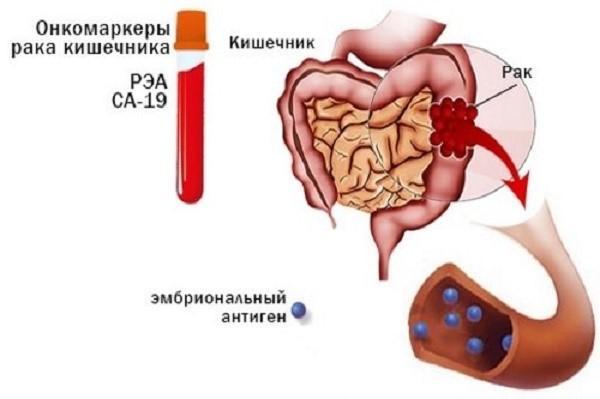
Each organ has its own combinations of tumor markers
What tumor markers can be detected in case of damage to the gastrointestinal tract
When the attending physician suspects the presence of cancerous processes in the gastrointestinal tract, a specific list of cancer "marks" is expected to be detected. Let's take a look at each of them in order.

Schematic representation of tumors covering the patient's intestines
CEA
The desired marker is not subject to detection in adults. The fact is that it is produced by the cells of the tissue of the gastrointestinal tract of the embryo, which is in the mother's abdomen.
The concentration of the desired element in the biological fluid, which is within the normal range, ranges from 0 to 5 nanograms per milliliter. The abbreviation of the desired tumor markers is deciphered as "cancer embryonic antigen". As part of documents and certificates issued for a sick patient, it is usually indicated in abbreviated form.

Some characteristics of the embryonic cancer antigen
A biochemical analysis designed to detect the desired cancer antigen is prescribed for the following reasons:
- the attending physician needs to make a prognosis regarding the increase in neoplasm;
- additional information is needed, allowing, when receiving them, to draw conclusions about the stage of development at which the disease is located.
The presence of a cancerous embryonic antigen in the biological fluid allows, as a result, to select treatment appropriate to the specific state of affairs, as it helps to determine the specific dimensions neoplasms.
In addition, CEA helps to determine the occurrence of relapses in those patients who have already defeated the disease once, and to take measures at an early stage.
CA 19-9
Another cancer marker, the so-called carbohydrate antigen, allows early action and detection of gastrointestinal cancer. When it appears, doctors usually determine the development of pathological processes in the following organs:
- colon;
- esophagus;
- gall bladder;
- ovaries;
- ducts;
- rectum;

Features of the desired specific protein
The abnormal concentration of antigen in the fluid ranges from 40 international units per milliliter.
Using the desired oncological marker, it is possible not only to track the onset of the disease, but also its development, as well as extinction. It serves as a control unit in the treatment of cancer patients admitted to a medical institution with lesions of the gastrointestinal tract.
As in the case of the cancer embryonic antigen, it allows to determine the development of a relapse inside the body of a previously ill person.
Detection of the CA 19-9 carbohydrate antigen in question is possible in the cells of the following human vital organs:
- in the epithelium of the pancreas;
- mucous surfaces of the stomach;
- liver;
- small intestine;
- large intestine;
- gallbladder.
In addition, you can also find carbohydrate antigen in the following fluids:
- urine;
- semen;
- stomach acid;
- saliva;
- discharge of the duodenum;
Due to the fact that the tumor marker in question can be concentrated in the cells of many organs and in an extensive the amount of discharge, with its help it is not possible to thoroughly specify the localization of the focus of the appearance of the tumor possible.
CA 242
Pathologies in which the desired tumor marker is formed in the tissues of the human body coincide with the list presented for CA 19-9. However, the specific marker considered in this section still has its own specifics, narrower than the previous agent.

The CA 242 marker is found in human blood
The identification of CA 242 is most often a fact indicating the appearance of oncological pathologies in the following organs of the human body:
- pancreas;
- rectum;
- colon.
The specificity of the appearance of the desired marker has been confirmed over the years, during which research in the field of oncology was carried out. The sought marker CA 242 is one of the main ones for the diagnosis of gastrointestinal tract cancer.
In addition, its discovery is invaluable also for the elimination of relapses. Their appearance CA 242 allows you to determine for a period of three months to six months.
The normal concentration of the substance of interest should not exceed 0 to 30 international units per milliliter of body fluid.
CA 72-4
This oncological marker mainly indicates the occurrence of stomach cancer, as well as colorectal pathology.

CA 72-4 is most often found in combination with other "marks" in gastric cancer
Colorectal cancer refers to the disease of the following two elements of the gastrointestinal tract:
- colon;
- rectum.
The concept is collective, since in practice it is very difficult to separate the disease of a particular section of each of the listed segments of the intestine. In addition, at advanced stages, metastases spread along the entire length of the considered element of the body.
In a satisfactory value, the concentration of CA 72-4 should not exceed 6.3 international units per milliliter of biological fluid.
The test for finding CA 72-4 in the body is most often carried out in conjunction with the detection of a cancerous embryonic antigen. Most often, its presence indicates the development of colon and stomach cancer in the body. However, CA 72-4 is also found in organisms of patients with non-small cell lung cancer.
The cells of the tissues of the body of a healthy person practically do not contain the desired oncological marker. Normally, it should not be.
Тu М2 –РК
This type of cancer "marks" is metabolic. This means that it indicates some changes in metabolic processes in the cells of neoplasms.

Marker Тu М2 –РК speaks about metabolic changes in processes in cells of neoplasms
The designation of the tumor marker is deciphered as tumor pyruvate kinase type M2. It should be noted that the protein under consideration, despite its highly specificity, cannot clearly indicate the localization of the disease focus in any particular organ.
Some doctors call Tu M2 –RK “elective”, since it allows one to determine the development of neoplasms of a completely diverse etiology. In addition, it is also available for definition using the desired protein:
- the presence of metastases;
- early detection of recurrent recurrence.
How is the diagnosis carried out?
To detect almost all of the cancer markers listed in the section above, synthesized in the human body in the event of cancer of the segments of the gastrointestinal tract, are made analyzes. The material for their implementation is a certain biological fluid taken from the body of a sick patient - blood.

To diagnose the presence of gastrointestinal cancers, it is necessary to pass routine tests.
For the analyzes to be reliable, certain prerequisites must be met.
- First of all, it is necessary to remember that blood, to be determined by the presence of oncological markers in it, is given on an empty stomach. To avoid doubts about the results obtained, blood sampling should be carried out no earlier than 8 full hours after the last meal. Ideally, the interval should not be 8, but 12 hours.
- Even under the condition that fasting was performed as much as is normally required, it is best to neglect the following drinks before analysis, without which any person's day usually does not pass:
- juice, fresh or packaged;
- tea, black or green, as well as herbal;
- coffee, black or with additives, with and without sugar.
- Before the procedure for determining tumor markers, drink plain water, without any additives. In addition, a limited sugar intake is recommended.
- If you are taking tests to confirm the presence of CA 72-4 in your blood, you need to pay attention to the following fact: if you are taking biotin, whose dosage per day exceeds 5 milligrams, then the interval between taking the drug and passing the tests should be at least 8 hours. Best of all, as in the case of food, if it is larger.
During the first day after the transfer of blood samples for analysis, the following specific proteins are determined:
- CA 242;
- CEA;
- CA 19-9.
The rest of the cancer markers are determined over a period lasting from three days to a full week.
You will need blood to determine most of these specific proteins, however, some "Witnesses" of cancers of the gastrointestinal tract are in other secretions of the human organism. This applies, for example, to Tu M2-PK. In order for the studies to show a reliable result, in this case, certain conditions must also be observed.
So, the feces should be obtained naturally, that is, during bowel movements. It is forbidden to use enemas, as well as to take various medications that have a laxative effect. To obtain the result, it is necessary to collect an amount of feces equal to about two teaspoons. It is necessary to place the resulting mass in a clean, best of all, previously unused container. For example, in special plastic pharmacy cups sold for little money.
The result of determining the desired tumor marker will be known a week after the laboratory receives the material for research.
What Cancer Markers Show
Determining the exact localization of tumor occurrence is almost impossible when determining only one tumor marker. Prepare for doctors to look for them all. At the same time, specificity in the obtained analyzes will be possible in the presence of certain combinations of cancer markers, manifested in the form of specific specific proteins.

Please note that the presence of any specific protein in biological fluids is not necessarily an indicator of oncology.
Table 1. The most common combinations are
| Disease | Combination of tumor markers |
|---|---|
| Tumor originating in the patient's stomach | This disease will be characterized by a combination of the following specific proteins: |
| Rectal cancer | Determine the desired pathological process will help: |
| Colon oncology | The disease in question can be determined by the presence in the blood and feces: |
Pay attention to the following fact: if your analyzes show increased concentrations of specific proteins, even if the norm seems to be greatly exceeded, they do not necessarily indicate the presence of cancer in the body.

Diseases for which any markers have been identified may not have an oncological etiology
The appearance of tumor markers in blood and other fluids can also indicate the presence of other diseases, unpleasant, however, much less serious than cancer.
- Thus, a cancerous embryonic antigen is a frequent indication of the occurrence of pathologies of the most important organs of the body. Often, its indicators go off scale when:
- cirrhosis of the liver;
- Crohn's disease (affects the gastrointestinal tract);
- chronic or exacerbated pancreatitis.
- The antigen labeled CA 19-9 appears in cholecystitis (inflammation of the gallbladder).
- The CA 72-4 antigen can be found in the patient's blood when:
- peptic ulcer of the stomach;
- cirrhosis of the liver;
- pneumonia;
- bronchitis, chronic or acute.
- Tumor type M2 pyruvate kinase is manifested when:
- infections of bacterial etiology that have affected the gastrointestinal tract;
- rheumatism;
- complications of diabetes mellitus and the like.

What is Crohn's disease?
Video - Tumor markers. What is it and how is cancer treated?
Let's sum up the togas
Finding cancer markers in the biological secretions of the human body is an invaluable way of detecting and, therefore, preventing the manifestation of cancer in the early stages. Science does not stand still and continues to develop in the field of early detection of oncological diseases. Perhaps, in the future, special combinations of cancer “marks” will be identified or new specific proteins will be found that will allow not only to determine not the imminent onset of the disease, but the distant one. Then the percentage of sick citizens and deaths as a result of receiving oncology will significantly decrease.
We would like to draw your attention to the fact that the isolation of tumor markers in the blood is not an obligatory indicator of the presence of cancer in the segments of the gastrointestinal tract. That is why, if they are found, do not refuse to conduct further clinical studies.

Observe the above rules when taking tests to maintain the reliability of their results.