How to check the pancreas: ultrasound, tests and diagnosis of diseases
The rhythm of modern life leaves very little time for proper and healthy nutrition. Violation of the principles of food intake negatively affects the condition of the pancreas.
For a long time, changes can be subtle. It is important to know the first signs in order to check the pancreas in time and pass the necessary tests.
Content
- 1 When to ask for help
-
2 Diagnostics
- 2.1 Laboratory research
- 2.2 Functional tests
- 2.3 Hardware diagnostics
- 3 Preparation for testing
When to ask for help
People often do not attach importance to the appearance of discomfort and a feeling of heaviness in the upper abdomen. The patient turns to the doctor when the condition worsens and there are periodic aching pains. An immediate examination of the pancreas (PZh) is necessary when the following signs appear:
- nausea after eating fatty, fried foods and alcohol;
- pain in the epigastric region, radiating under the ribs and scapula;
- belching with an unpleasant aftertaste, flatulence;
- violation of stool, when constipation is replaced by diarrhea and vice versa.

The structure of the pancreas
In addition, the person may experience weakness, sudden anxiety, and facial flushing. Red rashes and minor hemorrhages appear on the skin. Blood sugar levels may change. A person's urine and sweat takes on an unpleasant smell of rotten fruit or acetone.
If, along with the symptoms, the temperature rises, a strong stabbing, cutting pain appears, this is a sign of a developing inflammatory process in the pancreas. Such violations require urgent medical attention.
To get a complete picture of the condition of the pancreas, you need to contact a therapist or gastroenterologist and undergo an examination. To make a diagnosis, the doctor will prescribe a set of measures. The pathology detected in time and the treatment carried out excludes the further development of complications.
Diagnostics
The examination begins with interviewing the patient and taking anamnesis. The pancreas is located behind the stomach in the depths of the body, so it cannot be palpated. However, the doctor can make a preliminary diagnosis based on the patient's complaints.
Usually the discomfort is observed in the left hypochondrium. Pain occurs 30 minutes after eating. It can be short-term cramping, encircling. At acute pancreatitis the patient has pale skin with areas of cyanosis due to damage to the capillaries. There is sticky sweat, dry mouth, rapid breathing. To relieve suffering, during an attack, a person adopts a characteristic half-bent posture.
The chronic course is characterized by prolonged aching pain that can last for several days. There is a white coating on the tongue, there is a loss of appetite.
Dry, yellowed skin with hemorrhagic rashes and scratching indicates the presence of a neoplasm. The patient appears emaciated, with a large distended abdomen. Muscles of the press are tense, severe pain in the epigastrium.
With a decrease in enzymatic activity, a person can independently notice a violation of the process of assimilating fats by the type of feces. Feces have a shiny sticky surface, a fetid, persistent odor, and are difficult to wash off the toilet bowl. Undigested food debris is visible. Light feces indicate a violation of the patency of the bile ducts.
Laboratory research
The pancreas is a complex organ. It has a unique structure. Its functions are mixed secretion. The enzymes produced play an important role in digestion - they break down proteins and fats. The hormone insulin provides energy to cells and tissues.
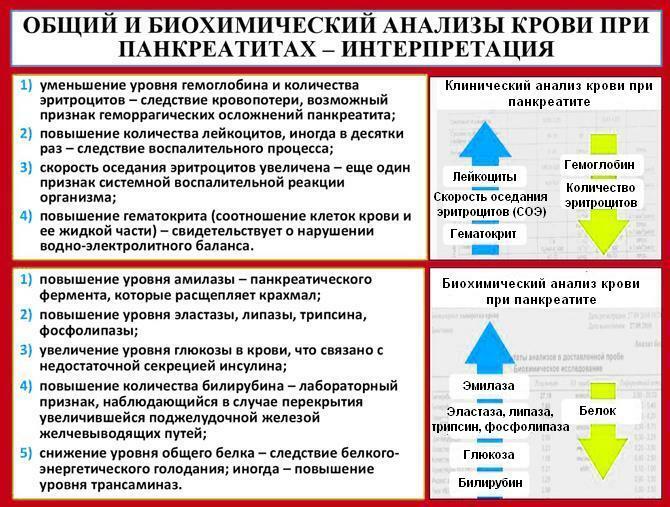
For diagnosis, it is necessary to check not only the enzymatic, but also the hormonal activity of the gland. T. because the acute period is characterized by increased secretion of enzymes, they can be found in large quantities in the blood, urine and feces. Analyzing the indicators, they judge the presence of the disease, the stage and severity of the course.
When examining an organ, a general and biochemical blood test is performed. Perform specific tests for pancreatic enzymes and hormone levels. And you will also need a urine test and coprogram. In some cases, along with the gland, liver function is also examined.
If in the general analysis of blood the erythrocyte sedimentation rate (ESR) is increased and the level of leukocytes speaks of an inflammatory process. But such changes are characteristic not only of acute pancreatitis or exacerbation of a chronic form. It can be inflammation of any other organ.
Biochemical analysis determines total and direct bilirubin, glucose and α-amylase levels, lipase and trypsin. Lack of enzyme production reduces the absorption of nutrients, and excess damages the gland itself. Insulin deficiency leads to the development of diabetes mellitus.
Insufficient processing of nutrients entering the body is reflected in the analysis of urine. In pancreatic disease, the indicators of glucose, amylase, amino acids differ sharply from the norm.
When examining feces, the color, consistency, and inclusions of unchanged food particles are analyzed. The amount of elastase, the type of fibers and cellulose, and the process of hydrolysis in the feces are determined.
If no significant deviations from the norm are found, laboratory tests are ended. Otherwise, additional analyzes of the pancreas are performed using stress tests.
Functional tests
Functional tests include:
- Glucoamylasemic test. On an empty stomach, the patient is determined by the level of amylase in the blood. Then the person drinks 50 ml of glucose. After 3 hours, the analysis is repeated. The increase in amylase levels should not exceed 25% of the first indicator.
- Proserine test. Determine urine diastasis. Next, the patient is injected with proserin, which enhances the synthesis of enzymes. The enzyme levels are measured for 2 hours. It should not increase more than 2 times, and after the expiration of time, return to the initial amount.
- Test with Iodolipol. After urinating in the morning, the patient drinks the drug. An hour later, they begin to make samples. To do this, every half hour, urine is taken to determine iodide. The maximum concentration should be in the last sample, after 2.5 hours.
- Pancreozymin test. The patient is injected intravenously with the hormone secretin. After a certain time, the contents of the intestine are collected using a probe. Then the amount of lipase, trypsin, amylase, which were secreted by the gland into the duodenum under the action of the hormone, is determined.
Hardware diagnostics
Analyzes do not always give an exhaustive answer, since the same indicators can characterize other diseases. Instrumental research provides more information about the size of the pathology and structural changes in the pancreas.

Hardware diagnostics of the pancreas
One of the standard procedures is Ultrasound. Ultrasonic waves are reflected from the tissue surface and converted into an image on the monitor screen. The size of the gland, its contours, level is automatically determined echogenicity, the presence of fluid in the abdominal cavity.
To determine the function of the ducts of the pancreas and duodenum, an endoscopic examination is performed. With the help of a special probe, the condition of the duct and the presence of patency are checked.
Computed tomography allows you to examine the structure of the gland, to find the place of degeneration of healthy tissue, to reveal a tumor.
The endo-ultrasonography method makes it possible to study the state of not only the gland and its ducts, but also the lymph nodes.
Along with the study, tissue puncture is carried out with a thin needle, which allows you to perform a histological analysis - to confirm or deny the presence of oncology.
Instrumental research is carried out by a specialist, ultrasound diagnostician. The doctor issues a form with the examination protocol, preliminary diagnosis and, if necessary, recommendations for further examination. As a result of the data obtained, the attending physician makes the final diagnosis and prescribes treatment.
It includes drug therapy, the use of enzyme preparations, and diet. In severe cases, surgery will be required to excise the damaged areas or completely remove the gland.
Preparation for testing
To ensure that the results are not erroneous, the doctor instructs the patient on how to properly collect the biological material:
- For several days, fatty, fried and spicy foods are excluded from the diet. You need to give up canned food, carbonated drinks and alcohol. Do not consume legumes as they cause gas formation.
- Do not smoke 2 hours before donating blood.
- To collect urine and feces, use sterile containers, wash hands with soap and water.
- Genital hygiene is mandatory for women before collecting urine. A vaginal swab should be used.
- For the purity of the material, you need to collect a medium portion of urine.
These simple and manageable rules will help you avoid skewing the results. Only a specialist can decipher, analyze and interpret the data. For prevention, you can check the condition of the pancreas even in the absence of any symptoms and complaints. The earlier the examination is carried out and the diagnosis is performed, the more successful the treatment is.
Video: Diagnosis of diseases of the pancreas
Read also: Diseases of the pancreas