Ossifying progressive fibrodysplasia (OPF) - stone man syndrome
Content
- What is ossifying progressive fibrodysplasia?
- OPF symptoms
- Fibrodysplasia causes
- Diagnostics
- Treatment
- To summarize
- Related Videos
What is ossifying progressive fibrodysplasia?
Ossifying progressive fibrodysplasia (or abbr. OPF, Muncheimer's disease, stone man syndrome) Is a very rare inherited disorder in which the connective tissues of the body, including muscles, tendons, and ligaments, are gradually replaced by bone (in a process called ossification).

Müncheimer's disease is present at birth, but symptoms may not appear until early childhood. Ossification can occur accidentally or after injury.
OPF symptoms
In those born with OPF, the signs and symptoms of ossification may not show up until the baby is a little older and starts to grow.

In newborns, the first sign of APF is often congenital toe anomaly.
Soon after birth, healthcare providers or parents may notice that the baby's big toes are shorter than the other toes. photo above).
This malformation occurs in all people with stone man syndrome and is an important clue for diagnosis.
The newborn may also have swelling around the eyes and scalp. In some cases, this edema can begin while the fetus is still in the womb, although this condition is usually only diagnosed after birth. Near 50 percent of people with this disease, they also have similar congenital anomalies in the thumbs - other malformations have also been observed, for example, in the spine.
Most people with ossifying progressive fibrodysplasia first experience the main symptoms of the disease (sometimes called "flare-ups") by 10 years of age.
While the overall rate of progression of the condition is unknown, ossification tends to follow a pattern from the neck to the shoulders, trunk, limbs, and feet.
However, because bone formation can be affected by injury (such as a broken arm) or viral disease (such as flu), the disease may not strictly follow this progress.
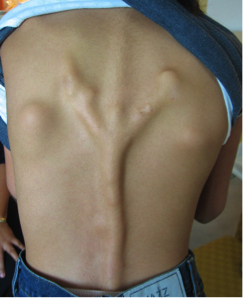
The main symptoms of Münheimer's disease depend on which parts of the body have become ossified. Often, with the disease, there are tender lumps under the skin (subcutaneous nodules, see. photo above). Sometimes the formation of these nodules is preceded by a mild fever. Most people with OPF will have general symptoms of pain, stiffness, and progressive lack of mobility as bone grows.
Depending on which parts of the body are ossified, more specific symptoms of APF may include:
- nutritional problems that can lead to nutritional deficiencies or malnutrition;
- difficult to talk;
- dental problems;
- labored breathing;
- respiratory infections;
- hearing impairment;
- hair loss (baldness);
- anemia;
- compression of nerves;
- right-sided stagnant heart failure;
- rachiocampsis (scoliosis and kyphosis).
- sensory abnormalities;
- moderate mental retardation;
- neurological symptoms.
Read also:Antiphospholipid syndrome
People with stone man syndrome may have periods in their lives when bone will not grow. In other cases, it may appear that this phenomenon occurs by accident and in the absence of any obvious injury or illness. If ossification occurs in an unusual part of the body (where bones are usually not found), it can lead to fractures.
Over time, the formation of new bone and tissue tumor that accompanies this condition can seriously affect how well a person can move.
In most cases, ossifying progressive fibrodysplasia ultimately leads to complete immobilization. Many people with this condition will be bedridden by the age of 30.
Fibrodysplasia causes
Most people born with OPF develop the disease as a result of an accidental genetic mutation. Although it is a genetic disorder, it usually does not occur in the entire family.
A person needs only one affected gene to develop ossifying progressive fibrodysplasia. Most cases are due to an accidental mutation - a person rarely develops the condition because only one parent inherits the abnormal gene. In genetics, this phenomenon is referred to as an autosomal dominant disorder.
The gene mutation responsible for the condition has been identified by researchers from the University Pennsylvania - they identified a receptor on chromosome 2 called the type IA activin receptor (ACVR1). ACVR1 is present in a gene that codes for bone morphogenetic proteins (BMPs) that help build and repair the skeleton from the moment the embryo is formed.
Researchers believe that a mutation in the gene prevents these receptors from being turned off, allowing uncontrolled bone to form in parts of the body where it usually does not appear during life person.
Diagnostics
Ossifying progressive fibrodysplasia is very rare. It is estimated that only a few thousand people have this disease, and there are only about 800 known patients with this disease in the world - 285 of them are in the United States. APF appears to be more common in children of a particular race, and the condition is as common in boys as it is in girls.
Diagnosis of ossifying progressive fibrodysplasia can be difficult. It is often misdiagnosed as a form of cancer initially or as a condition called aggressive juvenile fibromatosis.
At the beginning of the diagnosis of Müncheimer's disease, if the tissue is biopsied and examined under a microscope (histological examination), it may have some similarities with aggressive juvenile fibromatosis. However, in the latter disease, the lesions do not progress to fully formed bone, as in stone man syndrome. This can help the doctor distinguish between these diseases.
Read also:Juvenile rheumatoid arthritis in children: causes, symptoms, methods of diagnosis and treatment, prognosis for the future
One of the main diagnostic signs that can lead a doctor to suspect a disease Müncheimer, in contrast to another condition, is the presence of short, malformed large toes.
If the tissue biopsy is unclear, a clinical examination of the child may help the doctor rule out aggressive juvenile fibromatosis. Children with aggressive juvenile fibromatosis do not have congenital malformations of the toes or hands, but this is almost always the case in children with OPF.
Another condition, progressive bone heteroplasia, can also be confused with ossifying progressive fibrodysplasia. The main difference in diagnosis is that bone growth in progressive bone heteroplasia usually begins on the skin rather than underneath it. These bony plaques on the surface of the skin are different from the delicate nodules that form with OPF.
Other tests that a doctor may prescribe if there is a suspicion of stone man syndrome include:
- complete medical history and physical examination;
- X-rays such as computed tomography (CT) or bone scintigraphy (bone scans) to look for changes in the skeleton
- laboratory tests to measure alkaline phosphatase levels;
- genetic testing to look for mutations.
If OPF is suspected, doctors try to avoid any invasive tests, procedures, or biopsies. because the injury usually results in more bone formation in a person with this disease.
Although the condition does not usually affect the entire family, parents who have a child diagnosed with Münheimer's disease may benefit from genetic counseling.
Treatment
There is currently no cure for OPF. There is also no specific or standard course of treatment. Current therapies are not effective for every patient, and therefore the main goal is to treat symptoms and prevent bone growth, if possible.
While therapy will not stop the condition from progressing, medical decisions for treating pain and other symptoms associated with OPF will depend on the needs of the individual patient. The doctor may recommend trying one or more of the following drugs and procedures to improve the patient's quality of life:
- High-dose prednisone or other Corticosteroid;
- drugs such as Rituximab (usually used to treat rheumatoid arthritis);
- Iontophoresis of medicinal substances for the delivery of drugs through the skin;
- Muscle relaxants or local anesthetic injection;
- drugs called Bisphosphonatesthat are used to protect bone density;
- Non-steroidal anti-inflammatory drugs (NSAIDs);
- drugs to suppress mast cells, which can help reduce inflammation.
Ossification often occurs randomly and cannot be completely prevented, however, in rare cases, it can also occur in response to inflammation, injury, and illness.
Thus, recommendations regarding activity, lifestyle, preventive care and interventions can be prescribed from childhood.
Read also:Psoriatic arthritis (PA)
Recommendations may include:
- avoid situations that could lead to injury, such as avoiding sports entirely;
- avoid invasive medical procedures such as biopsies, dental procedures, and intramuscular immunizations;
- antibiotic prophylaxis to protect against disease or infection when needed;
- infection prevention measures, such as good hand hygiene, to protect against common viral diseases (such as flu) and other respiratory viruses, as well as from complications such as pneumonia;
- physiotherapy;
- mobility aids and other assistive devices such as a walker or wheelchair;
- other medical devices that can help in daily life for dressing and bathing.
- Medical devices or other safety measures to prevent falls, such as getting out of bed or showering
- psychological and social support for patients and their families;
- educational support, including special education and homeschooling;
- families can benefit from genetic counseling.
Invasive procedures or surgery aimed at removing areas of abnormal bone growth are not recommended, as trauma from surgery almost always leads to the development of further ossification.
If surgery is absolutely necessary, the most minimally invasive technique should be used. Patients with OPF may also require special anesthetics.
In recent years, several clinical trials have been conducted to develop better treatment options for people with fibrodysplasia.
To summarize
Ossifying progressive fibrodysplasia is an extremely rare condition in which a gene mutation causes connective tissues of the body, including muscles, tendons and ligaments, are gradually replaced by bone (a process called ossification).
There is no cure for Münheimer's disease and diagnosing the condition is quite difficult.
Treatment is mostly supportive, and the progression of the condition is usually quite unpredictable. Taking steps to avoid injury and other situations that can lead to increased ossification can help reduce the number of substitutions in a person, however, new bone may still form without any obvious causes.
OPF usually results in complete immobility, and by the age of 30 most people are bedridden. Clinical trials are underway that will hopefully lead to better treatment options to improve the quality of life for patients with this condition.