Dizziness, nausea, lack of coordination: reasons that this may be
Dizziness is a condition when a person feels the non-existent movement of objects around and space. It is also called vertigo. The symptom is called the illusion of movement. Dizziness is not considered a separate disease - one of the signs of the disease.
Content
- 1 Types of dizziness
- 2 Associated symptoms
-
3 Causes
- 3.1 Among women
- 3.2 In children
- 3.3 In the elderly
- 3.4 In pregnant women
- 4 Diagnosing the problem
-
5 Treatment
- 5.1 Conservative treatment
- 5.2 Surgery
- 5.3 Folk remedies
Types of dizziness
This symptom is so common that doctors soon began to distinguish types of dizziness. There are two main types: central, peripheral. Now they began to distinguish the systemic and physiological.
Central vertigo is provoked by diseases of the brain or disorders in it. A possible cause is trauma, tumors. The cause of peripheral vertigo is damage to the vestibular nerve. Physiological dizziness is caused by overwork, lack of glucose in the body. This species is considered the most harmless. The reason for the systemic circling is the failure of the system responsible for orientation in space.
Associated symptoms
Dizziness may be accompanied by:
- Throbbing pain in temples.
- High blood pressure (arterial).
- Morning sickness.
- Vomit.

- Pain in the right, left ear.
- Sharp pain in the head in the morning.
- Disorder in coordination.
- Darkening in the eyes.
- Weakness in the body.
- Elevated temperature.
- Fainting.
- The left or right temple hurts.
Causes
Dizziness is associated with a large number of diseases. For the correct diagnosis of diseases, the appointment of treatment, it is worth familiarizing yourself with them.
- Inner ear inflammation is characterized by the presence of vertigo, decreased hearing, and discharge from the ear opening.
- Tinnitus, decreased hearing, nausea, vomiting, dizziness are signs of Meniere's disease.
- Vertigo manifests itself in vestibular neuritis. The head is spinning when it is turned. The patient feels the illusion of movement.
- Severe dizziness is diagnosed with a stroke. There is a bifurcation of the image in the eyes, there is a violation of coordination, weakness overcomes, speech is impaired.
- Spine injuries, heads accompanied by vertigo, torments weakness and nausea.
- The pathology of the muscles of the eyes is caused by a rapid change in the image in front of them. Vertigo is an accompanying symptom.

- A light-headed state appears with Basilar migraine. It occurs accompanied by nausea, vomiting.
- Headache and vertigo can cause brain tumors.
Among women
The female body, due to its anatomical, physiological differences, is subject to dizziness. The basis of the condition is the reasons:
- Premenstrual syndrome is accompanied by headache, apathy, aggression.
- Violation in the cycle may be accompanied by light-headedness, flatulence, and vomiting.
- Female anemia occurs due to menstruation, which also causes vertigo.
- Menopause in women.
- Infectious diseases of the organs of the reproductive system cause weakness, increase the temperature.
In children
It is almost impossible to determine vertigo in a child, especially an infant. The causes of the symptom in children are identical to those in adults.
A child's head spin is due to heatstroke, accompanied by nausea and vomiting, and general weakness of the body. The symptom of dizziness accompanies seizures of epilepsy in a child. The increased pressure inside the skull also causes dizziness, vomiting, and severe headache.
Often children complain of dizziness in transport, subsequently nausea and vomiting occur. The totality of symptoms speaks of motion sickness, kinetosis.

In the elderly
Vertigo is the most common symptom in older people. The body of an old person becomes weakened, susceptible to many ailments, and dizziness accompanies many of them.
- Violations of the circulatory system and diseases of the vestibular analyzer can be a likely cause of vertigo.
- Neurological disease - Parkinson's disease, characterized by severe tremor of the limbs, body instability.
- Eye diseases also cause dizziness. Glaucoma, cataracts interfere with visual perception, cause vertigo.
- With cervical osteochondrosis, intervertebral hernia.
In pregnant women
More often, dizziness in a pregnant woman occurs due to an improper lifestyle: overeating or malnutrition, abuse of bad habits, but there are other options.
The first cause of dizziness is an ectopic pregnancy. Toxicosis is also accompanied by vertigo. Anemia, all sorts of infections in the body of the expectant mother. The most dangerous condition is preeclampsia. It threatens the life of the mother and child. Signs of the disease are pressure in the temples, nausea, vomiting, blurred vision and severe headache.
Diagnosing the problem
The disease can be diagnosed using a variety of methods, including laboratory, instrumental, objective studies of the patient's sensations.
The first diagnostic method is physical. It includes a conversation with the patient, where he talks about subjective sensations (dizzy when I get out of bed in the morning after sleep, presses in the temples), the doctor writes down, asks questions. The next way is to take blood tests, urine, biochemical blood tests. Using the results, you can determine the cause of your dizziness.
Electrocardiogram, electroencephalography, ultrasound examinations of blood vessels in the neck, brain, as well as computed and magnetic resonance imaging are considered important. With the help of these methods, the cause of the dizziness is guaranteed to become known.
Treatment
Due to the fact that there are quite a lot of possible diseases associated with dizziness, it means that there are no less methods of treatment. Here, not only symptomatic, but also etiological, pathogenetic treatment is used. Symptomatic treatment deals with the elimination of the causes, symptoms. Etiological eliminates the cause of vertigo, and pathogenetic treatment affects the mechanism that provoked the disease. All of them are divided into conservative methods, including treatment with medicines and developed maneuvers, alternative methods and operations.
Conservative treatment
Maneuvers used to treat vertigo involve taking actions to help improve the condition.
The following types of maneuvers are used: the Semont, Epley, Lempert maneuver. Semont's maneuver is to turn his head to the side where the healthy ear is while sitting on the bed. Fix the head, the position of the body can be changed. Then lie on your side for a couple of minutes, which hurts, and then roll over onto the other, also for 2 minutes. Then return to the first position and align your head.
Surgery
Intervention by the surgeon occurs when it is impossible to correct the situation with the help of medication and maneuvers.
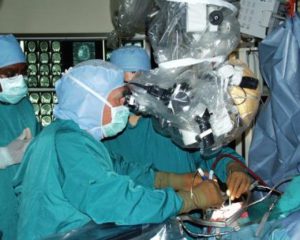
Brain surgery
Surgical solutions:
- Removal of malignant neoplasms of the brain that provoked vertigo and other unpleasant, painful symptoms.
- In case of dizziness, an operation is performed to insert a vestibular implant, when it was caused by a violation of the vestibular apparatus.
- Kimmerle's technique is to normalize the blood supply to the brain.
- Chiari malformation normalizes the outflow of cerebrospinal fluid.
- Classical labyrintectomy is a cardinal measure. It is considered as such because it consists in the complete removal of the labyrinth, which is responsible for the sensation of changes in motion and gravity.
- A common cause of vertigo is vision problems - various operations are performed to correct it.
Folk remedies
There are many ways to soothe dizziness. Doctors have a positive attitude towards folk remedies for solving this problem, but they advise to take a comprehensive approach to the problem, because various diseases can be the cause of vertigo. Using only folk remedies, you can get rid of the symptoms, but the source of the symptom is impossible. It is worth remembering that folk remedies are often harmful to health, if you do not take into account all the subtleties. Self-medication is absolutely not worth it!
When dizzy, use hawthorn tincture. The composition of the infusion contains substances that improve blood circulation, eliminate the main symptom. Pregnant women are contraindicated to take tincture. Frequent intake of the infusion makes a person drowsy.
Lemon balm tea can be drunk in the morning - it improves brain function, reduces pain in the temples and head. The following tea with honey and apple cider vinegar is also worth drinking in the morning - it acts as a sedative.