Muscular dystrophy
 Muscular dystrophy is a chronic disease of the skeletal musculature of the human body, which has a hereditary character. With this disease, muscle weakness and degeneration are noted. Most people with this pathology can not move without the help of a wheelchair, crutches.
There are several forms of the course of muscular dystrophy, each of which differs in the time of its manifestation( symptoms of some types of muscular dystrophy are revealed even in childhood, others are found after adulthood).Against the background of muscular dystrophy, problems with respiratory, cardiovascular and other body systems are not excluded.
Duchenne muscular dystrophy
This form of muscular dystrophy derives its name from the name of the scientist who first described it.
Muscular dystrophy of Duchesne is the most common disease among various pathologies of the muscular system, the frequency of occurrence is 3.3: 10 000( and the probability of occurrence of muscular dystrophy of this species in boys is greater than in girls).The disease is transmitted on a recessive type, X-linked.
The first symptoms of muscular dystrophy in children are found when the child starts walking alone. They include: frequent falls and difficulties in changing the position of the body, a staggering gait, an increase in the calf muscles, problems during running and jumping.
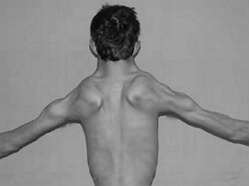
Duchenne muscular dystrophy manifests itself in childhood - from 3 to 5 years. In sick children, the gait changes, they go waddling. There are frequent falls, with the arms raised, the blades "move away" from the trunk( "pterygoid shoulder blades").At the age of 8-10 years, children move with difficulty, and by the age of 12-13 the patients are completely immobilized, later they can not do without a wheelchair. Development of weakness of the heart muscle causes death( occurrence of heart failure, respiratory failure, infection, weakening the body).
The first clear sign of the development of Duchenne muscular dystrophy is the condensation of the gastrocnemius muscles. Then their volume gradually increases due to pseudohypertrophies, which can also develop in deltoid, gluteus muscles. Subcutaneous fat layer hides atrophy of hip and pelvic muscles. Later the muscles of the back, shoulder girdle, free upper limb( proximal parts) are affected. At the terminal stages of muscular dystrophy, weakness of the respiratory muscles, muscles of the face and pharynx can be noted.
Progressive muscular dystrophy of Duchesne is characterized by: "duck walk", the presence of "pterygoid shoulder blades", clearly pronounced lumbar lordosis, "free forearms".Often there are early muscular contractures, typical are tendon retractions( in particular, Achilles tendons).Knee reflexes fall, followed by reflexes of the free upper limb.
In most cases of muscular dystrophy myocardium is affected by the type of cardiomyopathies, ECG changes in the early stages of the disease. During the examination, there are: changes in the heart rate, deaf heart sounds with the expansion of its boundaries. Moreover, acute heart failure is, as a rule, the main cause of death in this disease.
In Duchenne muscular dystrophy, a characteristic symptom is a decrease in the patient's intellectual level, and changes in higher nervous activity are associated not only with the neglect of children in the pedagogical plan( such children leave children's teams early, because of defects in the motor apparatus do not attend kindergartens and schools).At autopsy a disturbance of the structure of the convolutions in the cerebral hemispheres is detected, the cytoarchitectonics of the cerebral cortex is broken, hydrocephalus is noted.
A striking feature of Duchenne muscular dystrophy is the high degree of hyperfermentemia that appears in the early stages of the disease. The level of creatine phosphokinase( a specific enzyme of muscle tissue) in the blood increases in tens, and even hundreds of times the usual indicators. There is also an increased content of aldolase, lactate dehydrogenase and other enzymes.
Muscular dystrophy of the cause of
In the encoding of the amino acid sequence, which subsequently becomes a "building material" for proteins protecting the muscle fibers, a large number of genes participate. The defective condition of one of these genes determines the development of muscular dystrophy. Each form of the disease is a consequence of a genetic mutation that determines which type of muscular dystrophy the type refers to. Most of these mutations are hereditary. However, some of them arise spontaneously in the maternal ovum or in an already developing embryo.
Despite the fact that most of the muscular dystrophy was described in detail at the end of the twentieth century and well studied clinically, questions concerning pathogenesis are still unanswered. The lack of reliable data of the primary biochemical defect does not allow us to derive any single classification of muscular dystrophies. Usually the basis in the existing classifications of this disease is the type of inheritance or the clinical principle.
So, according to the classification proposed by Walton( 1974), the following forms of muscular dystrophy are distinguished: linked to the X-chromosome, autosomal recessive, face-scapular-brachial, distal, ocular, oculopharyngeal. The latter of these forms have an autosomal dominant type of inheritance. Thus, Duchenne and Becker muscular dystrophy is transmitted only to the male sex( due to adhesion to the X chromosome), in turn, the shoulder-lobular-facial, limb-lumbar muscular dystrophies have no connection with the sex, so the probability of obtaining a defective gene isBoth in men and in women.
It should be noted that diagnosing such a disease as muscular dystrophy is often a time-consuming process because of the large variability in the clinical picture and the small number of children in the family( this complicates the definition of the type of inheritance).
Muscular dystrophy symptoms
The main symptom of muscular dystrophy of any type is muscle weakness. With age, each of the forms of muscular dystrophy is modified, the sequence of damage to the muscle groups of the patient changes.
Duchenne muscular dystrophy manifests before the age of 5, is characterized by a malignant course, after 12 years the child is no longer able to move independently. The first symptom of muscular dystrophy in children is the thickening of the gastrocnemius muscles. In addition, there are respiratory insufficiency, cardiomyopathy, the level of intelligence is lowered.
Becker's muscular dystrophy can be detected both in childhood and after adulthood. There are: a gradual defeat of the muscles of the pelvic, humeral girdles with the preservation of the ability to walk after 15 years. After 40 years of age, respiratory failure occurs, and cardiomyopathy is possible. In general, people with this form of muscular dystrophy are able to maintain their ability to work for a long time, only accompanying diseases of various systems and organs force patients to link their lives with a wheelchair.
Myotonic dystrophy can begin at any age. There is a slow progressing muscular dystrophy of the neck, face, eyelids, and free limbs. Possible damage in the conduction of the heart muscle, mental abnormalities. Cataracts develop, gonads atrophy, frontal alopecia.
Shoulder-scapular-facial dystrophy is usually diagnosed up to 20 years. It is characterized by: slowly developing weakness of the muscles of the face, shoulder girdle, the back flexor of the foot is affected, hypertension and hearing impairment are observed. In the early stages, the patient is not able to completely close his eyelids, lips( hence the problems with speech, the inability to inflate the cheeks), mimicry differs from that of healthy people.
Muscular dystrophy treatment
In modern medicine, there is still no remedy with which it is possible to stop the process of muscle atrophy. The main methods used in the treatment of muscular dystrophy are aimed at preserving the mobility of various parts of the patient's body for as long as possible. In other words, timely treatment slows muscle atrophy without eliminating it.
If there are any suspicions about the presence of muscular dystrophy in a child, you should consult a doctor. When examining the child and interviewing the parents, the doctor can predict the disease in the child( if the family already had cases of the disease).If the child has no relatives with muscular dystrophy, he is assigned electromyography, which allows to evaluate the function of the nerves in the muscles, to detect the presence of muscular dystrophy. A biopsy of muscle tissue is also used as a method of diagnosing muscular dystrophy.
Treatment of muscular dystrophies is based on the slowing down of the processes of muscle atrophy. To do this, apply: vitamin B1, vitamin E, blood transfusions, amino acids( leucine, glutamic acid), intramuscular injections of ATP, certain biologically active additives, the administration of corticosteroids, nicotinic acid. Traditional medicine advises the use of overgrown grains of wheat, rye, grass spores, horsetail, ginseng, royal jelly, rhizome of Jerusalem artichoke.
In the long term, a patient's stem cell transplant, taken from the bone marrow or from skeletal muscles, is transplanted. However, genetic engineering can not yet achieve a positive result, since the dystrophin gene isolated by scientists can not be artificially introduced into muscle cells, where its defective copy is located.
For the treatment of muscular dystrophy, some types of therapies are used that improve the quality of life of the patient and in some situations its duration:
- Physical therapy. It is aimed at providing the maximum possible mobility of the joints. Allows to keep their flexibility, mobility;
- Therapeutic massage to maintain muscle tone and improve blood circulation in the affected area;
- Purpose of vasodilator preparations. Combines with physiotherapy, oxygen therapy, balneotherapy;
- Mobile devices. Various braces support weakened muscles, keep them stretched, retain the flexibility of the muscles, which slows the progression of the contracture. Walkers, walking sticks, strollers help the patient to maintain mobility, to be independent;
- Auxiliary respiration( the use of special devices that improve the oxygen supply to the patient during sleep due to weakening of the respiratory muscles).For some patients this is not enough, therefore, special devices are used that pump oxygen into the lungs;
- The use of orthopedic devices, which strengthens the "hanging" foot and stabilizes the ankle joints, the frequency of falls is reduced;
- Assigning anabolic hormones. Accepted data means short courses( for example, Retabolil - once a week, the course consists of 5-6 injections) along with blood transfusion( 100 ml each);
- In the presence of pronounced myotonic symptoms, the course of Diphenin( 0,03-0,05 g 3 times a day, the course of application - about 2,5 weeks) is prescribed to reduce posttetanic activity in muscle tissue.
Surgical intervention for the treatment of muscular dystrophy is possible with:
- Presence of contractures. Surgery on tendons weakens contractures;
- Scoliosis. In this case, surgical treatment is used to eliminate the curvature of the vertebral column, which makes breathing difficult;
- Heart problems. To provide a more rhythmic contraction of the heart, a pacemaker is introduced.
If the family has cases of muscular dystrophy, it is necessary to conduct a medical genetic consultation in order to find out a possible detection of the disease in the future generation.