Symptoms of prostate cancer and treatment methods
Malignant neoplasm of prostate is an oncological pathology that occurs most frequently in men after 50 years of age.
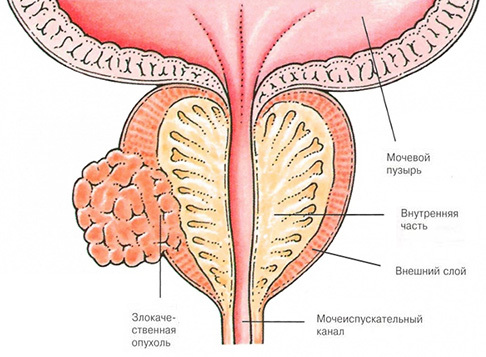
Fig.1 - Prostate cancer.
More than 78% of the cases are men aged 65 years. The probability of lifelong development of malignant neoplasm of the prostate at a microscopic level is 30%, and the probability of a fatal outcome is 3.5%.The incidence of prostate cancer is high enough, and is 13-15 per 100 thousand population with a constant tendency to increase.
Lifetime in prostate cancer depends on:
- prevalence of the process;
- degree of differentiation;
- adequacy of ongoing therapy.
Content
- 1 Factors contributing to the development of prostate cancer
- 2 stage prostate cancer
- 3 Symptoms
- 4 Diagnostic criteria
- 4.1 Finger urological prostate study
- 4.2 prostate-specific antigen( PSA)
- 4.3 TRUS
- 4.4 Magnetic resonance imaging( MRI)
- 5 TreatmentProstate cancer
- 5.1 All therapies
- 5.2 Treatment depending on stage
- 6 Forecast
Factors contributing to the development of prostate cancer
These include:
- Age of the man;
- Weighed down by heredity. With confirmed prostate cancer in a closely related relative, the chances of getting sick increase 2-3 times;
- Overweight. There is evidence that eating fatty foods contributes to the development of prostate cancer;
- Infections, viruses, sexually transmitted diseases( herpes, cytomegalovirus, HPV).There are data that to oncopathology of the prostate gland is involved in HPV( human papillomavirus);
- Environmental factors. Contact with heavy metals, radiation, ionizing radiation contributes to a malfunction in the immune system;
- Hormonal background. Proponents of the hormonal theory of prostate cancer believe that the success of hormone therapy in the treatment of oncological process in the prostate confirms the leading role of hormones( testosterone and dihydrotestosterone) in triggering mechanisms of pathology development( see Effect of androgens on the prostate gland);
- Insufficient amount of 5-alpha-reductase enzyme.
Stages of prostate cancer
To assess the prognosis of the disease, there are two main classifications in oncourology.
Classification by TNM. To determine the stage of prostate cancer, it is customary to use the international TNM classification, where Tx-a-c-c evaluates the tumor size( from the tumor in place( 1) to total spread( 4)), N presence( 1), or lack of metastaticFormations in regional lymph nodes( 0) and M - tumor metastasis to distant lymph nodes, target organs and skeleton bones( from M0-M1c).
Read on:
- Characteristics and prognosis of survival in prostate cancer of different degrees
- Metastases for prostate cancer
Gleason scale. Convenient for the concept of histological pattern is the Gleason scale. Classification by histological trait has 5 gradations, based on the differentiation of cells in the form of clearly distinguishable structures. The higher the score, the more aggressive the tumor, i.e., the probability of metastasis depends on the degree of differentiation of the tumor cells.
Histologically, tumor pathology of the prostate can be:
- is highly differentiated;
- is a mean differentiated;
- is a low -deffined one.
Symptoms
The medicine has all the necessary methods of examination, and with the timely passage of a urological examination, it is not difficult to diagnose prostate cancer. But, despite this fact, more than 50% of prostate tumors are primarily diagnosed already in the advanced stage, when radical treatment can not be performed.
The leading symptom is considered dysuric, it is characterized by complaints about:
- feeling of incomplete emptying of the bladder;
- attenuation of the urine stream;
- labored urination;
- discomfort in the urethra.
In 25% of cases the disease manifests itself by the development of acute retention of urination.
In a common stage of the process, a man may have an admixture of blood in his urine( hematuria), pain in the perineal region and in the lower abdomen.
If the prostate cancer is bordered by the rectum, then the following complaints are added:
- pains in the area of the external opening of the anus;
- tenesmus( false urge to defecate);
- spotting.
When spreading to the ureteral orifices, a clinic of a venerable insufficiency, acute inflammatory diseases( pyelonephritis, cystitis, prostatitis, orhoepidymitis) will manifest itself.
When metastasizing to the lymph nodes, edema of the scrotum, lower limbs may appear. In case of metastases of regional lymph nodes, the patient will have complaints of edema in the scrotum, stagnation in the vessels of the lower limbs.
If the tumor of the prostate metastasized in the pelvic bone, the lumbosacral spine, then in addition to the high probability of paraplegia( paralysis of the upper and lower extremities), the clinical picture will be complicated by a pronounced pain syndrome.
Diagnostic Criteria
Finger Prostate Urology Prostate
Finger prostate ultrasonography transrectally by 80% allows one to suspect a diagnosis of prostate cancer. With cancer, the prostate gland is palpable in rocky density, asymmetric, the mucous membrane is immobile, moderately painful. Seminal vesicles can be palpated.
Differential diagnosis is performed with prostate calcification, hyperplasia, fibrosis, tuberculosis, granulomatous prostatitis.
Prostate-specific antigen( PSA)
A specific role in the diagnosis belongs to screening the blood test for the level of prostate-specific antigen( blood on PSA).
PSA is a special protein, common and free. With an increase in PSA levels above 4 ng / ml, there is a good reason to examine a patient for an oncological process in the prostate gland.
The PSA level of 10 to 20 ng / ml may indicate the spread of the pathological process through the capsule, and above 30 ng / ml - the presence of distant metastatic lesions.
Tracking the level of PSA in the dynamics helps to get an idea of the effectiveness of the treatment, to suspect a relapse.
With the increase in PSA level, even with palpation of the "quiet" prostate gland, it is necessary to perform TRB( transrectal biopsy).
TRUSI
Transrectal ultrasound( TRUS) of the prostate allows detecting a tumor process up to 1 cm. With the help of ultrasound diagnosis, the prevalence of pathology is estimated.
Transrectal biopsy is performed under the supervision of ultrasound.
Magnetic resonance imaging( MRI)
Main article: MRI of the prostate
MRI is used to assess the prevalence of the tumor process, which allows you to determine the tactics of the patient.
Treatment of prostate cancer
In prostate cancer therapy, all the therapies used in modern oncology are used:
- surgical;
- radiotherapy;
- hormone therapy;
- drug therapy.
In the T1a-v tumor stage, expectant management tactics are used, with PSA and TRUS control 1 every 3 months. For this stage, a random detection of the pathological process is characteristic in the absence of any clinical manifestations.
There is confirmed information that in patients older than 65 with a highly differentiated form of adenocarcinoma, the disease progresses over a period of 10 years.
Treatment of prostate cancer will depend on the stage of the disease, in assessing the Gleason score, the histological type of tumor.
All therapies of
In oncology, the following treatments for prostate cancer are used:
- Chemotherapy. In therapy, various chemicals are used that exert a destructive effect on cancer cells.
- Radiation therapy. The tumor is affected by rays, which leads to the death of atypical cells and stops their growth. The type of radiation therapy is selected by the oncologist-radiologist, depending on the characteristics of the malignant neoplasm.
- Targeted Therapy. The effect is due to the introduction of monoclonal antibodies, which only affect malignant cells.
- Treatment with hormones. It is aimed at achieving chemical castration.
- Brachytherapy. One of the modern radiological methods of treatment of prostate cancer.
- Operative treatment. Distinguish: radical and palliative. The radical nature of surgical intervention is said in cases where the size of the tumor is small and the tumor has not spread to neighboring tissues and organs, i.e., at the initial stages of the disease. Palliative surgical treatment is used when you can not overcome the disease, but you can alleviate suffering, help for a while.
- Symptomatic therapy. It is prescribed in inoperable, neglected states with metastatic forms of cancer. Prognosis of survival from 24 to 36 months. Basically, therapy is reduced to choosing adequate anesthesia, correction of hemoglobin, decrease of intoxication.
Open radical prostatectomy is rarely used, as it is considered more invasive for the patient, and has a greater mortality and likelihood of complications compared to TUR.
Treatment depending on stage
- With stage T1a-c - dynamic observation, chemical castration;
- In the stage of T1c-T2a-in-c, T3a - transurethral resection with biorectectomy, hormonal therapy, radiation treatment is possible. If there are contraindications to the operation, the treatment will consist of irradiation and brachytherapy, treatment of prostate cancer according to this scheme is quite effective;
- Т3в - operation, biorhectomy, hormonotherapy, radiation therapy, chemotherapy;
- T4 - biorhectomy, chemotherapy, symptomatic therapy.
Forecast
The prognosis for life depends on the stage of the disease:
- T1-T2 - prognosis for life and rehabilitation is favorable;
- T3 - satisfactory;
- T4 - doubtful, unfavorable.
With high-tech treatment methods, the prognostic signs in the T3-T4 stage are significantly improved.
Urological doctor Mishina V. V.
Recommended screen viewing: