Features of uroflowmetry in men
Uroflowmetry is a method for determining the volumetric rate at which urine is excreted from the urethra when urinating. Allows you to clarify the state of the sphincter tone of the lower urinary tract and the contractility of the bladder, as well as the patency of the urethra. It is a non-invasive method that does not require special pre-treatment. Has no contraindications and undesirable consequences.
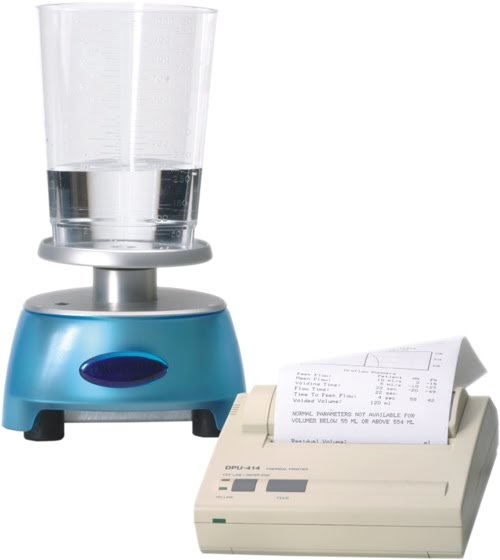
The Uroflow meter allows differential diagnosis of the causes of difficulty urinating without resorting to direct cystometry.
. Contents
- 1 Key Learned Parameters:
- 2 Scope of Application
- 3 Rules for
- 4 Normal Results
- 5 Factors Affecting Results
- 6 Diagnostic Significance of Deviations
Main Learned Parameters:
- MediumThe speed of urination;
- maximum flow rate of urine;
- duration of urination;
- volume of allocated urine;
- the percentage of urine released during urination relative to the total volume of the contents of the bladder.
After determining these parameters, the volume of residual urine( OMD), that is, left in the bladder cavity after urinary excretion from the urethra, is diagnosed. This allows you to get a complete picture of the act of urinating. For this purpose, ultrasound scanning is used in most cases, however, it is possible to determine the PDS and using a urinary catheter.
The computer software of the uroflow meter allows to present numerical values of parameters on the basis of the measured parameters, as well as to display graphs showing the individual features of the uroflowmetry curve in a particular patient.
Scope
The study is conducted to diagnose both structural and functional disorders of urination caused by the pathology of the bladder and urethra.
Uroflowmetry is used in the diagnosis:
- of the causes of urinary incontinence;
- disorders of the nervous regulation of the bladder( neurogenic, hyperactive);
- organic changes in the lower parts of the urinary system( malignant and benign tumors, inflammatory processes and their complications).
The procedure is performed to determine the indications and scope of surgical intervention for urological pathology:
- prostate tumors( adenoma, cancer);
- narrowing with a decrease in the urethral lumen( strictures);
- scar changes of the neck of the bladder.
Uroflowmetry is also performed to monitor the effectiveness of treatment to ensure the recovery of normal urine flow through the urethra and to monitor for the recurrence of diseases and their complications.
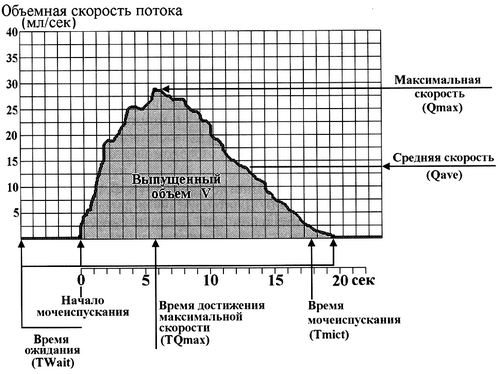
Method of investigation - measurement of the volume of excreted urine and time spent
Rules for
No preliminary investigation is required. It is recommended to discuss with the doctor-urologist a planned intake of drugs that can affect the results. And if possible, cancel 1-2 days before the procedure of antispasmodics( no-shpa, papaverine), diuretic( furosemide, torasemide, veroshpiron), and temporarily replace drugs that reduce pressure and have a relaxing effect on smooth muscles( calcium antagonists).
Before the beginning of the procedure, the doctor explains the essence of the method and the procedure for the patient. The device is in a separate room, the patient in this room remains alone during the procedure. Thus, maximum comfort is created and anxiety and a feeling of awkwardness in the subject are removed.
Depending on the individual characteristics( age, the presence of diseases), the patient drinks 0.5-1 liter of water 30 or 60 minutes before the study( the time and volume of the fluid is determined by the doctor).
Procedure:
- When the patient is ready( feel the urge to urinate, the usual intensity), he tells the therapist presses the "start", stand for 5 seconds and urinates into a special funnel.
- After the discharge of urine in 5 seconds, the patient repeatedly presses the key.
- The computer program analyzes the indicators of the sensors and displays a graphical display of the results and numerical values of the indicators. Normal results
main parameter value is determined in a uroflow is the maximum speed at which the act of urination allocated urine.
Table 1 - Normal parameters uroflow male
| Age group | Maximum |
|---|---|
| urine flow rate to 40 | more than 22 ml / s |
| from 40 to 60 years | more than 18 ml / s |
| over 60 years | more than 13 ml / s |
In this case, in healthy individuals, the average urinary flow rate is less than the maximum in 1.5-2 times. The time during which urination begins does not exceed 10 seconds( from the moment of psychological permission to urinate before the urine is released), and the interval to reach maximum speed is on average from 4 to 9 seconds. On the basis of the described characteristics, a uroflowmetry curve is constructed, which normally has a symmetrical peak.
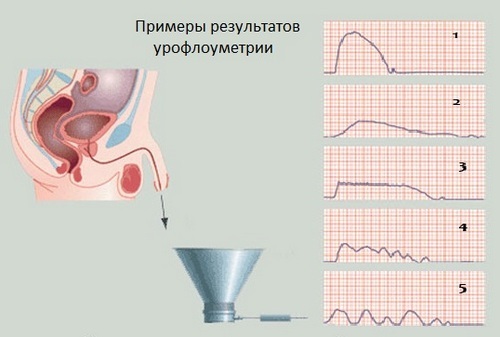
The first result is the norm. The rest indicate different types of
disorders. The normal volume of residual urine does not exceed 40% of the urine volume in the bladder before urination.
Factors Affecting the Results of
Urination is a partially conscious process that is prone to exposures not associated with the functioning of the genitourinary system.
Factors determining the flow rate of urine during urination:
- pressure in the bladder cavity;
- Stability and adequacy of the tone of the neck of the bladder, its internal sphincter.
effect on the indexes, except for diseases of the urinary system, straining the muscles of the abdominal wall, involuntary contraction of muscle fibers of the pelvic floor and the perineum, coughing and sneezing. They cause an increase in the rate of urination and create a false picture of the results of the study.
In the event the capacity of the bladder or the total volume of urine is also possible to produce unreliable results: the small volume of urination( not exceeding 150 ml) and bladder distension( capacity 400 ml).These characteristics should be determined before the beginning of uroflowmetry with the help of ultrasound.
Thus, in order to obtain reliable information it is necessary:
- to provide comfortable conditions for the procedure;
- as much as possible to reduce anxiety, a feeling of awkwardness in the subject;
- should be urinated in the patient's usual position( standing or sitting), which should be noted in the report;
- act of urinating to exercise when natural urge.
The results of the study must be analyzed, taking into account complaints, clinical manifestations and the results of other survey methods.
Diagnostic value of abnormalities
Uroflowmetry does not hold a definitive diagnosis and reveals the peculiarities of urination when one or other pathology.
Analyzing the data, the following graphic options are obtained:
- is an obstructive type of curve, characteristic of organic obstructions to urine flow( cicatricial urethral changes, tumors);
- is an obstructive type that occurs when straining and straining the muscles of the abdominal wall( the study is not informative and should be repeated);
- curve of rapid urination( characteristic of urinary incontinence);
- intermittent type of curve( due to involuntary frequent contraction of sphincters or the unsynchronous functioning of smooth muscles and the blocking mechanism of the bladder and urethra).
Thus, uroflowmetry is a simple and highly informative study in urological practice. According to the recommendations of the doctors, all men aged 40 years and over should take it every year with a prophylactic goal, even in the absence of complaints and signs of diseases of the genitourinary system.
Recommended for viewing: